
 desk
desk Share
Share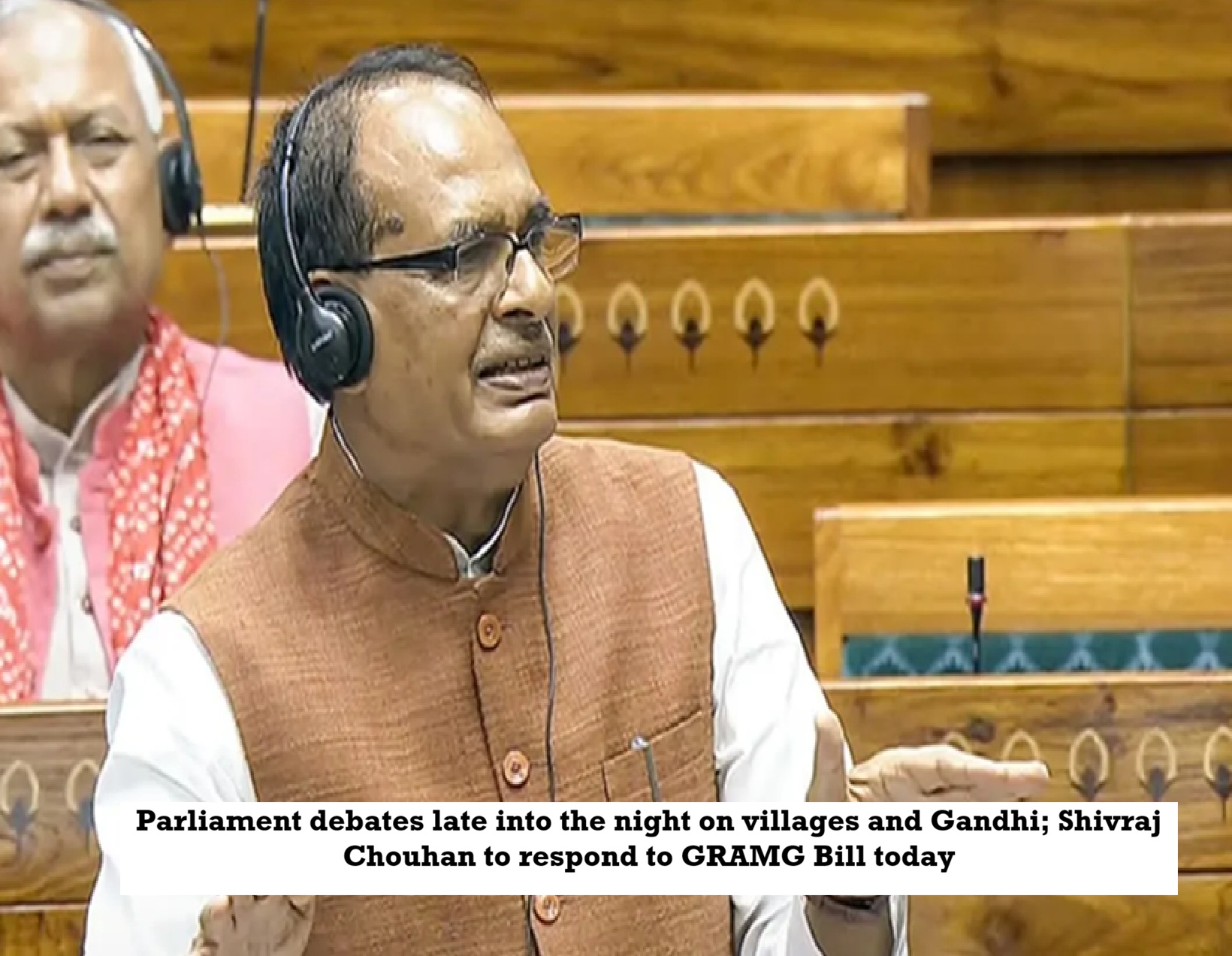
News Topical, Digital Desk : A lengthy and thoughtful debate on rural employment, village self-reliance, and Mahatma Gandhi's legacy continued late into the night in the Lok Sabha on Wednesday. The Lok Sabha was adjourned at 1:35 a.m. The government and the opposition were at loggerheads during the discussion on the Vikasit Bharat-Guarantee for Employment and Livelihood Mission (Rural), or VB-JIRAMJI Bill, which replaced the MNREGA Act.
The discussion on the Rural Employment and Livelihood Mission (Rural) ( VB-G RAM G) Bill, 2025, concluded after midnight on Wednesday, with 98 members participating. Rural Development Minister Shivraj Singh Chouhan will reply to the debate on Thursday.
The government described it as a reform that would strengthen the legal guarantee of employment and make villages self-reliant, while the opposition strongly opposed it, accusing it of removing Gandhi's name and attacking the interests of the poor.
During the discussion, with the consent of the members, Speaker Om Birla extended the debate time and clarified that the minister's reply would come on Thursday. Opening the discussion, Rural Development Minister Shivraj Singh Chouhan said that this bill is not just an employment scheme, but a comprehensive effort towards making rural India poverty-free and self-reliant, according to the National Bureau.
He said that in the last twenty years, MNREGA has provided employment to the rural poor, but in view of the changing economic conditions, technology and rural needs, now there is a need for such a law which links livelihood, skill development and permanent asset creation along with employment.
The minister said that under the new law, every rural household will have the right to 125 days of legal employment per year, 25 days more than the current system. The aim is to prevent forced migration from villages to cities.
He also clarified that within six months of the law coming into force, states will have to prepare plans tailored to local needs, so that employment generation is linked to works like water conservation, rural infrastructure, community assets, roads, sanitation, energy and digital facilities.
Shivraj emphasized that the proposed law advances Mahatma Gandhi's concept of Gram Swaraj, enabling villages to become self-reliant and strengthening the rural economy. The proposed law strengthens transparency and accountability, ensuring that the true benefits of employment schemes reach those in need.
Congress' Jai Prakash, opening the debate, said that removing the name of Mahatma Gandhi, the Father of the Nation, from the bill is the biggest crime. He said that the proposed law will impose a financial burden on the states. It will also deprive grassroots bodies like Gram Sabhas of their right to decide on the work to be done under the proposed law. The Hisar MP said that the proposed law is against the poor and Dalits because it has been drafted by a "rich" government.
He said the government was moving towards weakening the employment guarantee and merely changing the name would not solve the problems of the villages.
According to PTI, Trinamool Congress MP Mahua Moitra said that by abolishing MNREGA and renaming the scheme, the government is completely destroying Mahatma Gandhi's idea of Ram Rajya.
She accused the government of "insulting" Gandhi and Rabindranath Tagore, who had given the Father of the Nation the title of Mahatma. Moitra said the bill shows that the government believes in "no support, no development for anyone."
According to the Bureau, Naresh Chand Patel of the Samajwadi Party raised a practical question, saying that the real issue is whether the 125 days of employment will actually be delivered on the ground. Citing the economic situation of the states, he expressed concern that the additional financial burden could undermine the employment guarantee and pose a challenge to the federal structure.
Brijmohan Agrawal of the BJP said the previous Congress government had turned MNREGA into a "dig a hole and fill it" scheme. He claimed the scheme did not help strengthen the rural economy but instead fostered rampant corruption. Agrawal said the presence of "Ram" in the proposed law would deter people from engaging in corruption.
--Advertisement--


