desk
desk Share
Share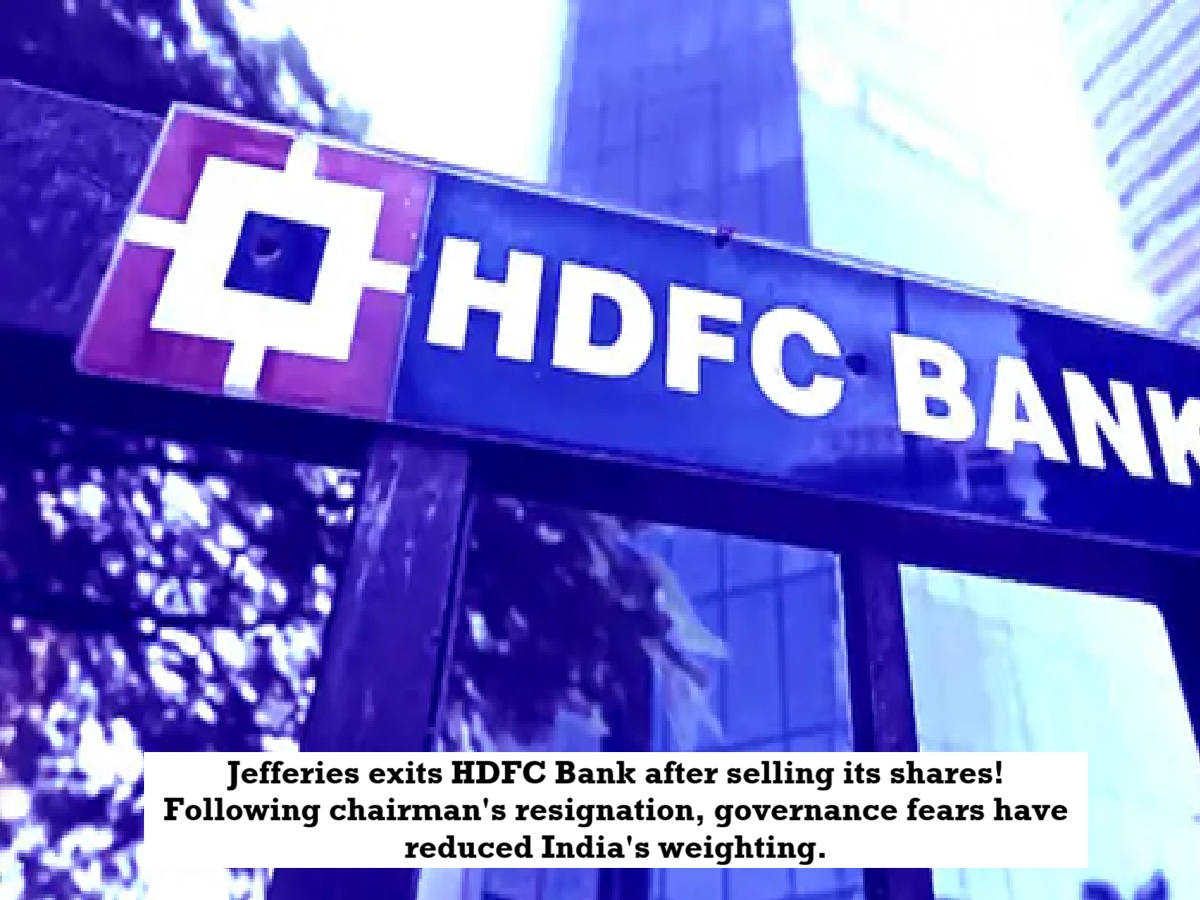
News Topical, Digital Desk : Global brokerage Jefferies has made a major decision regarding private sector giant HDFC Bank. Immediately following the resignation of former chairman Atanu Chakraborty, Jefferies not only completely withdrew its investment from HDFC Bank but also reduced its stake in India. This move has created a stir in the market. The biggest question among investors now is whether this is just a decision or whether it carries deeper governance implications.
Global brokerage Jefferies has made a major and surprising decision regarding HDFC Bank. Following the resignation of the bank's former chairman, Atanu Chakraborty, Jefferies has completely removed HDFC Bank's investments from three of its major portfolios.
These include the Asia ex-Japan long-only equity portfolio, the global long-only equity portfolio, and the international long-only equity portfolio (ex-USA). Jefferies' top strategist, Chris Woods, made this change in his Greed & Fear report, though he did not provide a clear reason for it. However, the timing has certainly prompted market reflection. Interestingly, after exiting HDFC Bank, Jefferies added a 4% weighting to HSBC. This suggests the fund's focus now shifts away from India and toward other global banks. Furthermore, due to this change, Jefferies has also reduced its overall stake in India. Changes have also been made to the Asia Pacific ex-Japan portfolio. According to the report, the weightings for Australia and India have been reduced by 2% each, while Taiwan's weighting has been increased by 4%. However, India's share in this portfolio remains 13%, 50 basis points higher than the MSCI AC Asia Pacific ex-Japan Index. Now let's discuss the trigger that initiated this entire change.
HDFC Bank announced on March 18th that its part-time chairman, Atanu Chakraborty, had resigned. In his resignation, he clearly stated that certain things had happened at the bank over the past two years that were inconsistent with his "values and ethics." Although he did not mention any specific irregularities, this statement alone was enough to galvanize the market. JP Morgan analyst Anuj Singla believes that even though the resignation contains no concrete allegations, the mere perception could undermine investor confidence. This could increase the "governance risk premium" on the stock. There are also reports that the RBI has become active in investigating the matter. It is believed that differences between the chairman and the bank management, especially CEO Shashidhar Jagdishan, may be the reason. The impact is clearly visible in the market. HDFC Bank shares were trading at ₹761.35 on the NSE, down about 2.7%. In the past month, the stock has fallen by more than 14%. Overall, Jefferies' move isn't just a portfolio change, but also sends a significant signal to the market. Investors will now be watching the bank's actions to address these governance concerns and whether trust can be restored.
--Advertisement--