desk
desk Share
Share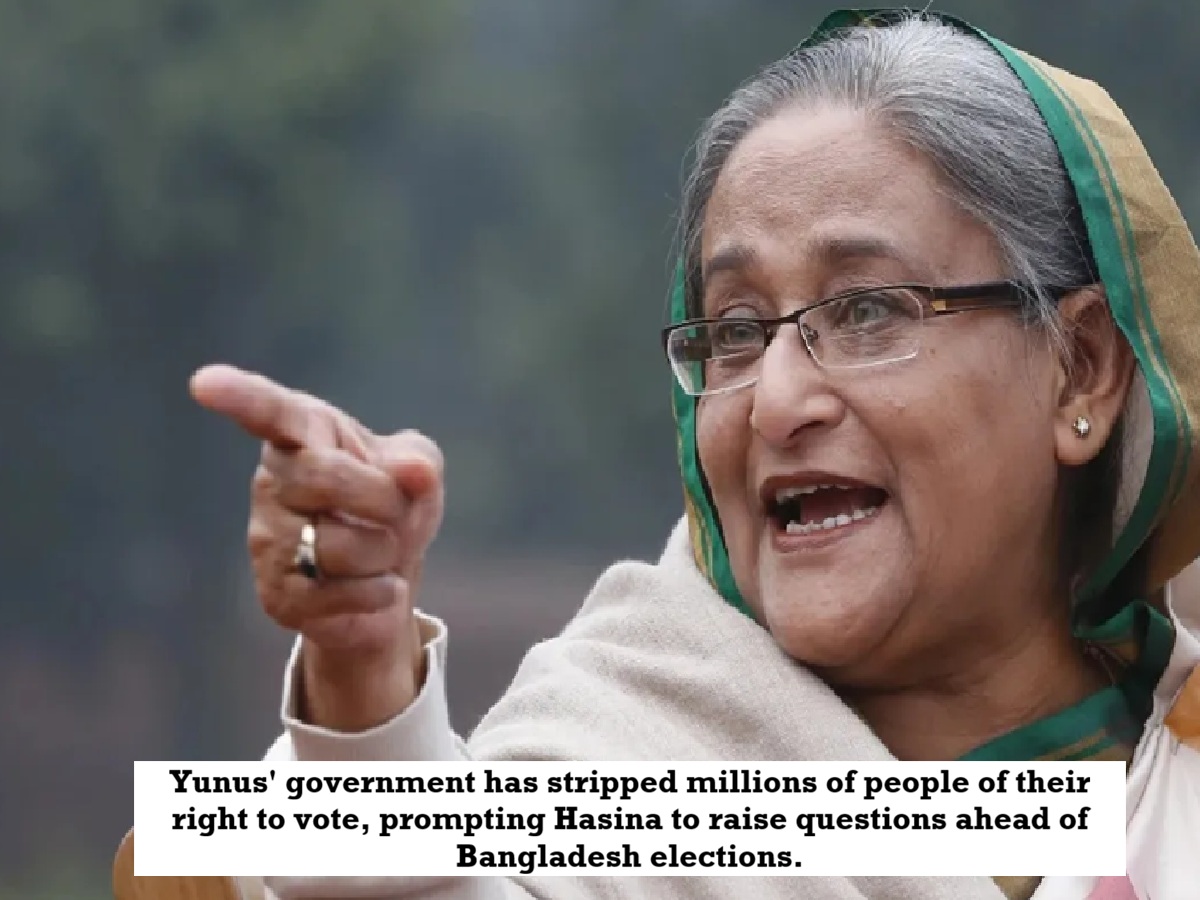
News Topical, Digital Desk : The unrest in Bangladesh seems to be increasing before the elections. The interim government led by Mohammad Yunus has barred Sheikh Hasina's party, the Awami League, from participating in the elections. In this sequence, former Bangladesh Prime Minister Sheikh Hasina has targeted the interim government regarding the upcoming elections in the country. Taking the Yunus government to task, Hasina said that the voting rights of millions of people in the country have been taken away.
There will be instability in Bangladesh
Sheikh Hasina warned in an email to The Associated Press (AP) last week that without inclusive, free and fair elections, Bangladesh would face prolonged instability. She alleged that the interim government led by Nobel Peace Prize winner Muhammad Yunus had deliberately disenfranchised millions of supporters by excluding her party from the polls.
Hasina raised questions on the interim government
"Whenever a large segment of the population is excluded from political participation, it deepens discontent, erodes the legitimacy of institutions, and creates conditions for future instability," Hasina wrote. She added, "A government formed through exclusion cannot unite a divided nation."
Bangladesh will hold elections on February 12.
More than 127 million voters are eligible to vote in Bangladesh's February 12, 2026, election. The election is considered the most important in decades, as it is the first national election since the massive 2024 uprising that ousted Hasina from power. Yunus' interim government is overseeing the process, which will also include a constitutional referendum on sweeping political reforms.
Yunus took charge of Bangladesh
Yunus returned to Bangladesh in August 2024 and assumed power three days after Hasina fled to India. He has promised free and fair elections, but critics question whether the process will be truly inclusive and democratic given the ban on the Awami League. Uncertainty also persists regarding security arrangements and constitutional changes.
What did Yunus's office say?
Yunus' office said in a statement to the Associated Press that security forces would ensure orderly and peaceful elections, and that no one would be allowed to influence the results through violence or coercion. The statement also called for an invitation to international observers and human rights organizations. According to the Election Commission, about 500 foreign observers, including from the European Union and the Commonwealth, will observe the February 12 elections.
Bangladesh is facing challenges
Bangladesh is grappling with numerous political and security challenges following Hasina's ouster. Human rights organizations and minority groups have accused the interim government of failing to protect citizens. The Awami League has claimed arbitrary arrests and custodial deaths of its members, claims the government has denied. Critics have expressed concern about the growing influence of Islamist groups and attacks on minorities, particularly Hindus. Press freedom has also been under question under the Yunus government, with several journalists facing criminal charges and the offices of two major daily newspapers attacked by protesters.
Bangladesh Nationalist Party is the main contender
Meanwhile, the Bangladesh Nationalist Party, led by Tarique Rahman, has emerged as the main contender. Rahman is the son of former Prime Minister Khaleda Zia and returned home in December after more than 17 years in exile. He has promised to work for the stability of this country of 170 million people. The main challenger to the BNP is an 11-party alliance led by Jamaat-e-Islami.
--Advertisement--