desk
desk Share
Share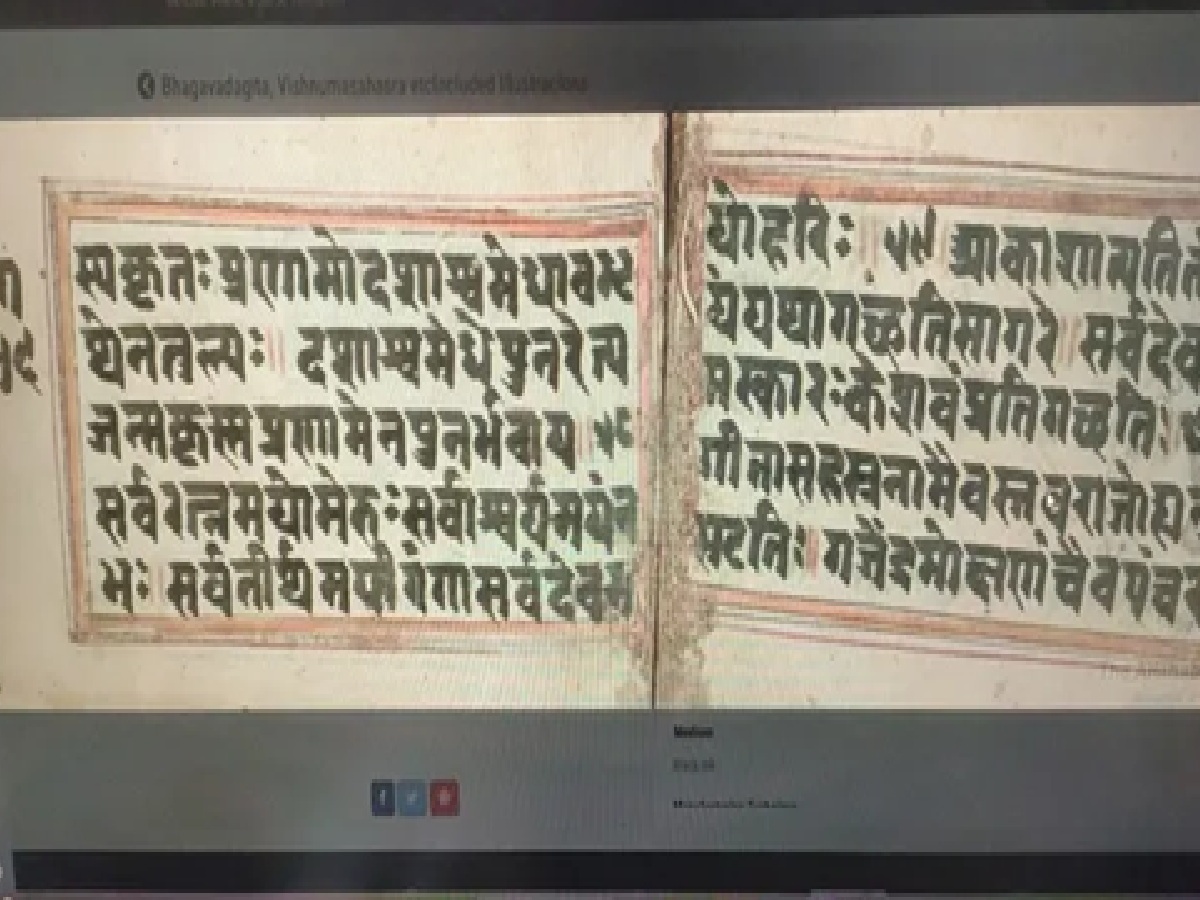
News Topical, Digital Desk : Manuscripts hold national importance from a historical and cultural perspective. The Allahabad Museum houses a rare manuscript of the Bhagavad Gita, whose author used gold ink in some places, while most of the verses are written in pink and black. However, the museum has never displayed it in its gallery.
The museum houses many important heritage sites.
Thousands of people visit the heritage sites every year. The reason the manuscript isn't displayed is that its history has been lost. While the Allahabad Museum displays many important heritage items both permanently and temporarily, it also has a literary gallery, but no attempt has been made to display the book-sized manuscript, which provides insight into the history of the Mahabharata and its teachings.
The museum received this manuscript in the year 1942.
It is also a collection of hymns as it contains the Bhagavad Gita in the first section, Vishnu Sahasranama Stotra in the second section, Bhishma Stavaraj in the third section and concludes with Gajendra Moksha in the fourth section. Bhishma Stavaraj describes the praise of Lord Krishna by Gangaputra Bhishma under the Shanti Parva of Mahabharata. It is estimated that SC Kala, the first curator of Allahabad Museum, had received most of the ancient heritage in the year 1942, and this manuscript is also one of them.
The manuscript is approximately 150 years old.
The Allahabad Museum claims that all manuscripts in its safekeeping are 100 or, at most, 150 years old. The golden-lettered Bhagavad Gita is missing its history, lacking the author's name or the period of its writing. There's also no record of who the museum acquired it from. Word of mouth suggests it may be 150 years old.
It is uploaded on the museum's Jatan portal.
Dr. Rajesh Mishra, media in-charge of the Allahabad Museum, says that the manuscript containing the Bhagavad Gita is not displayed in the gallery, but it is uploaded to the Allahabad Museum's Jatan portal, which can be viewed on the Museum of India website. Many treasures kept in the protected collection are in fragments, which is why they are not being brought out. The museum does not have any records of the manuscript's history.
--Advertisement--