desk
desk Share
Share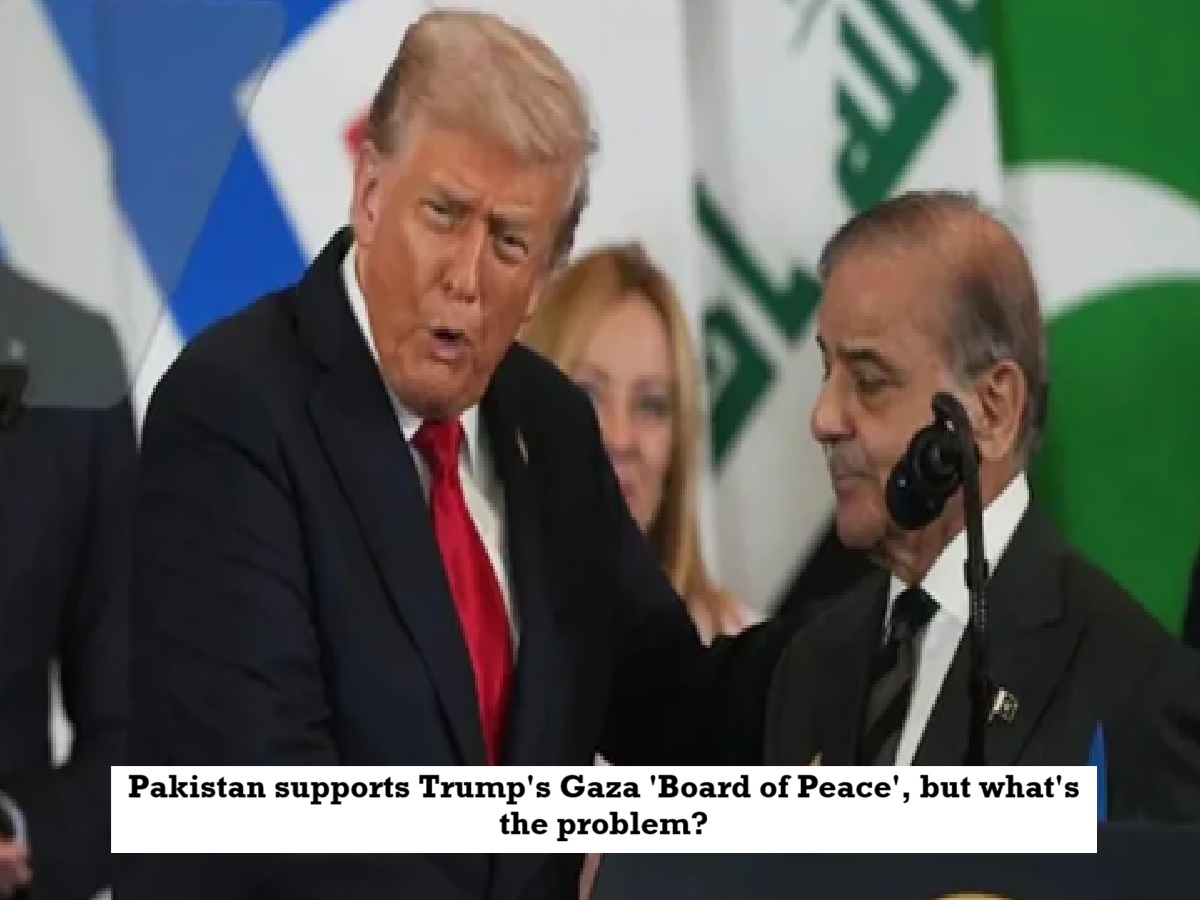
News Topical, Digital Desk : Pakistan formally endorsed US President Donald Trump's Gaza Board of Peace in Davos. Shahbaz Sharif was present on stage when the initiative was unveiled.
It is a move that brings Islamabad closer to the US-led post-war framework for Gaza, even though questions remain about whether political support will translate into reality on the ground.
Palestine is not included.
Palestine is not included on Trump's Board of Peace. It is a mechanism to oversee the second phase of his 20-point Gaza roadmap, which includes governance, reconstruction, investment, fundraising and regional coordination.
At the core of this plan is an International Stabilization Force (ISF), tasked with overseeing demilitarization, humanitarian aid distribution, and security on the ground, raising the possibility of member states becoming involved in operational roles inside Gaza.
Which countries are included?
The board includes Pakistan, Saudi Arabia, Qatar, Turkey, Jordan, the UAE, Bahrain, and Morocco, as well as countries from Central Asia, Eastern Europe, and Latin America. Of the 50-60 invitations sent, approximately 35 countries have confirmed, while Western European countries have declined to join due to concerns about the board's structure and purpose.
Pakistan's support
Pakistan confirmed that Prime Minister Shahbaz Sharif had received a formal invitation from Trump to join the Board of Peace and attended the launch in Davos. Foreign Office spokesman Tahir Andrabi said, "Pakistan will remain involved in international efforts for peace and security in Gaza and for a lasting solution to the Palestinian issue in accordance with UN resolutions."
Some Unresolved Questions
But this support also leaves some unresolved questions. The UN Security Council adopted a US-drafted resolution paving the way for the formation of a transitional administration and the ISF in Gaza. Pakistan, chairing the council, voted in favor. Yet, Islamabad also warned that important concerns had not been addressed
Pakistan's UN Ambassador Asim Iftikhar Ahmed said the resolution failed to clarify Gaza's governance structure, the role of the proposed peace board, the mandate of the ISF or the extent of UN jurisdiction.
According to Al Jazeera, he said, "These are all important aspects that will impact the success of this effort. We sincerely hope that more information will be available in the coming weeks to provide the necessary clarity on these issues."
Despite these reservations, Pakistan already supported Trump's Gaza roadmap last year, making it one of the countries most aligned with the US approach.
Improvement in relations with America
With the largest army among Muslim-majority countries supporting the initiative, Pakistan is seen as a potential contributor to the ISF. Islamabad's geopolitical importance has grown in recent months, driven by intensified diplomacy with Middle Eastern partners and Washington.
Pakistan has signed a strategic defense pact with Saudi Arabia, increased military engagement with Jordan and Egypt, and Army Chief Field Marshal Asim Munir has forged an unusually close relationship with Trump. This is largely part of a larger effort to improve years of strained relations between Washington and Islamabad.
In June, Trump hosted Munir for a private lunch at the White House, marking the first time a US president met Pakistan's army chief alone.
Under constitutional amendments passed by Pakistan's civilian government last month, Munir will retain his rank of field marshal for life and enjoy lifelong immunity from criminal prosecution. "Few people in Pakistan enjoy the luxury of taking greater risks than Munir. He has unlimited power, which is now constitutionally protected," said Michael Kugelman, senior fellow for South Asia at the Washington-based Atlantic Council.
This situation strengthens Pakistan's power, but also raises expectations.
Domestic Risks
Any possibility of sending ground troops into Gaza carries serious political risks at home. Palestine is a highly emotive issue in Pakistan, which does not recognize Israel and explicitly prohibits travel there with Pakistani passports
Even indirect coordination with the Israeli military would be politically sensitive and could spark protests against both the civilian government and the military. Any deployment of Pakistani troops in Gaza under a US-backed plan could rekindle opposition from Islamist parties, which are staunch opponents of the US and Israel.
These groups have the capacity to mobilize thousands of supporters onto the streets. The Pakistan Tehreek-e-Insaf (PTI), led by politically imprisoned former Prime Minister Imran Khan, rejected the government's decision to join the "Board of Peace," saying such decisions of international importance should be taken with "complete transparency and consultation."
In a statement, the party said Pakistan's participation in any peace initiative should strengthen the UN's multilateral system, rather than create "parallel structures" that could undermine global governance.
Meanwhile, Pakistan faces persistent security challenges along its eastern and western borders, hampering any foreign deployment. It also has its own ongoing issues with Afghanistan.
Currently, Pakistan and Afghanistan agreed to maintain a ceasefire during ongoing peace talks in Istanbul, Turkey, in November, Turkey said, after earlier talks between the two sides failed, but tensions remain.
Economic Concerns
Another concern when it comes to Pakistan joining the "Board of Peace" is the country's ongoing economic problems. Citing a draft charter, Bloomberg reported that Trump wants participating countries to pay $1 billion to maintain good relations with the US and maintain a seat on his proposed "Board of Peace," which some have described as an alternative to the United Nations
This is crucial because Pakistan's economy, far from recovering, is under severe pressure. Years of weak growth, high inflation, persistent balance-of-payments stress, and rising external debt have left it repeatedly dependent on IMF bailouts and emergency foreign funding.
Chinese loans and investments have provided short-term relief but deepened financial dependence, while initial re-engagement with the United States has provided little relief. Domestic political instability, the military's overreaching role in governance, privileges held by powerful individuals, and corruption are undermining reforms.
External pressures and risks, from regional security tensions to water disputes, are increasing, leaving Pakistan trapped in a cycle of stabilization without change.
--Advertisement--