desk
desk Share
Share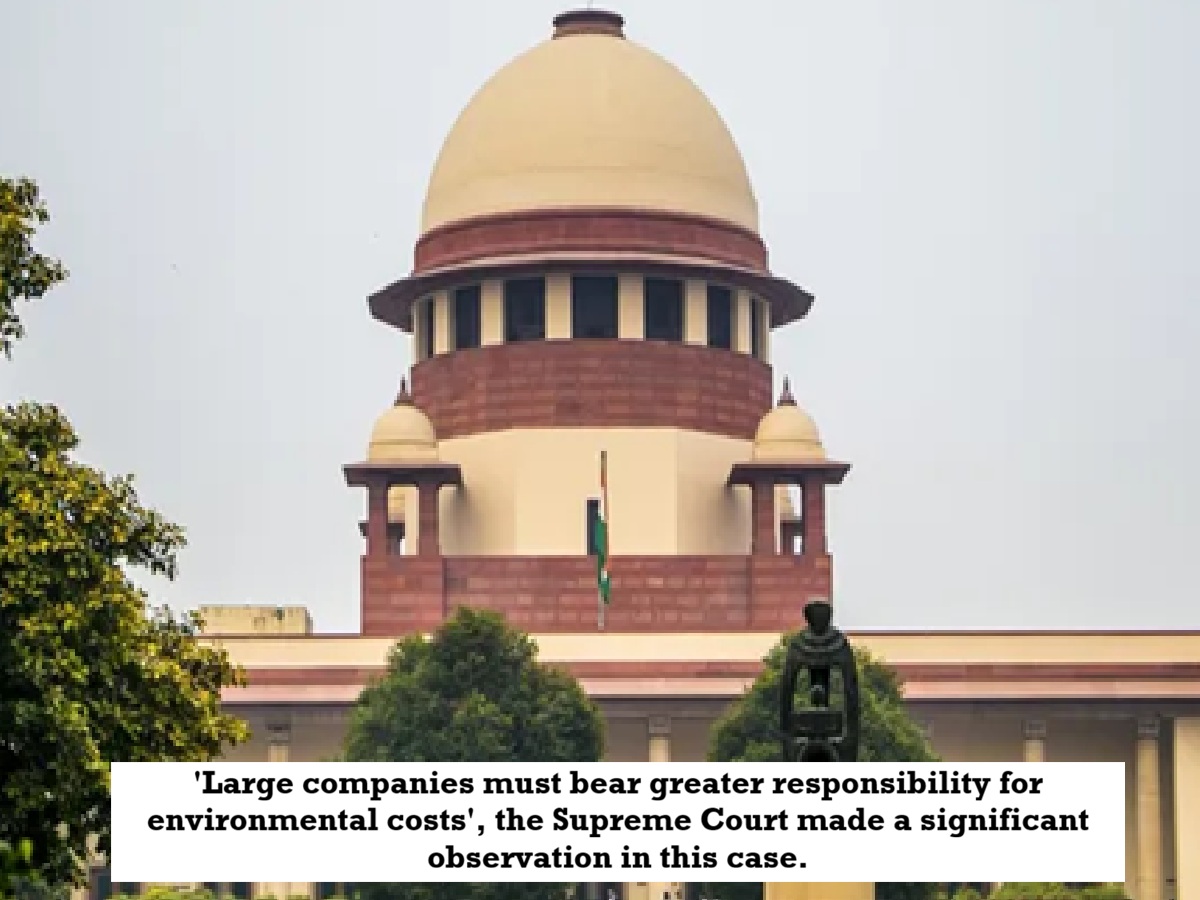
News Topical, Digital Desk : A company earning more profits from its large scale business will have to bear greater responsibility for environmental costs, the Supreme Court said on Friday, upholding the National Green Tribunal (NGT) order that imposed Rs 5 crore environmental compensation on a builder for violating environmental norms.
The bench said that in matters relating to environmental protection, linking the scale of a company's operations to environmental damage can be an important factor in determining compensation.
The court said that larger scale often means use of more resources, more emissions and more waste, thereby putting more pressure on the environment.
The bench said that if a company has a high turnover, it reflects the vast scale of its operations. If such a company is found to be contributing to significant environmental damage, its turnover may be directly related to the extent of the damage.
Therefore, in our opinion, the argument that turnover can never be a relevant factor in determining compensation commensurate with the quantum of loss is incorrect.
Appearance of lawyer will not be considered as intimidation: Supreme Court
The Supreme Court has dismissed a criminal case filed against a lawyer, saying that the appearance of a lawyer in the discharge of his professional duties will not be considered as intimidation.
A bench of Justices Arvind Kumar and PB Varale said that flimsy allegations without concrete evidence do not constitute an offence under Section 506 (criminal intimidation) of the IPC.
The Supreme Court has quashed a criminal case registered under Section 506 of the IPC against lawyer Beri Manoj, who is the uncle of an accused in a Protection of Children from Sexual Offences (POCSO) Act case.
The bench noted that there was improvement in the statement given by the victim, which was recorded under Section 161 (statement before a police officer) and Section 164 (statement before a magistrate) of the CrPC.
"Finally, the appearance of an advocate while discharging his professional duties would not amount to intimidation and this is a fundamental fact which is clearly absent in this case," the bench said in its January 20 order.
The Supreme Court said that the explicit statement recorded under Section 164 of the CrPC makes it clear that no intention of criminal intimidation has been prima facie established.
--Advertisement--