desk
desk Share
Share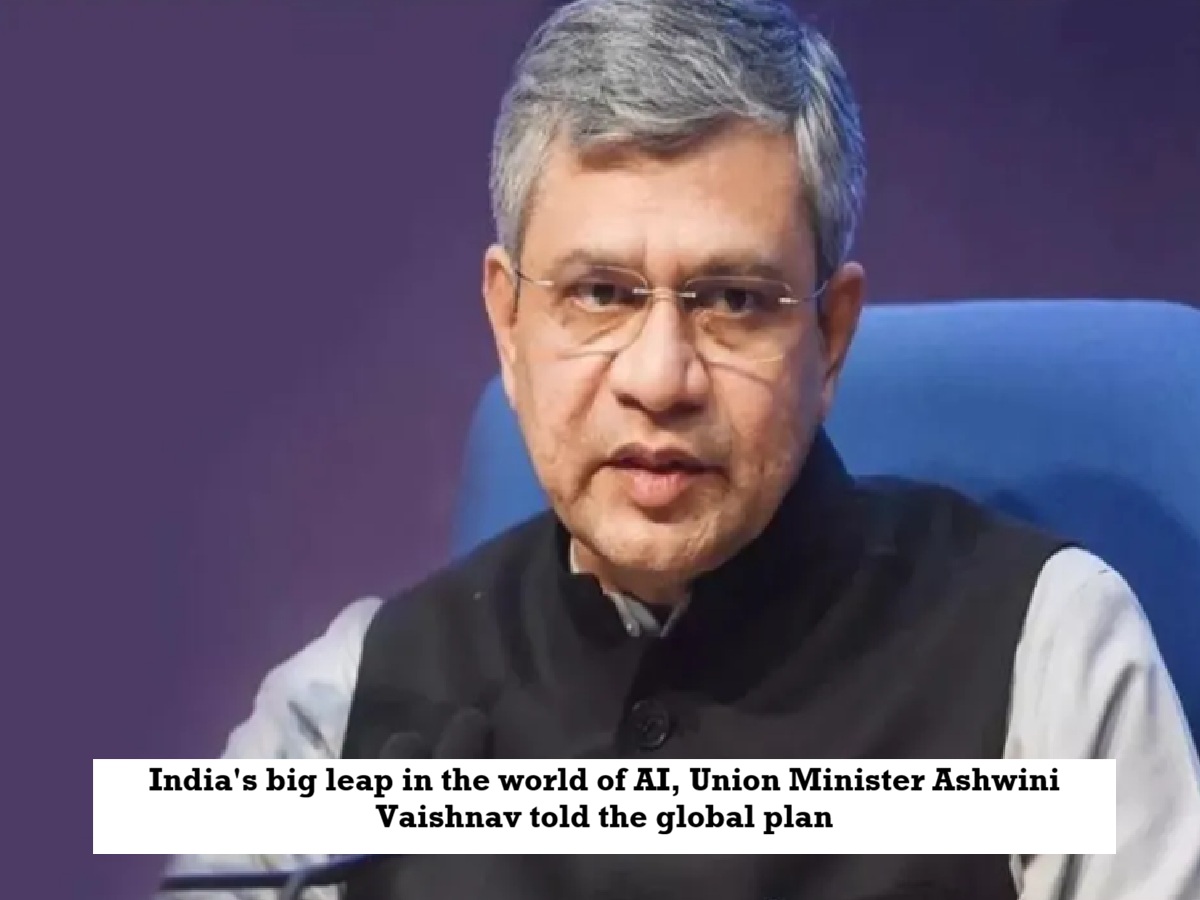
News Topical, Digital Desk : Union Minister Ashwini Vaishnav outlined India's five-pronged AI mission during a discussion at the World Economic Forum in Davos, Switzerland. He highlighted five key pillars of India's ambitious artificial intelligence (AI) mission—applications, models, chips, infrastructure, and energy.
Union Minister Ashwini Vaishnav, speaking at the World Economic Forum, made it clear that India is not only harnessing technology but is also poised to lead this 'fifth industrial revolution' through public-private partnerships (PPPs) and affordable computing power.
Five pillars of AI
Explaining the technical framework, Union Minister Ashwini Vaishnav said that if we look at artificial intelligence (AI), it has five pillars. The first element is the application layer, i.e. how we use it. The second element is the model layer, i.e. the models created. The third element is the chip layer, i.e. the semiconductor layer. The fourth element is the infrastructure layer, i.e. the data centers. And the fifth element is energy.
He further stated that energy is going to be a huge factor in the world of artificial intelligence, which is being called the fifth industrial revolution. In such a situation, India's systematic work, from energy to applications, has been highly appreciated worldwide, and especially by the artificial intelligence-related industry. Meanwhile, Ashwini Vaishnav detailed India's comprehensive strategy to dominate the global artificial intelligence landscape, emphasizing a shift away from resources controlled by large technology companies and toward a public-private partnership model.
India's participation
While discussing the role of AI in economic growth and global impact at the World Economic Forum, the Union Minister revealed that India has successfully established a public-private partnership with 38,000 GPUs as a shared computing facility, available to students, researchers and startups at about a third of the global cost, whereas in many countries big tech companies control access to GPUs.
Union Minister Vaishnaw advocated for a techno-legal approach rather than relying solely on independent legislation. He argued that the complexities of modern technology require robust technical tools to address risks such as bias and deepfakes, including identification systems accurate enough to withstand judicial scrutiny.
He further stated that India is developing technologies to mitigate bias, enable reliable deepfake detection, and ensure proper unlearning before deploying AI models. He also highlighted a strategic shift to the Fifth Industrial Revolution economy, suggesting that the vast majority of future return on investment (ROI) will come from cost-effective, scalable solutions rather than just "brute-force" computing.
He debunked the myth that all AI advancements require expensive hardware and said that about 95 percent of AI work can be done using 20-50 billion parameter models.
--Advertisement--