desk
desk Share
Share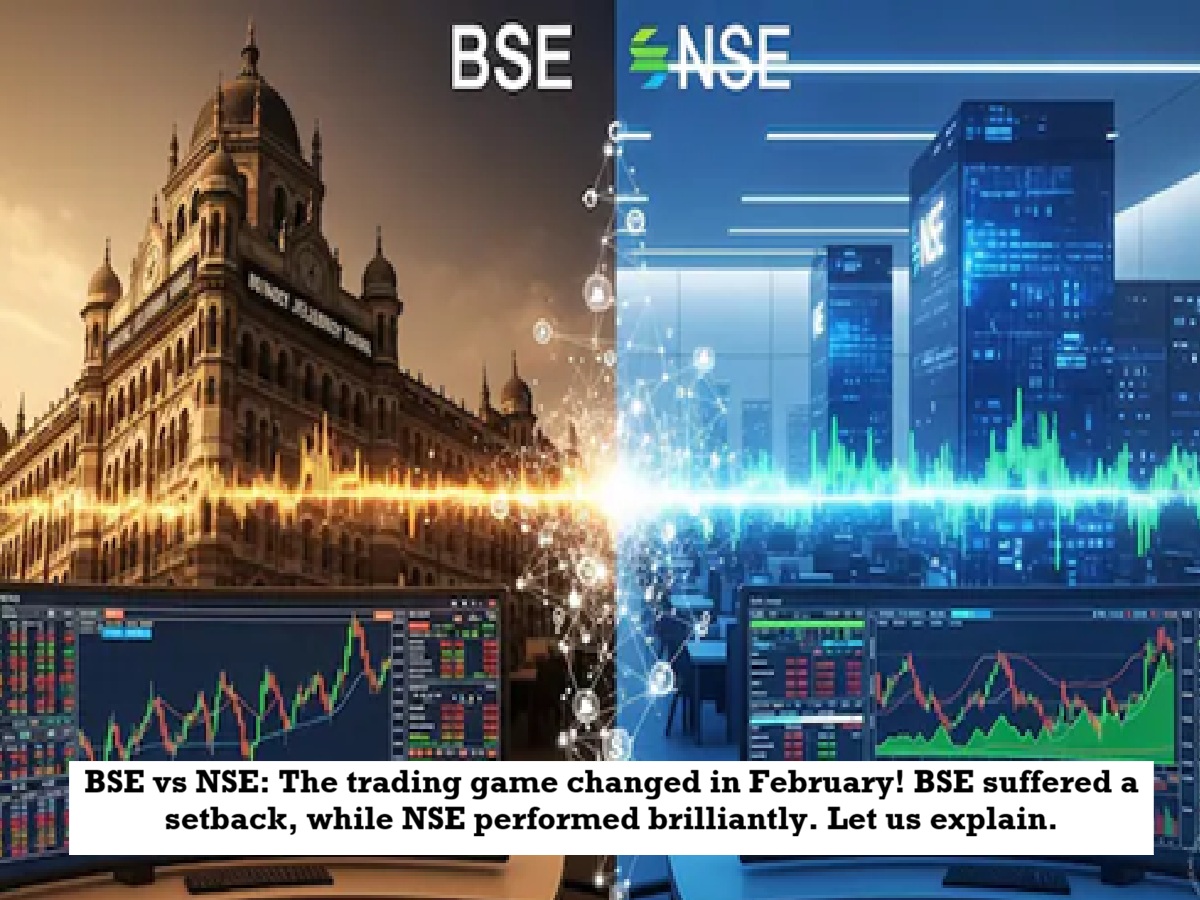
News Topical, Digital Desk : February trading data indicates a shift in the stock market landscape. According to Haitong data, BSE's market share has declined, while NSE's has increased. Furthermore, options trading activity across the industry has weakened. The question is: is the market sentiment changing among traders, or has volume merely declined temporarily? Understanding these data is crucial for the average investor, as they indicate both market direction and risk.
It is clearly visible from the initial trading data of the month of February that a big change has been seen at the exchange level in the Indian stock market.
According to Haitong's report, BSE's market share has declined from 33% in January to 30% in February, a decline of nearly 3% in just one month. On the other hand, NSE's market share has increased by 2% to 70%, indicating that a significant portion of trading activity is shifting back to NSE.
The question now is, what does this shift in market share mean? Simply put, exchanges with higher trading volumes have better liquidity, meaning easier trading. Traders and large institutional investors often choose platforms with higher volumes. Therefore, the NSE's increasing market share can be considered a positive sign for the exchange. The report also revealed another important statistic: the industry's notional options ADTO (Average Daily Turnover) declined by 14% in February. This means that the enthusiasm for trading in the derivatives segment, which was evident in previous months, has now diminished.
For the average investor, this simply means that the market is shifting to a more cautious and less aggressive trading environment.
Looking at individual exchanges, BSE's ADTO has fallen by 21%, while NSE's ADTO has also fallen by 7%.
This means that the decline isn't limited to just one exchange; volumes have declined across the entire market. Furthermore, the 20% decline in BSE's futures ADTO indicates that futures traders have also reduced their positions.
From an average investor's perspective, this data isn't a cause for alarm, but rather a signal to understand the market's mood.
When volumes decrease, market volatility can sometimes decrease, but the risk of sudden movements also increases.
At such times, it's more important to focus on investing in strong companies and managing risk rather than trading recklessly.
Overall, the February data indicates that trading activity in the market has cooled slightly, and competition among exchanges is intensifying again.
The trend in volume and market share in the coming months will determine the direction in which investor confidence is moving.
--Advertisement--