desk
desk Share
Share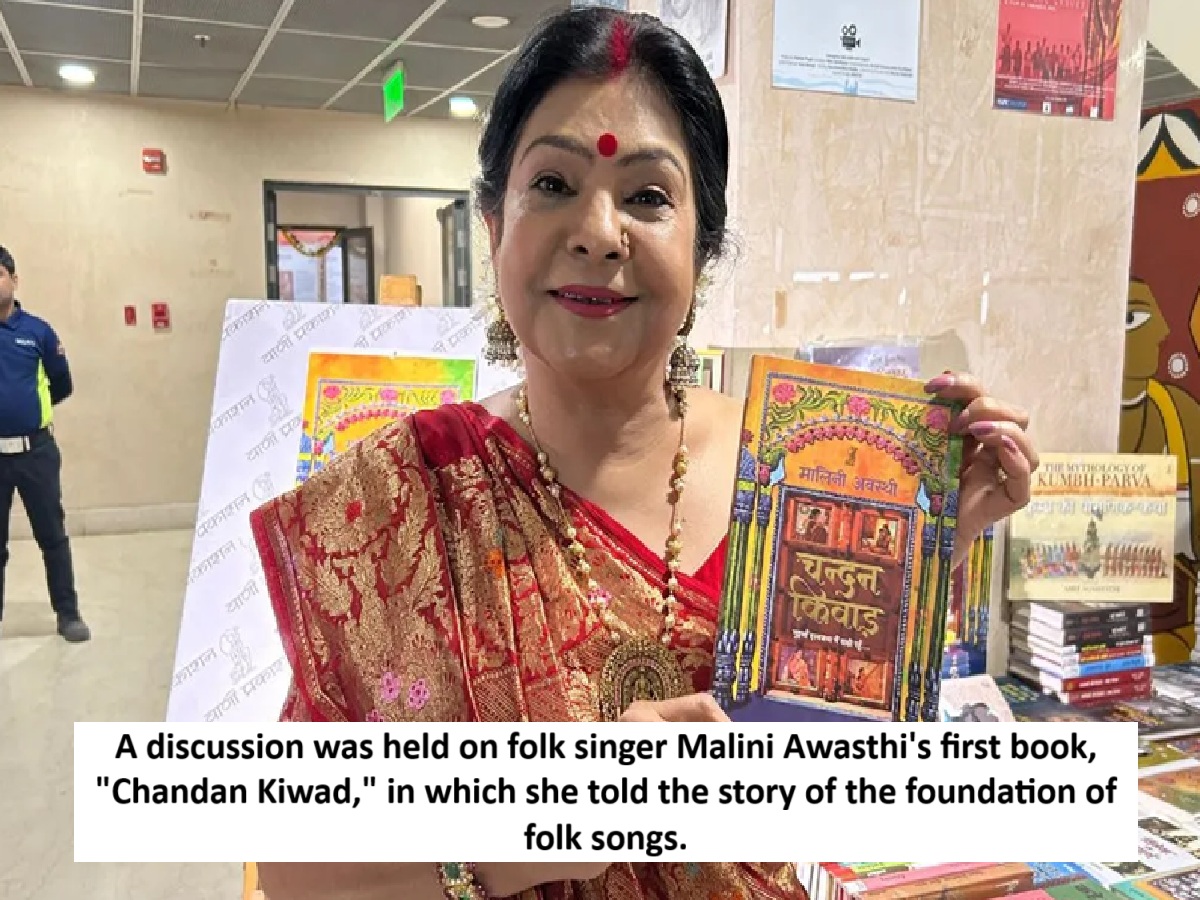
News Topical, Digital Desk : Malini Awasthi, a renowned name in folk music and a famous singer, is now with us in a new role: a writer. A discussion on her first book, "Chandan Kiwad," took place at the Indira Gandhi National Centre for the Arts in Delhi. Awasthi explained that she has been writing as a columnist for the past 10 years, but her first book has just been published. The primary focus of this book and its rationale lies in the foundation of the folk songs we sing, how they came into being, who wrote them, and what circumstances have led to their continued sungness for centuries. These are, in part, our social conditions. What are those images of India that allowed our ancestors to continue singing and drawing strength from these unrecorded folk songs? That foundation is Chandan Kiwad. And Chandan Kiwad, as the book's title suggests, is an ancient heritage, one that holds immense reverence. Only by opening the door can we enter this world, where our grandmothers, your aunts, and your aunts live, come with a pure heart. They have protected our culture for centuries, through songs and stories. This is the "Sandalwood Door."
The story behind "Guiyan Darwajwa Mein Thadhi Rahun"
Talking about the line written on the cover of the book "Chandan Kiwad", "Guiyan Darwajwa Mein Thadhi Rahun", Malini Awasthi said that if I write something, then how is it possible that it does not have music in it? "Guiyan Darwajwa Mein Thadhi Rahun" is a very traditional Thumri of Kashi. And secondly, Chandan Kiwad is said in many of our songs, "Khol Mori Shyam Chandan Kiwadiyaan" or "Bajar Pade Ram Toe Chandan Kiwadiyaan", it is mentioned in many songs that if there is a door, it should be made of sandalwood only, it is imagined like this.
What does Malini Awasthi want to do as a writer?
The purpose of writing this here is that you should come to the door, knock on the door, if you feel like coming then come, otherwise you can just peek and go away or even pass by the door after looking at it from the front. I am standing right here. I am waiting for the readers to open this door. I am waiting for those who want to see, who are eager for culture. As an artist, as a writer, I want to give you a glimpse of this India, where there has been such a philosophy of life that gave birth to so many songs, so many stories, because of which we are what we are today. Hence "Guiyaan Darwajwa Mein Thadhi Rahun".
What is special about the cover page of the book?
And if you look at the illustration on the cover of the book, it shows an ordinary woman, a mother, a reader, doing her sewing and embroidery, and sometimes singing. And there are many other illustrations. We chose Chandan Kiwad because a woman lives many lives. She becomes a mother and a wife, but she never gives up her true identity, which can include her interest in literature, music, and being a reader. And Chandan Kiwad is about stories of such women.
Why did Malini Awasthi write the book "Chandan Kiwad"?
How much time did it take to write the book Chandan Kiwad, what was the thinking behind it and why was there a need to write a book like Chandan Kiwad. Regarding this Malini Awasthi said that I have been singing on stage for 40 years now and even while singing many songs again and again, it feels as if characters have started appearing through those songs. I started seeing who the heroines are. While singing those songs, the songs have settled in my mind so much, and I started seeing the reasons due to which those songs must have come into existence. If the song "Railiyaan Bairan Ho Jaye" is popular, that is why I am giving its example, that is also a chapter in it. People always make requests, they make requests with a lot of laughter.
How much time did it take to write "Chandan Kiwad"?
And this book is also for music lovers. They will likely understand the layers of each song. For example, one of my favorite lines in it is "Mat Ja Mat Ja Jogi." It is a very famous composition in Raga Bhairavi. From the tradition of Jogis, Bhartrihari is sung in our folk songs. Songs from the Jogi tradition are also connected to the Nath tradition. Their guru is Mahaguru Gorakhnath. And those who wrote the Niti Shatak, Shringar Shatak, and Bhartrihari Shatak based on the story of King Bhartrihari, how much respect did all the Jogis in our country receive? And why was the raga chosen as Bhairavi? How many traditions of Jogi singing exist? They are endless. Jogi singing exists in Chhattisgarh, in Haryana, in Rajasthan, and in Bihar and Uttar Pradesh. So, I can say that Chandan Ke Kiwaad is a culmination of music, literature, and somewhere within me, the scholar, the inquisitive student. It took me 2 to 2.5 years to write this book.
Which incident of the book is closest to Malini Awasthi?
Malini Awasthi told that there are 27 chapters in the book Chandan Kiwad, so obviously all the 27 incidents are close to her heart. It is difficult to choose from these, but there is one song of Hazrat Amir Khusro which we always sing. "Kahe ko byahi bides are o lakhiya babul more", in which the farewell of a girl is described and I have always sung this, I think sometimes that when I was young I used to feel that I was singing for my own farewell. When I became mature, I used to feel that the brother for whom I am singing is my brother. Later when my daughter was farewelled, I felt that the time tested songs are such that in every generation everyone feels that they have their own story.
--Advertisement--