desk
desk Share
Share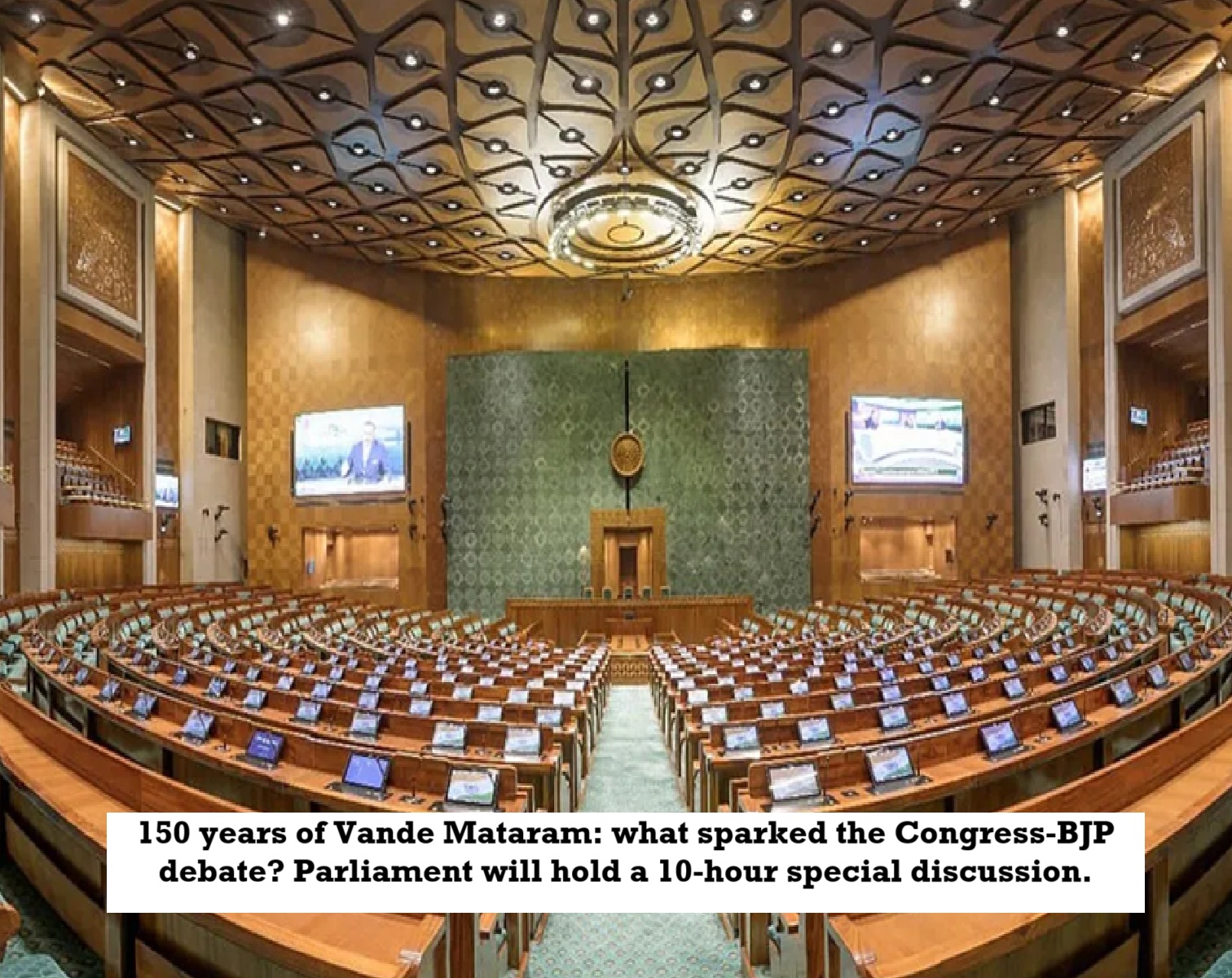
News Topical, Digital Desk : A special discussion commemorating the 150th anniversary of Vande Mataram will begin in the Lok Sabha on Monday. This debate is not merely a ceremonial event, but comes at a time when politics surrounding the song is once again heated. Prime Minister Narendra Modi will open the debate, and Defense Minister Rajnath Singh will conclude it. Following this discussion, which is expected to last approximately 10 hours, a debate will also take place in the Rajya Sabha the next day, initiated by Amit Shah.
Why is there a debate?
At an event last month, PM Modi said that the Congress party removed essential parts of Vande Mataram in 1937, a move that sowed the seeds of partition. He alleged that by dividing the song into fragments, its original spirit was weakened.
The Congress party immediately responded, citing a decision by a Working Committee meeting attended by Gandhi, Nehru, Patel, Bose, Rajendra Prasad, Maulana Azad, and Sarojini Naidu. The party said that only the first two positions were chosen in 1937 because the other positions carried religious symbolism, which some disagreed with.
Congress also stated that the decision was not made to create division, but to respect the sentiments of all communities. The party also accused the Prime Minister of distorting history and diverting attention from current issues.
The beginning of Vande Mataram
Vande Mataram was composed by Bankim Chandra Chattopadhyay around 1875. It was later published in his novel Anandamath in 1881. The novel depicted the " mother " as Bharat Mata , a land that was once powerful, now suffering, and would one day rise strong. However, later critics noted that parts of the song contained goddess-like imagery, which may not be equally acceptable to all religions.
During the partition of Bengal in 1905, this song became the rallying cry of the independence movement. Vande Mataram resonated everywhere—in the Swadeshi movement, protest marches, and newspapers. In 1906, Hindus and Muslims marched together in Barisal under this slogan, and its appeal at the time was not communal, but a symbol of patriotism.
Rabindranath Tagore, Bipin Chandra Pal, and Aurobindo were among those who popularized this slogan. The British government was so troubled by it that it was banned from being used in various places.
Congress and Vande Mataram
Tagore first sang it at the 1896 Congress session, and it became famous throughout the country. In 1905, the Congress adopted it for national occasions. But as religious objections to some of its verses grew in the 1930s , policymakers felt it was necessary to keep the movement inclusive.
What was the decision of 1937 ?
The Congress Working Committee decided in 1937 that only the first two stanzas would be sung at national events. The reasoning behind this was that these stanzas were the most popular and uncontroversial; the remaining stanzas contained religious symbolism, and many Muslim leaders objected to those parts.
The Congress's objective was to ensure that no community felt left out. Therefore, the remaining verses were not removed, nor were they designated solely for the national anthem. The organizers could have added other songs if they wished . Tagore's belief that the national emblem should be one that every citizen could adopt without hesitation also formed the basis of this decision.
decision of the Constituent Assembly
On January 24, 1950, the President of the Constituent Assembly, Dr. Rajendra Prasad, announced that Jana Gana Mana would be the national anthem of India, and that Vande Mataram would enjoy equal status as a national anthem. All members of the assembly agreed to this.
What is today's controversy?
BJP 's stand
- Vande Mataram is a civilizational symbol
- The 1937 decision was a wrong and reckless step.
- It should be proudly presented again on completion of 150 years.
Congress's side
- It is the first party to give national status to the song.
- The 1937 decision was for inclusiveness, not partition.
- BJP is distorting history.
Opinion of Jamiat Ulema-e-Hind
Jamiat chief Maulana Mahmood Madani has clearly said that the first two verses are historically acceptable, but the remaining verses do not match the Islamic principles and in them the Mother has been called as Goddess Durga, which cannot be accepted in Muslim theology. According to him, reciting any such line in which someone else is given the status of God is not valid in Islam.
Read More: Marital dispute like 'Mahabharata war', Supreme Court annuls 10-year-old marriage
--Advertisement--