desk
desk Share
Share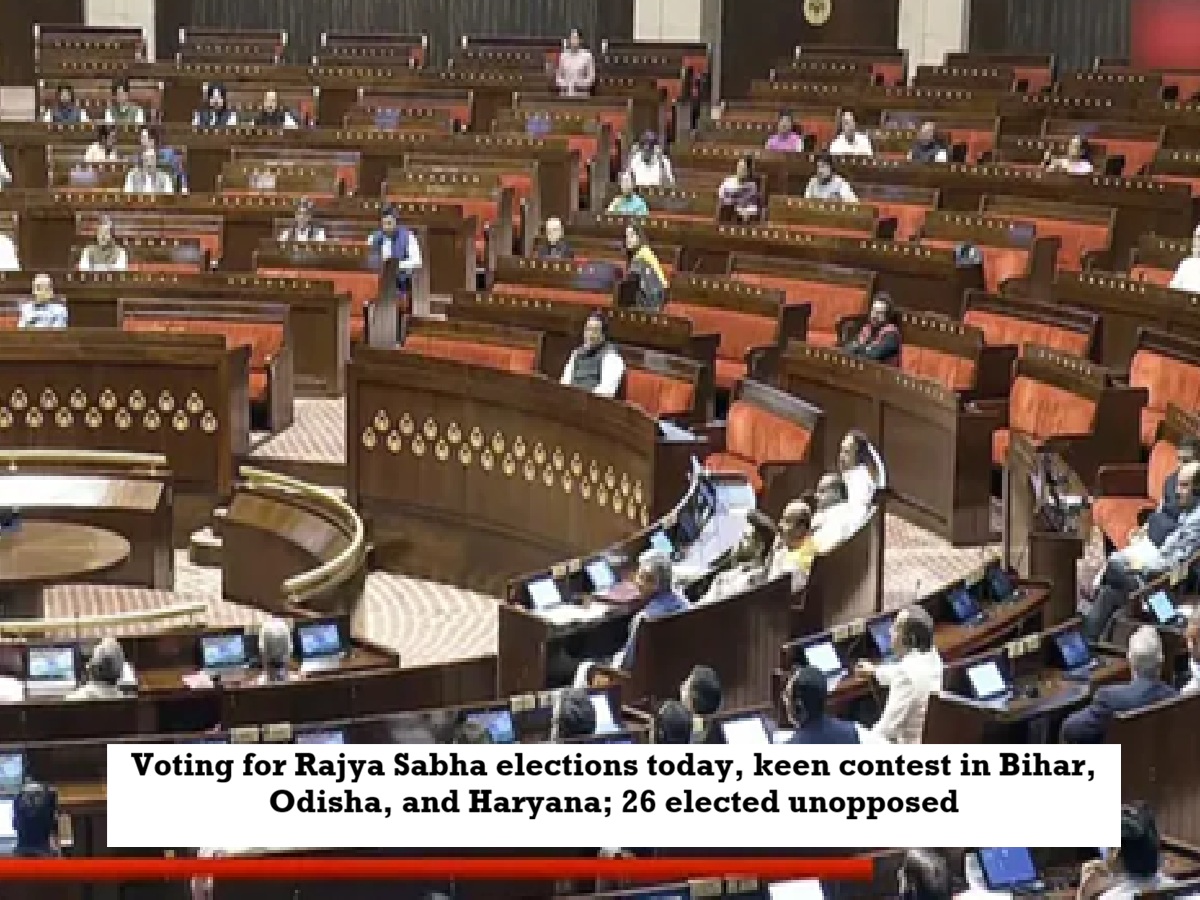
News Topical, Digital Desk : Voting for the Rajya Sabha elections will begin at 11 am today, and the results will be announced in the evening. Of the 37 seats, 26 leaders were elected unopposed in elections held in seven states, including Sharad Pawar, Ramdas Athawale, Abhishek Manu Singhvi, Thambi Durai, Vinod Tawde, and Babul Supriyo. However, close contests are being witnessed in three states: Bihar, Odisha, and Haryana.
In Bihar, Chief Minister Nitish Kumar and Ramnath Thakur of the JDU, as well as Nitin Naveen and Shivam Kumar of the BJP, are considered almost certain to win. However, the fifth seat is a close contest between Upendra Kushwaha of the NDA and AD Singh of the Grand Alliance, a contest that will only be decided by voting.
Close contest for the fifth seat in Bihar
Data shows that the Grand Alliance, which currently has 35 MLAs, needs the support of 41 MLAs to win. All five AIMIM MLAs have announced their support for Tejashwi Yadav's Rashtriya Janata Dal. Furthermore, a BSP MLA may also vote for the RJD candidate.
On the other hand, the NDA has claimed that its candidate, Upendra Kushwaha, will win. To win, Kushwaha will need the votes of at least three MLAs from the Grand Alliance. While it's difficult to predict who will support him, it appears his camp is eyeing the six Congress MLAs and the lone BSP MLA.
BJP and BJD are neck and neck in Odisha
In Odisha, both the BJP and the BJD are expected to win two seats each. State BJP chief Manmohan Samal, BJP Rajya Sabha MP Sujit Kumar, and BJD leader Santrut Mishra are all set to be elected unopposed. However, two candidates are currently vying for the fourth seat. Odisha Assembly data shows that 30 votes are required to secure a Rajya Sabha seat in the 147-member House.
The BJP currently holds 79 seats and has the support of three independent MLAs, bringing its total to 82. Consequently, two BJP candidates appear certain to win, leaving the party with 22 more votes. However, to ensure the victory of the third candidate, the BJP will need to secure eight more votes.
Meanwhile, the BJD has 48 seats, making it a safe bet for one of its candidates to win. If the 14 Congress MLAs and one CPM MLA are added, the number rises to 33, three more than the required number of votes. BJP-backed Dilip Ray will need the support of eight MLAs from the other party to reach the winning mark. According to sources, he is eyeing the support of 14 Congress MLAs and some BJD MLAs.
The situation in Haryana
A similar situation is unfolding in Haryana. The state assembly has 90 seats, of which the BJP holds 48. In addition to the two INLD MLAs, three independent MLAs have also pledged their support to the BJP, increasing its strength to 53. Winning a seat requires 31 votes; ensuring the victory of its official candidate, Sanjay Bhatia, will leave the BJP with 22 more votes.
At the same time, Congress has 37 seats and it will easily ensure the victory of its candidate Karamveer Bodh, due to which it will have 6 more votes.
BJP-backed independent candidate Satish Nandal has upset the electoral mathematics of the Rajya Sabha elections by filing his nomination papers. Nandal needs nine votes to win, which is impossible without cross-voting by Congress members. This is why the Congress has sent 31 of its MLAs to Himachal Pradesh. The six MLAs who did not make the trip include Leader of the Opposition Bhupinder Singh Hooda, Vinesh Phogat, Kuldeep Vats, Mohammad Ilyas, Paramvir Singh, and Chandra Mohan Bishnoi.
These MLAs have already informed the Congress central leadership of their reasons for not traveling. This means that when voting takes place in Bihar, Odisha, and Haryana on Monday, the results could throw up more than one surprise.
Read More: There is a tussle over delimitation, will population be the only basis or will the rules change.
--Advertisement--