desk
desk Share
Share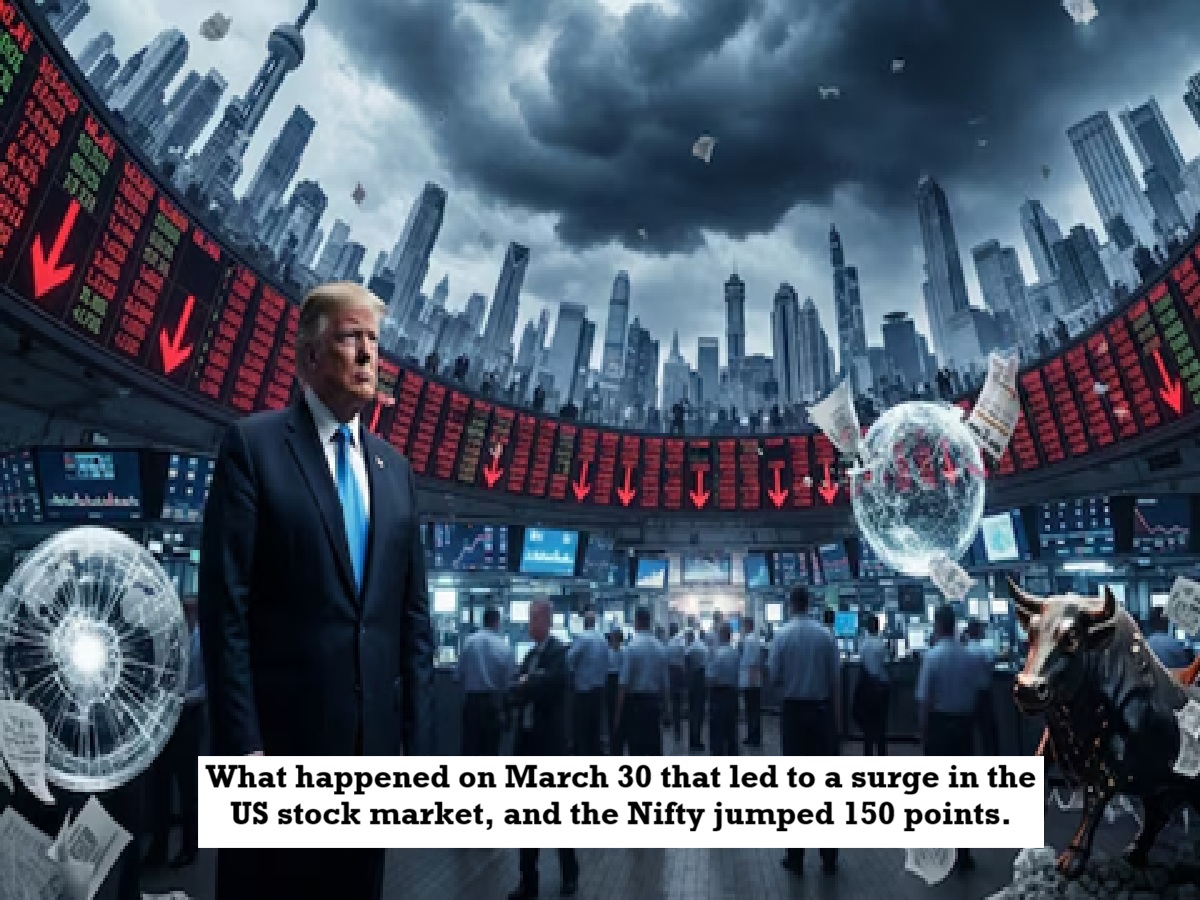
News Topical, Digital Desk : If you invest in the stock market, the most important thing right now is to understand why the market is moving. The fluctuations seen in the US and Asian markets are directly related to the Middle East war and oil prices. Importantly, Donald Trump's statement has increased hopes of an end to the war, leading to lower oil prices and providing some relief to the market. But the story is not over yet.
In another significant development,
Donald Trump now appears ready to end military action against Iran, even if the Strait of Hormuz is not fully opened. According to a report in the Wall Street Journal, the US fears that attempting to force the opening of this vital sea route could prolong the war.
In fact, the Strait of Hormuz is one of the world's most important oil supply routes. If a major operation is launched to open it, the war could last longer than six weeks. This is why the US is now considering a change in strategy.
Market experts believe that the sharp rise in crude oil prices played a major role in this decision. Brent crude has reached close to $120 per barrel, raising the risk of gas prices and inflation. In such a situation, continuing the war could be economically costly for the US.
According to experts, this war has now become "asymmetric," where prolonging it may be beneficial for Iran, while de-escalation appears more beneficial for the US.
To put the current situation in the common investor's terms, the entire market hinges on two things: tensions in West Asia and oil prices. When war or tensions escalate, oil becomes more expensive, increasing companies' costs and putting the market under pressure.
Meanwhile, when there is hope for a subsiding war, oil becomes cheaper, providing relief to the market. The same scenario played out on March 30, 2026,
when news emerged that the US was ready to end its conflict with Iran. Following this signal, oil prices fell, and US market futures saw a slight rise.
The Dow Jones Industrial Average rose 0.11% to close at 45,216. The S&P initially fell, then recovered, but finally closed lower, down 0.40% to 6343. The Nasdaq, an index of technology companies, fell 0.75% to close at 20,794.
However, India's Nifty is currently (at 10 am on March 31, 2026) up 122 points to 22,552. Additionally, Dow and Nasdaq futures have also risen half a percent.
On the other hand, Japan's market is sluggish, but Australia's stock market is rising, and China's stock market is also trading lower.
However, prior to this, the market had been experiencing continuous weakness. US markets had been falling for three days, and tech stocks were particularly under pressure.
Investor fear had increased so much that the volatility index, or fear index, reached above 30. This simply means that investors were nervous about uncertainty and wanted to reduce risk.
However, experts say that such a decline is not a cause for concern, as corrections of around 10% are common in the market, occurring every two years. This is considered a normal process for long-term investors.
Oil prices are currently determining market direction. When oil prices rise, costs increase in every sector, from transportation to manufacturing, which impacts corporate profits and weakens the market.
However, when oil prices fall, companies get relief and the market can rise. Therefore, every investor should keep a close eye on oil prices at this time.
Furthermore, another piece of good news came when Jerome Powell clearly stated that inflation is currently under control and there is no need to raise interest rates. This means that loans will not become more expensive, a positive sign for the market.
Asian markets witnessed a mixed trend. Some markets declined, while others recovered.
This clearly indicates that confusion persists among investors and confidence has not fully recovered. The market is still reacting sharply to news, especially geopolitical news.
Therefore, the most important advice for ordinary investors is to avoid making decisions in a panic. Not every decline is a loss; in fact, it sometimes provides an opportunity to buy good stocks at a low price.
Frequent trades based on news can be detrimental, as the situation is rapidly changing. If your investment is for the long term, it is a better strategy to ignore such fluctuations. Focus on strong companies and try to understand the larger trends in the market.
--Advertisement--