desk
desk Share
Share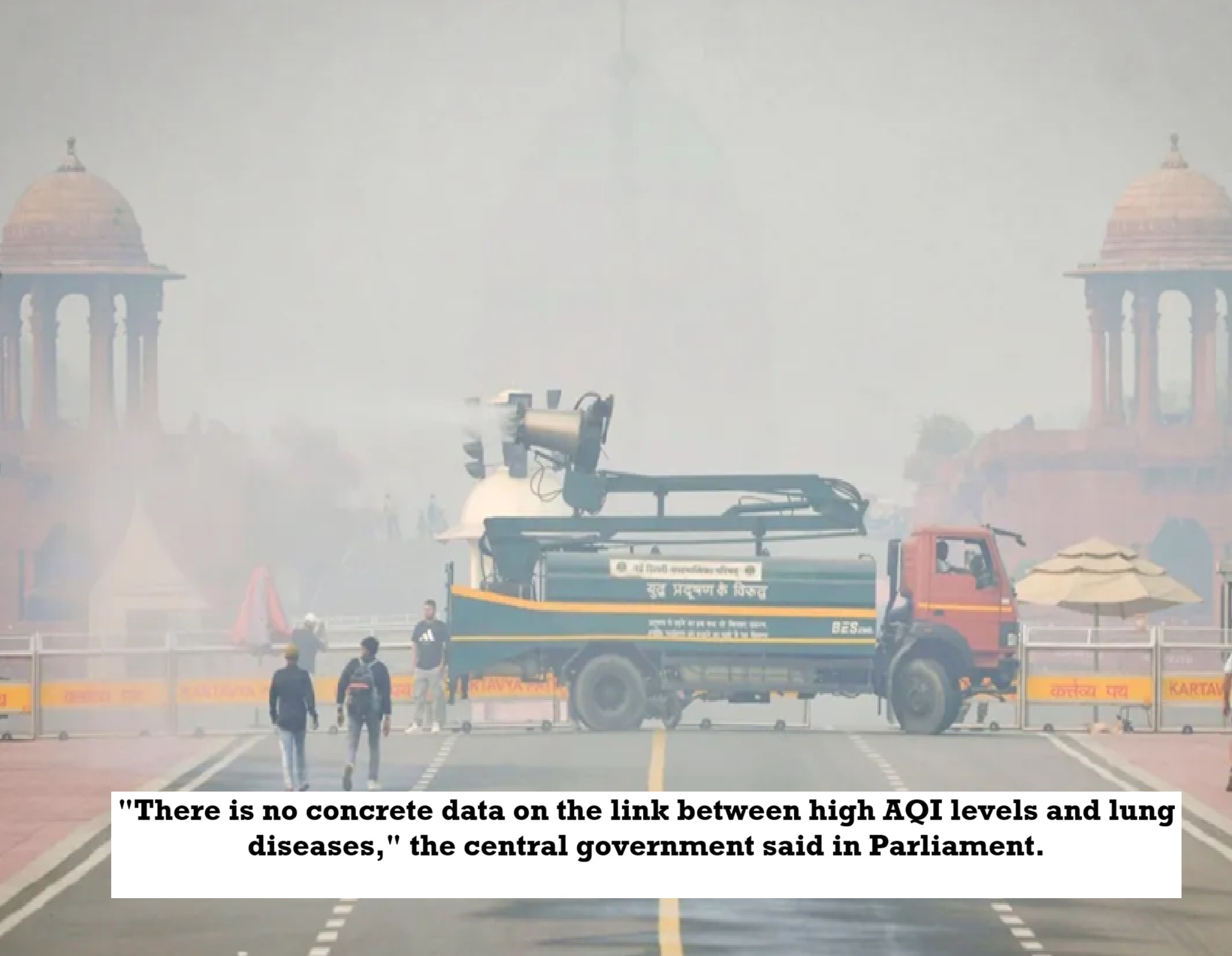
News Topical, Digital Desk : Air pollution has shrouded many cities, including the national capital, Delhi. Schools have been placed on hybrid mode due to the rising pollution. Private offices have called in 50 percent staff, with work from home mandates in place. Meanwhile, the issue of air pollution has also been raised in Parliament. People are facing numerous problems due to air pollution.
The central government said that there is no concrete data to establish a direct link between high levels of Air Quality Index (AQI) and lung diseases. This was stated by Minister of State for Environment Kirti Vardhan Singh in a written reply to a question in the Rajya Sabha on Thursday. However, the Union Minister admitted that air pollution is one of the factors contributing to respiratory diseases and related ailments. Minister Kirti Vardhan Singh said this in a written reply to a question by BJP member Laxmikant Bajpai.
BJP MP Laxmikant Bajpayee had asked whether the government was aware that studies and clinical trials had confirmed that prolonged exposure to hazardous AQI levels in Delhi-NCR was causing lung fibrosis, which leads to irreversible loss of lung capacity.
Bajpayee also wanted to know whether the lung elasticity of Delhi-NCR citizens has decreased by almost 50 percent compared to people living in cities with good AQI. The BJP MP further asked whether the government has any 'solution' to save millions of Delhi-NCR residents from deadly diseases like pulmonary fibrosis, COPD, emphysema, declining lung function and progressively decreasing lung elasticity.
In his reply, the Minister said that dedicated training modules have been developed in the area of air pollution for programme managers, medical officers and nurses, nodal officers, frontline workers like ASHAs, vulnerable groups including women and children and occupationally affected groups like traffic police and municipal workers.
Speaking in the House, he said that information, education and communication (IEC) materials targeting air pollution-related diseases have been prepared in English, Hindi and regional languages. Singh said that the National Programme on Climate Change and Human Health (NPCCHH) has also developed customized IEC materials for various vulnerable groups.
He also said that early warning systems and alerts for air pollution, as well as air quality forecasts, are disseminated by the India Meteorological Department to states and cities to help prepare the health sector and communities, especially vulnerable populations.
Read More: 'Relations will be affected', China creates new county in Aksai Chin, India furious.
--Advertisement--