desk
desk Share
Share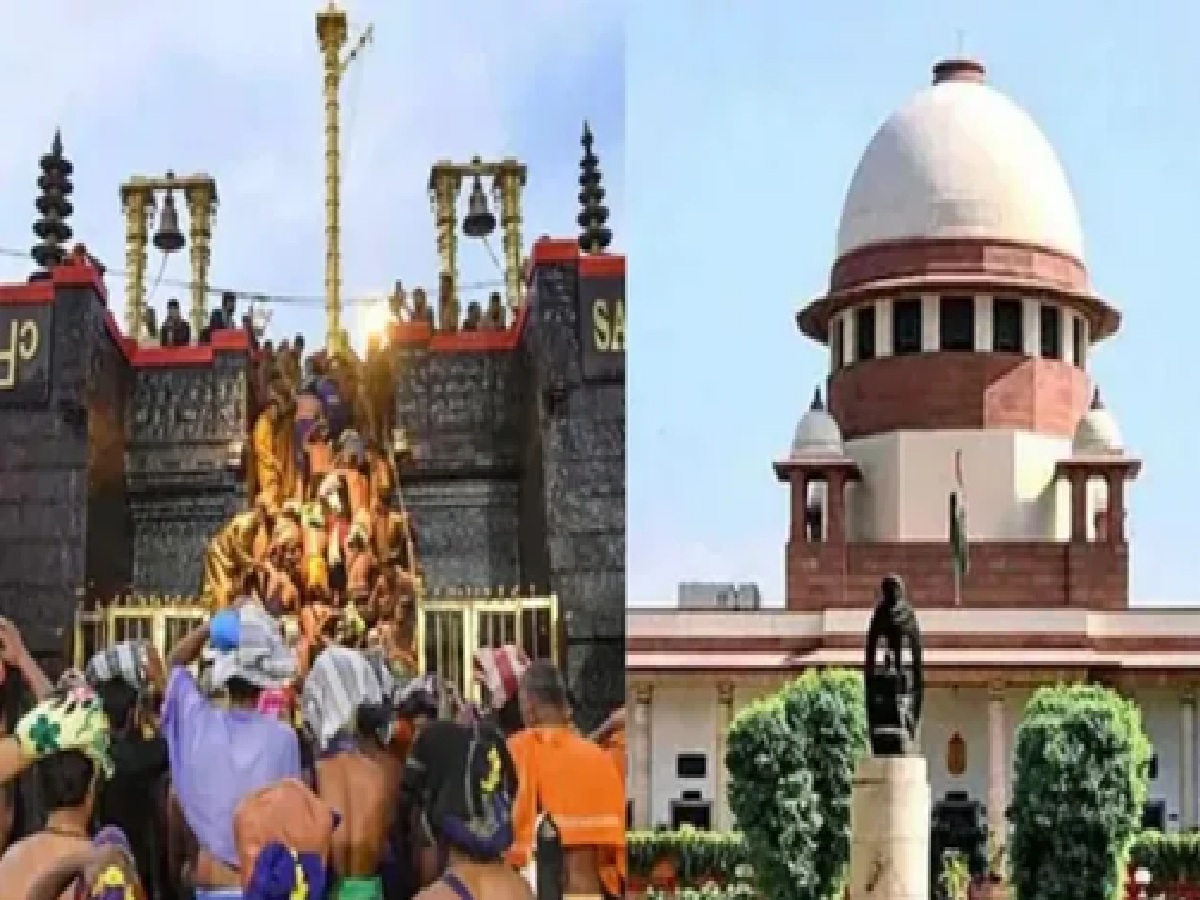
News Topical, Digital Desk : The Supreme Court heard the case regarding the Sabarimala temple in Kerala on Wednesday. During the hearing, the Supreme Court stated that no religion can be "hollowed out" in the name of social welfare and reform. The nine-judge bench stated that essential practices cannot be stripped from a religion in the name of social reform. The bench also stated that disproving the beliefs of millions of people is one of the most difficult tasks.
Women were allowed entry in 2018
It is worth noting that this bench, headed by Chief Justice of India Surya Kant, is currently hearing arguments on key constitutional questions related to the Sabarimala case. Specifically, the question of striking a balance between religious freedom and social reform is being debated. In 2018, the Supreme Court ruled that women of all ages should be allowed to enter the Sabarimala temple. The five-judge bench of the apex court stated, "Restrictions cannot be considered essential religious practices." The bench described the practice of barring women and girls aged 10 to 50 from entering the temple as "almost akin to untouchability."
Meanwhile, during Wednesday's hearing, responding to arguments regarding the admissibility of public interest litigation (PILs) in religious matters, Chief Justice Surya Kant remarked that perhaps the most difficult task facing the court is determining how to declare the beliefs of millions of people as false or misleading. Justice M.M. Sundaresh questioned whether the court could render a decision on such questions without hearing the views of the millions of people involved.
Religion cannot be undermined in the name of reform: Justice B.V. Nagarathna
Justice B.V. Nagarathna expressed similar concerns, saying that such PILs should not be considered unless the petitioner has a direct interest and is acting solely as an outsider. He added, "We cannot undermine any religion in the name of social welfare or reform."
Appearing before the bench on behalf of the Travancore Devaswom Board, which manages the 800-year-old temple, senior advocate Abhishek Manu Singhvi explained the relationship between Article 25(2)(b) and Article 26(b) of the Constitution. He argued that both provisions should be interpreted in a balanced manner.
Article 25 guarantees every person the right to freedom of religion, while Article 26 grants religious institutions the right to manage their own religious affairs. In contrast, Article 25(2)(b) empowers the government to enact laws for social reform and to allow all sections of society access to places of worship.
Religious institutions should be given special privileges: Manu Singhvi
While all Hindu sects can claim the right to enter temples, any religious institution should retain the prerogative to determine how it conducts its internal religious rituals. He argued that when formulating laws, it is essential to ensure that the fundamental identity of the religion remains intact.
During the hearing, Justice Joymalya Bagchi questioned whether this implied that the "essential practices" of a religion could not be changed through legislative means. Singhvi argued that it was not the court's job to decide which religious practices were essential and which were not. He urged the court to reject the "essential religious practices" criterion, arguing that it wrongly allowed judges to decide what constituted the core essence of a religion.
Religious beliefs and practices should not be judged by outsiders: Manu Singhvi
He said, "The moment your Lordships allow the use of the words 'essential' or 'integral,' you essentially begin operating within the scope of the concept called 'religion.' This gives judges or external adjudicating bodies license to decide what constitutes the essential and non-essential components of a religion." He argued that religious beliefs and practices should be evaluated from the perspective of the community that professes them, rather than by external or judicial standards.
Singhvi further argued that once it is established that a practice is devoutly observed as part of a religion, it should be accorded constitutional protection, subject to the limitations of public order, morality, health and other fundamental rights under Article 25.
Meanwhile, Justice M.M. Sundaresh questioned why the term "social reform" was used in Article 25(2)(b). In response, Singhvi said that such measures were necessary to eliminate certain social evils, and laws enacted for this purpose could be considered social reforms.
The hearing will continue on Thursday as well.
It should be noted that for centuries, women of menstrual age have not been allowed to enter the Sabarimala temple. Devotees there believe that Lord Ayyappa is a celibate. In his ruling, the then Chief Justice of India, Dipak Misra, stated that devotion cannot be discriminatory and that patriarchal thinking cannot override equality in devotion. The Travancore Devaswom Board told the court that the ban was not directed against women and suggested that the court refrain from adjudicating on religious matters.
Read More: Kerala bomb blast case: 10 CPI(M) members get 25 years' jail for attacking RSS-BJP workers
--Advertisement--