desk
desk Share
Share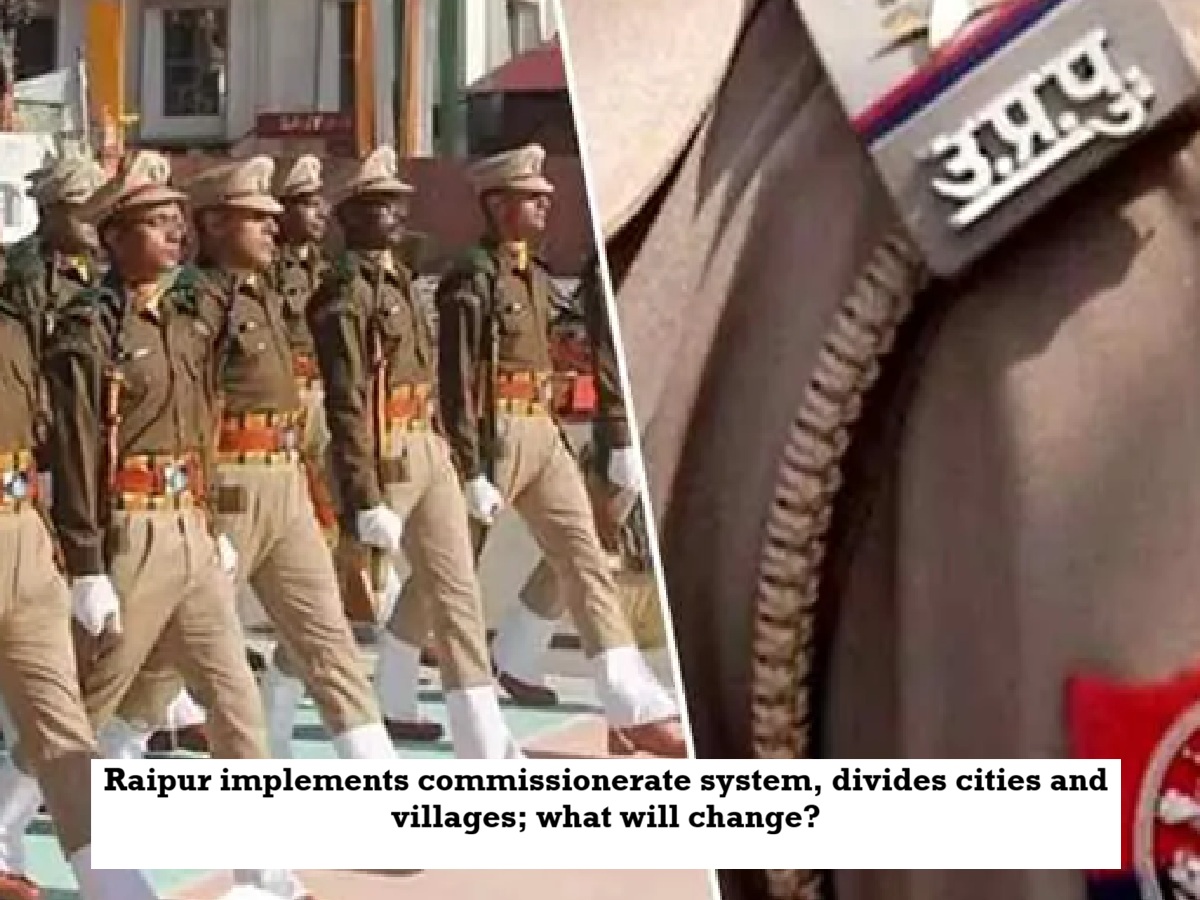
News Topical, Digital Desk : The commissionerate system has now been implemented in Raipur, the capital of Chhattisgarh. The Home Police Department has issued a notification ordering the inclusion of 21 police stations in Raipur into the commissionerate system.
The notification issued by Additional Chief Secretary of Home Department Manoj Kumar Pingua contains the names of 21 police stations where the commissioner system will be implemented.
There will be separate administration in the city and village
The Raipur Urban Commissionerate System includes the names of Civil Lines, Devendranagar, Telibandha, Kotwali, Ganj, Maudhapura, Golbazar, Purani Basti, DD Nagar, Amanaka, Azad Chowk, Saraswati Nagar, Tikrapara, Kabir Nagar, Rajendra Nagar, Mujgahan (Sejbahar), Urla, Khamtarai, Gudhiyari, Pandri and Khamharid police stations.
The Home Department has appointed a separate Superintendent of Police for Raipur Rural. Dharsiwa, Kharora, Tilda Nevra, Mana, Mandir Hasaud, Arang, Nava Raipur, Rakhi, Abhanpur, Gobra Navapara, and Urla police stations will fall under Raipur Rural.
Powers of the commissionerate system
Police officers are generally not independent in making decisions. In emergency situations, they act only under orders from the District Magistrate, Divisional Commissioner, or the government. However, with the implementation of the Police Commissioner system, police officers gain the powers of the District Magistrate and Executive Magistrate.
How does the commissioner system work?
When the Police Commissionerate system is implemented, a Commissioner's headquarters is established. A senior IPS officer of the ADG level is appointed as the Police Commissioner. During this period, the metropolis is divided into several zones. Each zone is assigned a DCP, who, like the SSP, works in that zone and is responsible for the entire zone. Like the CO, SPs are posted in police stations, each with jurisdiction over two to four police stations.
When did the commissioner system come into effect?
The commissionerate system existed before independence under the British rule. After independence, it became part of the Indian Police. Under Part IV of the Indian Police Act, 1861, the District Magistrate has certain powers to control the police. Furthermore, under the Code of Criminal Procedure (CrPC), the Executive Magistrate has certain powers to maintain law and order. Under the commissionerate system, all these powers are vested in the police.
Read More: Marital dispute like 'Mahabharata war', Supreme Court annuls 10-year-old marriage
--Advertisement--