desk
desk Share
Share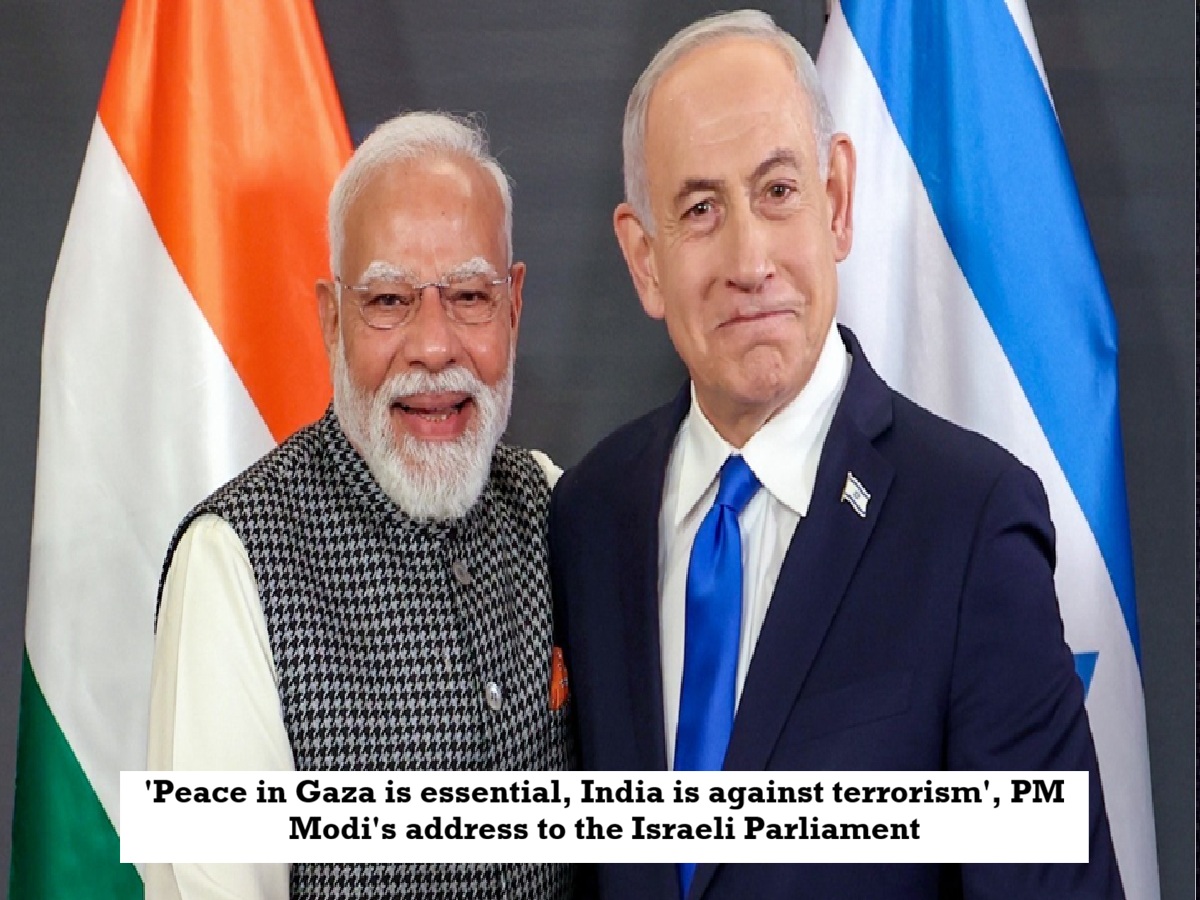
News Topical, Digital Desk : Prime Minister Narendra Modi is on a two-day visit to Israel. This visit is being seen as the beginning of a new era in India-Israel relations. Discussions on key issues such as defense, security, trade, investment, and technology are central to this visit.
Addressing the Israeli Parliament, Prime Minister Narendra Modi said, "For the last few years, India has been the fastest growing large economy in the world. Soon, we will be among the top three economies in the world. In the last few years, India has signed several important trade agreements with other countries...Our teams are working hard to negotiate a major free trade agreement."
Prime Minister Modi will hold delegation-level talks with Israeli Prime Minister Benjamin Netanyahu. He will also meet with President Isaac Herzog. Modi became the first Indian Prime Minister to address the Israeli Parliament, the Knesset. Even before his arrival, lawmakers chanted "Modi, Modi," creating an enthusiastic atmosphere.
Emphasis on defense and strategic cooperation
Defense and security cooperation is a key issue during this visit. Discussions are expected to focus on potential collaboration on India's indigenous air defense system, the Sudarshan Chakra, and Israel's Iron Dome technology. Both countries intend to expand their defense ties beyond just buying and selling, but rather to advance joint production and development of advanced defense systems.
According to media reports, talks could also be held on upgrading the two countries' relationship to the level of a "special strategic partnership," a status Israel has previously granted only to select countries like the US and Germany.
Discussion on trade, innovation and regional issues
There will also be a strong focus on economic cooperation, investment, and free trade agreements (FTAs). Discussions are also likely to include furthering existing bilateral investment agreements and the India-West Asia-Europe Economic Corridor. Prime Minister Modi will participate in an innovation event in Jerusalem and make a joint visit to the Yad Vashem memorial.
Discussions are also likely to focus on the current situation in Gaza and West Asia. Prime Minister Netanyahu's idea of a "Hexagon" coalition, which would include India, Arab countries, African countries, and Mediterranean nations, is also possible.
Special coverage in Israeli media
Israel's leading newspaper, The Jerusalem Post, described the visit as the beginning of a "new phase" in relations. The media hailed it as a historic moment and a strategic realignment. Reports also noted the personal chemistry between Modi and Netanyahu, revisiting photos of their famous 2017 beach walk.
Indian and Israeli flags were seen on the streets of Jerusalem, while the Parliament building was illuminated in the colors of the tricolor. PM Modi's visit is being seen as a new boost to relations between the two countries.
PM Modi receives grand welcome in Israel
Prime Minister Narendra Modi arrived in Israel on Wednesday on an official visit to Israel, where he was given a grand welcome with warmth and ceremonial honours. He was personally received by Israeli Prime Minister Benjamin Netanyahu at Tel Aviv's Ben Gurion International Airport.
He was accompanied by his wife, Sara Netanyahu, who, dressed in a saffron suit, extended a special welcome to the Indian Prime Minister. Several senior members of Netanyahu's cabinet were also present at the airport. A video released by the Israeli government shows Netanyahu welcoming PM Modi in Hindi.
Interestingly, Netanyahu himself pointed out to PM Modi that the square in his pocket and Sara's dress were saffron in color. In a statement issued before leaving for Israel, Prime Minister Modi said that India-Israel relations are based on "trust, innovation, and shared strategic interests."
What will be special during the trip?
He stated that the visit will provide new impetus to defense cooperation, advanced technology, agricultural innovation, water management, and startup partnerships between the two countries. He also underlined that in the changing global landscape, close cooperation between democratic countries like India and Israel is crucial for regional stability and economic development.
The eager anticipation of PM Modi's visit in Israel can be gauged from the fact that not only the Israeli government but also the Leader of the Opposition, Yair Lapid, posted a Hindi welcome message. The Jerusalem Post, the largest newspaper in Israel, also posted a Hindi greeting alongside Modi's photo on its front page.
PM Modi's visit comes at a time of heightened tensions in the Gulf region, particularly the tense relationship between Iran and the United States. The local situation will also be discussed during the high-level talks between PM Modi and Netanyahu on Thursday.
Additionally, defense co-production, cybersecurity, artificial intelligence, semiconductor technology, and supply chain cooperation will be key topics discussed during the visit. Discussions are also likely to include future plans for the I2U2, an organization of India, Israel, the UAE, and the United States.
Defense and technology partnerships between the two countries have grown significantly in recent years, and this visit is considered important in further institutionalizing that cooperation. Israel's ambassador to New Delhi, Reuven Azar, told Dainik Jagran that the two countries are now poised to move beyond traditional defense cooperation and expand coordination in advanced technology, energy, agriculture, and on global platforms.
India-Israel relations
It's worth noting that just before this visit, India joined over 100 countries at the United Nations in criticizing Israel's actions in the West Bank. India initially refrained from collective condemnation but later signed the joint statement.
Full diplomatic relations between India and Israel were established in 1992. In 2017, Prime Minister Modi became the first Indian Prime Minister to visit Israel. Since his historic visit, relations between the two countries have evolved into an open and multifaceted strategic partnership. Over the past decade, this relationship has deepened significantly in the areas of defense, trade, technology, and labor mobility.
--Advertisement--