desk
desk Share
Share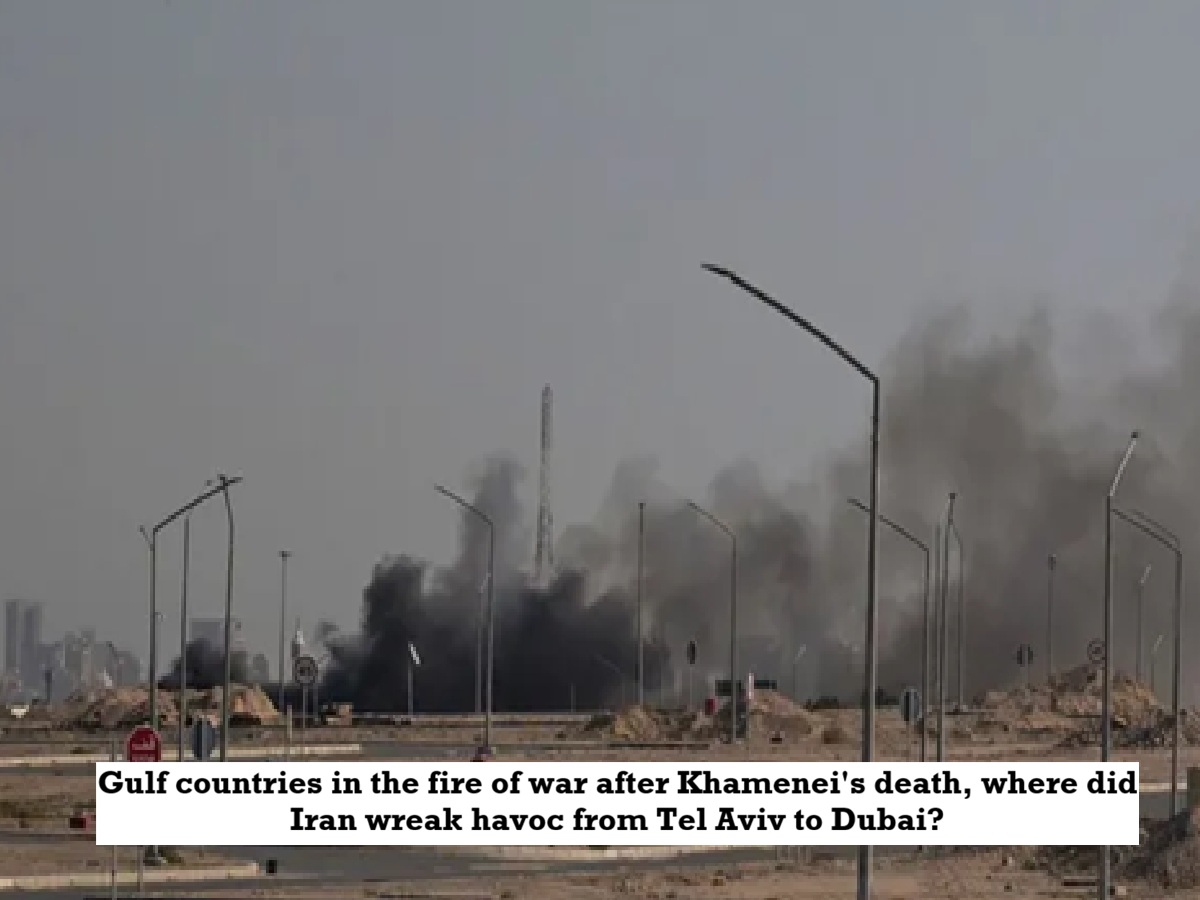
News Topical, Digital Desk : Tensions in the Middle East are at their peak. Following the US-Israeli attack on Iran, tensions have now spread to the entire Gulf countries. Following the killing of Iran's Supreme Leader Ayatollah Ali Khamenei in an Israeli-US military operation on Saturday, Iran retaliated by firing missiles at several locations, including Dubai, Abu Dhabi, Doha, and Manama.
Iran's counterattack sent explosions reverberating in the capitals of Qatar and Bahrain, as well as in the most populous cities of the United Arab Emirates. On Monday, the Israeli military confirmed the arrival of new missiles.
Following which, not only did air raid sirens sound in Tel Aviv, but heavy shelling and drone attacks were also witnessed on civilian infrastructure, airports and US military bases in Gulf countries.
Where did Iran attack?
On the third day after the attack on Iran's capital, Tehran, several missiles were intercepted over Tel Aviv and Jerusalem. Meanwhile, in Iraq, Erbil airport, where US-led coalition troops are stationed and a large US consulate complex is being repeatedly intercepted. Plumes of smoke were also seen rising near the US embassy in Kuwait.
Civilian infrastructure in Iraq, where several US military bases are located, has been severely damaged. On Sunday, a drone attack struck the airport in Bahrain's capital, Manama, causing minor damage.
The United Arab Emirates (UAE) has been hardest hit by Iranian attacks, where debris dropped by drones injured two people in residential areas of Dubai. On Saturday, Iranian attacks caused fires at buildings such as the Palm Seafront development and the Burj Al Arab hotel.
Meanwhile, at least one person was killed and seven others injured in an attack near Abu Dhabi airport, while another person was killed by falling debris earlier in the day.
These airports were affected
Iran's counterattack also hit Dubai Airport, the world's busiest airport for international traffic, and Kuwait's airport. In Saudi Arabia, Iranian missiles aimed at Riyadh International Airport and Prince Sultan Air Base (where US military personnel are stationed) were intercepted.
Iran fired 65 missiles and 12 drones at Qatar, home to the region's largest US military base, most of which were intercepted but eight people were injured, one seriously. Iran also targeted Oman's Duqm port with two drone attacks.
The US and its Arab allies condemned
"Targeting civilians and countries not involved in hostilities is reckless and destabilizing behavior," the US State Department said in a joint statement with Bahrain, Jordan, Kuwait, Qatar, Saudi Arabia and the United Arab Emirates.
On Sunday, the Gulf Cooperation Council (GCC), which includes the United Arab Emirates, Bahrain, Saudi Arabia, Oman, Qatar, and Kuwait, held a meeting to condemn the Iranian attacks. The council called for an immediate halt to these attacks, saying, "The stability of the Gulf region is not just a regional concern, but a fundamental pillar of global economic stability."
Iran will not back down
It's worth noting that US President Trump has repeatedly claimed that Iran has now come to its knees and is ready for negotiations. However, Ali Larijani, a top Iranian security official, said, "We will not negotiate with the United States."
--Advertisement--