







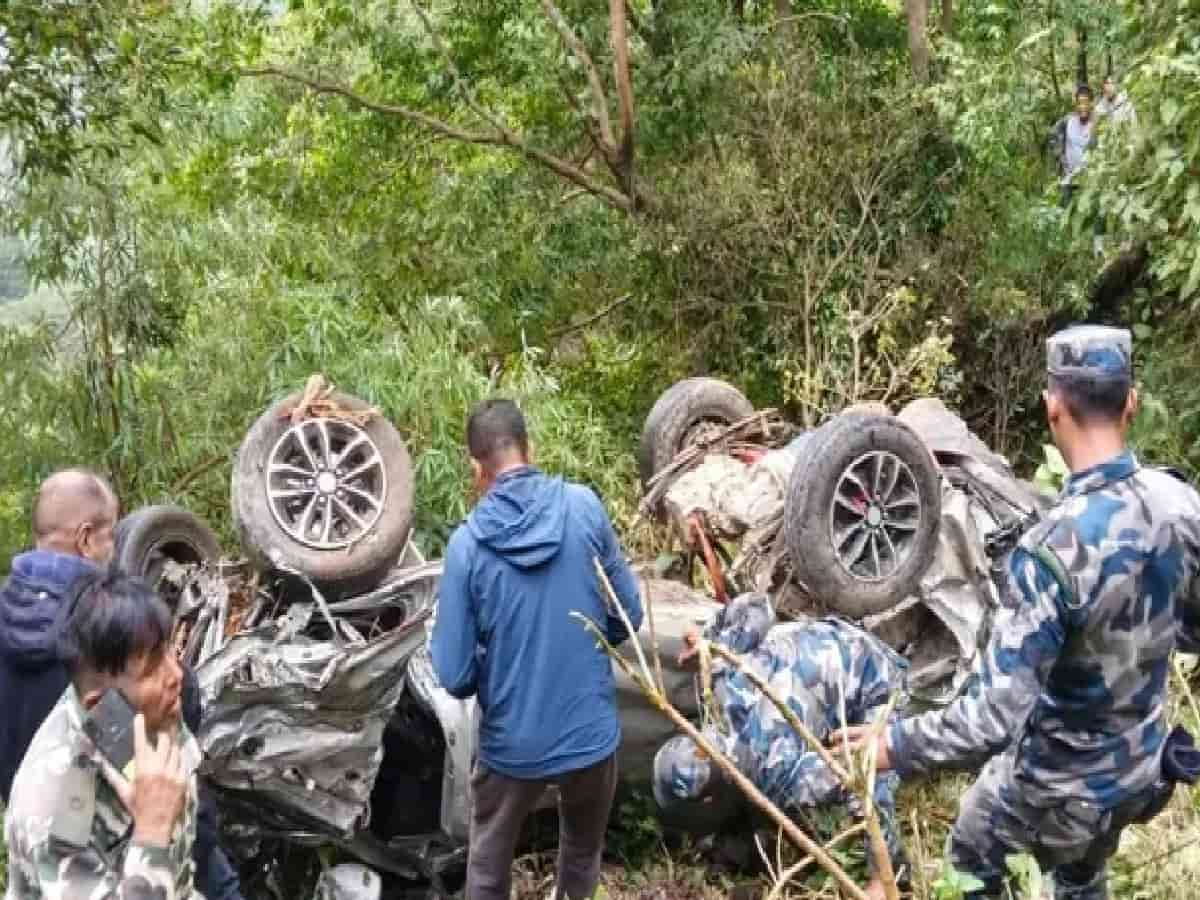
10 Killed as Electric Van Plunges Into Gorge in Nepal's Makwanpur
A devastating road tragedy struck the mountainous terrain of central Nepal early on Thursday morning, November 12, 2026, when a passenger-laden electric van veered off a narrow Himalayan highway and plunged deep into a steep gorge in Makwanpur district, claiming the lives of ten people and leaving five others injured. The fatal crash occurred near Chisapani Gadhi in Ward No. 6 of Bhimphedi Rural Municipality along the winding Bhimphedi-Kulekhani-Kathmandu road section. Carrying fifteen occupants—nearly all of them neighbors and extended relatives traveling home from the capital city of Kathmandu toward Malangwa, the district headquarters of southern Sarlahi district, to celebrate the auspicious Chhath festival—the electric microbus lost directional control and tumbled between 500 and 700 meters down the rocky precipice. The catastrophic plunge tore the vehicle apart on the forested slope, turning a joyful festive homecoming into a scene of unspeakable grief across both Bagmati Province and the Terai plains bordering Bihar.
Dawn Tragedy at Chisapani Gadhi: Chhath Homecoming Turns Fatal
According to survivor accounts and preliminary police findings, the ill-fated passenger electric van—an EV Hiace bearing registration number Madhesh Pradesh 03-001 Ja 0880—had been privately hired by a group of families residing in the Tikathali area of Kathmandu. Eager to cross the Mahabharat mountain range early and reach their villages in Sarlahi ahead of Chhath rituals, the group departed the Kathmandu Valley around 2:00 AM. Disaster struck between 5:45 AM and 6:10 AM as the vehicle navigated a treacherous stretch of sharp hairpin bends at Chisapani Gadhi, located approximately eight kilometers north of the Bhimphedi Area Police Office.
Initial traffic assessments indicate that the electric microbus was carrying 15 people despite having a designated seating capacity of only 10 passengers. Transport safety officials noted that operating an overloaded electric vehicle across steep, winding downhill gradients places immense strain on braking systems and vehicle stability. Unable to negotiate a tight curve in the early morning mist, the van left the tarmac and hurtled hundreds of meters down the sheer embankment. Armed Police Force (APF) Superintendent of Police Niwan Kumar Khadka, deployed in Makwanpur, confirmed that ten victims—comprising five men, three women, and two young girls—perished in the crash, adding that twelve bodies were initially found scattered across the rugged hillside before emergency teams verified the final fatality count.
Joint Rescue Operation in Steep Ravine: Army, APF, and Police Mobilized
As news of the plunge reached local authorities just after dawn, a massive, multi-agency search and rescue operation was launched across the difficult mountain terrain. Because the wreckage lay hundreds of meters below the road surface amid dense undergrowth and loose boulders, reaching the victims required specialized mountaineering and disaster-response gear. Emergency contingents from the Armed Police Force Security Base Camp in Bhimphedi, a district police team led by Makwanpur District Police Office Superintendent of Police Shyam Bahadur Khatri, troops from the Nepali Army, and a ten-member specialized unit from the Bagmati Province Disaster Management Battalion in Thanabharang descended into the gorge.
Working tirelessly for hours under challenging conditions, security personnel utilized ropes, harnesses, and stretchers to recover the deceased and haul the injured survivors back up to the highway. District police officials began the painful process of formal identification, confirming two of the deceased as Ravi Shankar Kumar Mandal of Ward No. 8 and Subek Yadav of Sundarpur Tole in Ward No. 4 of Chakraghatta Rural Municipality in Sarlahi. Authorities stated that forensic and mechanical inspections are underway to determine whether brake failure, excessive speed, or driver fatigue triggered the fatal loss of control.
Survivors Treated at Hetauda Hospital: Children Among the Injured
All five surviving passengers were evacuated from the accident site and rushed via ambulances to Hetauda Hospital in the Bagmati provincial capital of Hetauda for urgent medical intervention. Among the injured undergoing treatment at the facility are 33-year-old Mukesh Yadav of Sundarpur Tole in Chakraghatta Rural Municipality-4, alongside two young children from the same locality: five-year-old Saksham Kumar Yadav and three-year-old Sudan Yadav. Additional rescued passengers identified by local authorities include Devendra Yadav, Sanjay Yadav, and Sujan Yadav.
Providing an update on the clinical condition of the victims, Armed Police Deputy Spokesperson Shailendra Thapa stated that Mukesh Yadav sustained injuries to his head and back, while five-year-old Saksham Kumar Yadav suffered internal trauma, though doctors have placed both patients in stable condition. Three-year-old Sudan Yadav sustained injuries to his head and face and remains under close medical observation in moderate condition. News of the tragedy prompted expressions of deep sorrow across Nepal, with Nepali Congress President Gagan Kumar Thapa issuing a statement offering heartfelt condolences to the bereaved families in Sarlahi and wishing the injured a swift recovery.
Alarming Road Safety Crisis in Nepal: Police and World Bank Data
The Makwanpur catastrophe underscores a severe and persistent road safety emergency across Nepal’s fragile highway network. According to official statistics compiled by the Nepal Police, 2,707 people lost their lives in road traffic accidents during the 2025–26 fiscal year, which concluded in mid-July. That grim annual tally translates to an average of seven fatalities and 82 serious injuries occurring on Nepalese roads every single day. Over the past decade, fatal crashes involving passenger microbuses, jeeps, and buses along narrow mid-hill highways have repeatedly claimed scores of lives, particularly during major festive seasons such as Dashain, Tihar, and Chhath when thousands of migrant workers travel between Kathmandu and southern Terai districts.
Beyond the immeasurable human suffering, road crashes impose a staggering macroeconomic burden on the Himalayan nation. A comprehensive road safety study conducted by the World Bank in Nepal revealed that economic losses resulting from traffic collisions have tripled since 2007, draining an amount equivalent to 1.5 percent of the country's entire Gross National Product (GNP). The World Bank assessment further emphasized that traffic fatalities inflict a disproportionate socio-economic blow on low-income and rural households, noting that more than 70 percent of all road deaths in Nepal occur among the most vulnerable road users, including pedestrians, cyclists, motorcyclists, and rural transit commuters.
EV Safety and Mountain Highway Oversight Under Scrutiny
According to Nepal Police enforcement records, the single most common traffic violation driving fatal crashes across the country is excessive speeding, closely followed by reckless driver negligence and operating vehicles without a valid driving license. Transport safety experts in Kathmandu point out that the Bhimphedi-Kulekhani-Kathmandu corridor—while valued by commuters as a shorter alternative route linking the capital with Hetauda, Sarlahi, and Indian border towns in Bihar’s Sitamarhi and Madhubani districts—features steep inclines, blind turns, and inadequate steel crash barriers.
With commercial electric vans rapidly expanding across Nepal’s inter-city passenger routes due to lower fuel costs, aviation and road safety analysts have urged the Department of Transport Management to enforce stricter technical regulations. Ensuring mandatory pre-departure mechanical audits, strict enforcement against overloading beyond sanctioned seating limits, and the installation of reinforced guardrails along deep gorges will be essential to prevent festive journeys from ending in tragedy along Nepal’s mountain highways.




