desk
desk Share
Share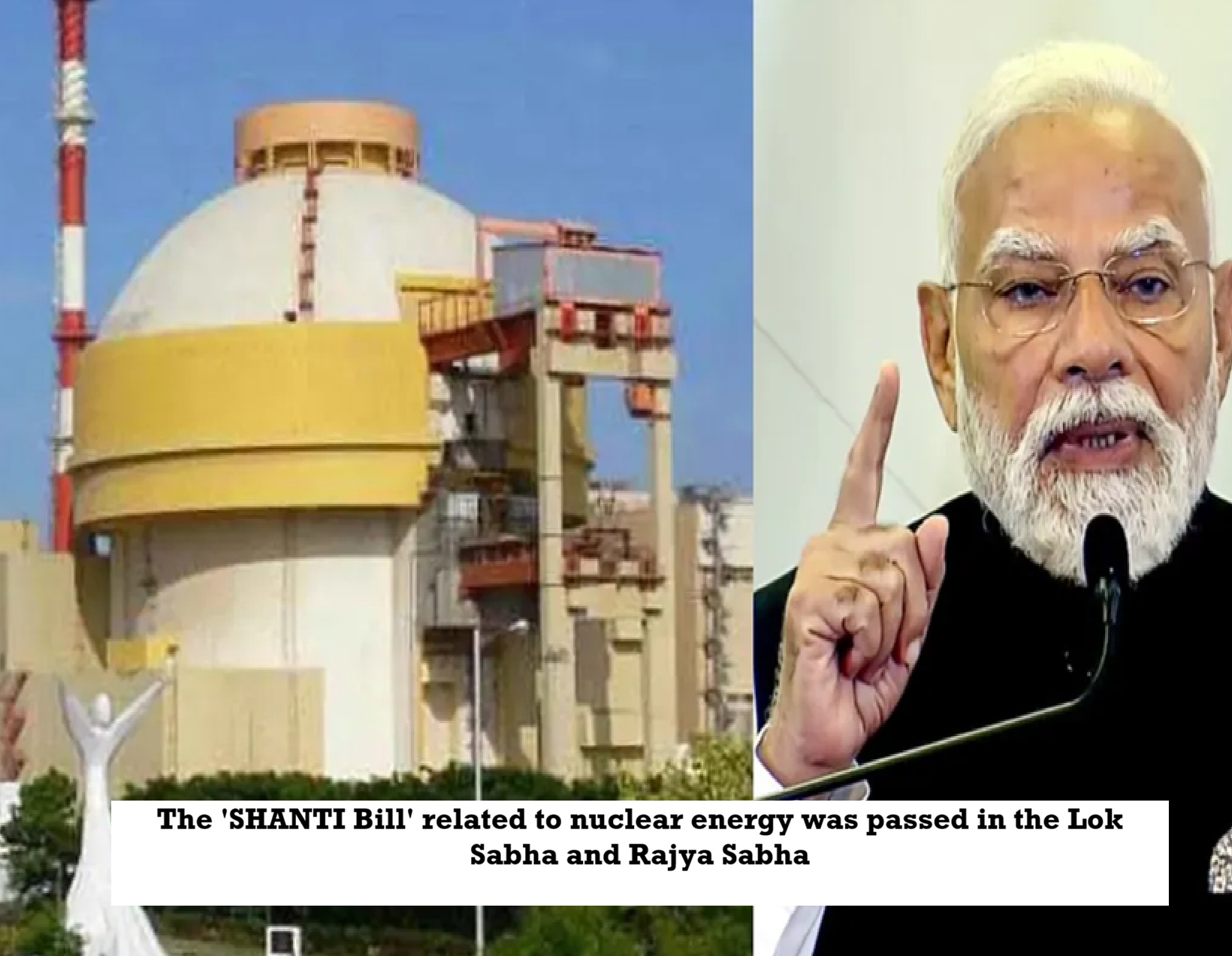
News Topical, Digital Desk : In the winter session of Parliament, both houses, the Lok Sabha and the Rajya Sabha, passed the Sustainable Harnessing and Advancement of Nuclear Energy for Transforming India (SHANTI) Bill 2025. This bill provides for private sector participation in the nuclear energy sector. The ruling party has described the bill's passage as historic and crucial for India's development. Meanwhile, the opposition has alleged that the bill was introduced solely to benefit private companies. Meanwhile, PM Modi has described the bill's passage as a transformative moment for the country.
What did PM Modi say?
On the passing of the SHANTI Bill by the Lok Sabha and Rajya Sabha, PM Modi said - “The passage of the SHANTI Bill by both Houses of Parliament is a transformative moment for our technology landscape. My gratitude to the MPs who supported its passage. From securely powering AI to enabling green manufacturing, it gives a decisive boost to a clean-energy future for the country and the world. It also opens up numerous opportunities for the private sector and our youth. This is a great time to invest, innovate and manufacture in India.”
What did the government say about the bill?
The government has described this bill as historic in the House and said that this bill is important to achieve the goal of making India a developed country by the year 2047. Union Minister Jitendra Singh has said that "India's role is increasing at the geographical level and in such a situation we will have to conform to global standards. If we have set a target of 100 gigawatts of clean energy by 2047, then the nuclear sector is important in achieving this." He has also said that "this bill is also important to meet the increasing energy needs and achieve the goal of self-reliant India."
What do the protesters have to say?
Protests are also being seen against the passage of the SHANTI Bill in both houses. The All India Power Engineers Federation (AIPEF), an organization of power engineers, has said that it will hold nationwide protests against this bill on December 23, along with members of central labor organizations and the farmers' organization Samyukta Kisan Morcha (SKM). The organization alleges that this bill opens India's civilian nuclear sector to private and foreign participation. Due to this, the structure of nuclear safety and accountability will be weakened.
Read More: There is a tussle over delimitation, will population be the only basis or will the rules change.
--Advertisement--