







Not Just Lord Rama: 6 Sacred Historical Events Behind Diwali
While the cultural imagination of the Indian subcontinent immediately associates Diwali with Lord Rama’s triumphant return to Ayodhya after fourteen years of forest exile, the festival of lights is far from a single-story celebration. Celebrated on Kartik Amavasya across the length and breadth of India and the global diaspora, Deepavali represents an extraordinary confluence of cosmic, historical, and philosophical milestones. Over millennia, diverse spiritual traditions—spanning Sanatana Dharma, Sikhism, and Jainism—have woven their most transformative narratives into this celestial autumn night. From the cosmic churning of the primal ocean to dramatic jailbreaks in Mughal-era fortress citadels, the illuminating clay lamps (diyas) lit on Diwali dispel not just external darkness, but the layered historical shadows of tyranny, ignorance, and spiritual bondage. Understanding these six profound episodes unveils the true, multi-dimensional essence of India's grandest festival.
The Triumphant Return: Lord Rama’s Homecoming to Ayodhya
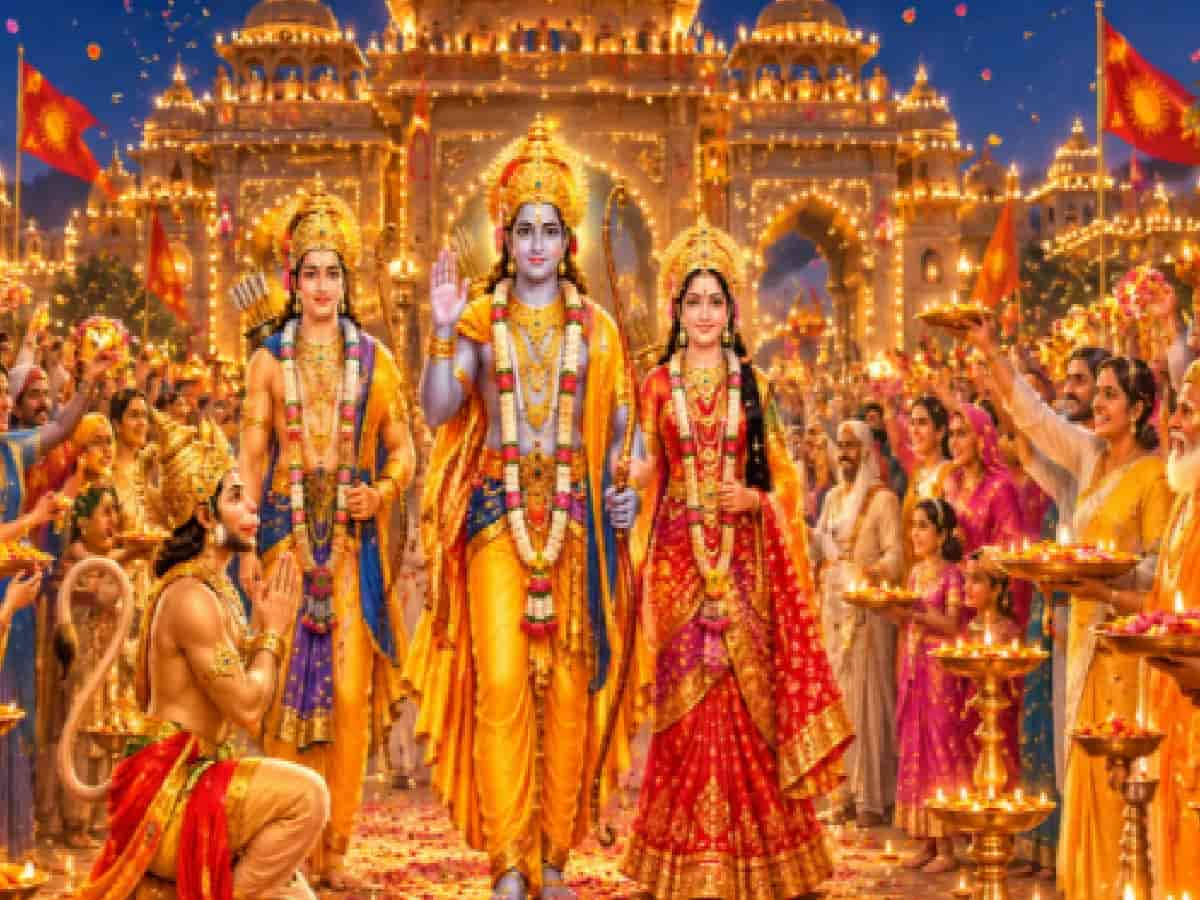
The most universally recognized narrative anchoring Deepavali is chronicled in the Valmiki Ramayana, marking the joyous conclusion to Prince Rama’s fourteen-year exile (vanvas). After vanquishing the ten-headed demon king Ravana in the epic war of Lanka, Rama, accompanied by his consort Devi Sita and loyal brother Lakshmana, boarded the divine aerial chariot Pushpaka Vimana to return to his ancestral kingdom of Ayodhya. News of their approach sent waves of ecstatic relief through the Kosala kingdom, whose citizens had endured more than a decade of separation under the regent rule of Rama’s devout brother Bharata.
Because their homecoming occurred on the moonless night of Kartik Amavasya, the capital city was plunged into pitch-black darkness. To guide the royal chariot safely home and express uncontainable jubilation, the residents of Ayodhya illuminated every street, balcony, terrace, and riverbank along the sacred Sarayu with millions of earthen oil lamps. The dazzling illumination symbolized the absolute victory of Dharma (righteousness) over Adharma (moral degradation), establishing the foundational ritual of Deepotsav. The historic return marked not merely the coronation of an earthly king, but the advent of Ramrajya—a legendary epoch characterized by universal justice, economic prosperity, and the moral renewal of society.
Slaying of Narakasura: Krishna and Satyabhama’s Historic Rescue
In southern and western regions of India, the focal point of the five-day Diwali festivities begins with Naraka Chaturdashi, commonly commemorated as Chhoti Diwali. This day honors the dramatic annihilation of the tyrannical demon king Narakasura of Pragjyotishpura by Lord Krishna and his warrior consort, Satyabhama. Emboldened by a divine boon that he could only be slain with the involvement of his mother, Narakasura had subjugated the mortal and celestial realms, plundering the heavenly earrings of mother-goddess Aditi and imprisoning 16,000 noble women in his subterranean fortress.
Responding to the desperate appeals of the celestial gods, Lord Krishna mounted the divine eagle Garuda, taking Satyabhama—an incarnation of Bhoomi Devi, Narakasura’s earth-mother—into the battlefield to dismantle the tyrant's magical defenses. In a fierce duel fought in the pre-dawn hours of Chaturdashi, Satyabhama struck the fatal blow, fulfilling the cosmic condition required to end the despot’s reign. Krishna immediately liberated all 16,000 captive women, restoring their dignity and social honor in an era where captives faced ostracization. To celebrate their freedom and cleanse the battlefield grime, the victorious army bathed before dawn, giving birth to the sacred tradition of Abhyanga Snan (herbal oil bath) practiced by millions across Maharashtra, Karnataka, Tamil Nadu, and Andhra Pradesh on Naraka Chaturdashi morning.
Bandi Chhor Divas: Guru Hargobind Sahib’s Defiance at Gwalior Fort
For the global Sikh community, Diwali coincides with the historic celebration of Bandi Chhor Divas, translating to the "Day of Liberation." This pivotal historical event commemorates the release of the sixth Sikh Guru, Guru Hargobind Sahib, from prolonged political imprisonment at the formidable Gwalior Fort under the Mughal reign of Emperor Jahangir in the early seventeenth century. Jahangir had interned the young Guru due to growing imperial unease over the increasing spiritual sovereignty, military training, and sovereign influence of the Sikh community in Punjab.
During his confinement, Guru Hargobind discovered that fifty-two Hindu kings and Rajput chieftains were also languishing in the damp dungeons of Gwalior, stripped of their principalities and subjected to harsh indignities. When imperial advisors later counseled Jahangir to release the Guru following deteriorating royal health and diplomatic pressure, Guru Hargobind steadfastly refused to leave the fortress unless the fifty-two royal prisoners were granted unconditional freedom alongside him. Jahangir, seeking to limit the concession, decreed that only those rulers who could hold onto the hem of the Guru’s cloak would be allowed to exit.
Demonstrating tactical brilliance and compassionate solidarity, Guru Hargobind commissioned a master tailor to craft a specialized royal robe featuring fifty-two distinct extended silk ribbons (kalas). As the Guru walked out of the prison gates on Diwali day, every single imprisoned king grasped a ribbon, walking into the sunlight of freedom. When Guru Hargobind arrived back at the holy city of Amritsar, the entire precinct of Sri Harmandir Sahib (the Golden Temple) was illuminated with thousands of oil lamps to celebrate the triumph of moral courage over authoritarian oppression.
Cosmic Manifestation: Goddess Lakshmi’s Emergence from Samudra Manthan
From a scriptural and cosmological perspective, Diwali represents the divine appearance day of Goddess Mahalakshmi, the primordial deity of wealth, grace, and spiritual abundance. According to the Bhagavata Purana and Vishnu Purana, when an ancient curse weakened the celestial gods, the Devas and Asuras united to execute the monumental Samudra Manthan (the churning of the cosmic ocean of milk) using Mount Mandara as the churning rod and the serpent king Vasuki as the rope to recover the nectar of immortality (Amrita).
As the churning churned through cosmic eons, fourteen divine treasures (Chaturdashi Ratnas) emerged from the depths. On the auspicious night of Kartik Amavasya, Goddess Lakshmi manifested from the churning waves, radiant and majestic, seated atop an immaculate blooming pink lotus. Her appearance restored cosmic balance, divine grace, and joy across the universe. Given the choice of an eternal companion among all the assembled deities, sages, and kings, Mahalakshmi placed the fragrant floral garland Vanamala around the neck of Lord Maha Vishnu, accepting him as her divine consort. The lighting of lamps on Diwali night thus commemorates the sacred moment Mahalakshmi blessed the universe with her presence, prompting devotees to keep their doors open and their homes illuminated to invite her eternal grace.
Bhagwan Mahavira’s Nirvana: The Eternal Flame of Jain Wisdom
In the Jain tradition, Diwali holds profound metaphysical importance as the anniversary of the final liberation (Nirvana) of Bhagwan Mahavira, the twenty-fourth and last Tirthankara of the current cosmic cycle. On the morning of Kartik Amavasya in 527 BCE, at the sacred pilgrim site of Pavapuri in modern-day Nalanda district, Bihar, Bhagwan Mahavira shed his physical mortal coil and attained Moksha, entering the eternal realm of liberated souls (Siddhashila).
On the very same evening, Mahavira’s chief disciple, Ganadhara Gautama Swami, finally overcame his deep personal attachment to his spiritual master and attained Kevala Jnana (infinite, omniscient knowledge). When the physical presence of the great Tirthankara departed from the earth, sixteen confederate kings of Kashi and Kosala, alongside thousands of disciples, gathered in deep contemplation. Realizing that the supreme beacon of physical light had passed into eternity, they resolved to light rows of clay lamps (Dīpālikā) to symbolize that the light of Mahavira’s spiritual teachings—grounded in absolute non-violence (Ahimsa), truth (Satya), and non-possessiveness (Aparigraha)—would remain eternally burning to guide humanity out of the darkness of worldly ignorance.
The Humbling of King Bali: Vamana Avatar and Bali Pratipada
The fifth day of the extended Diwali festival cycle, celebrated as Bali Pratipada or Govardhan Puja, traces its roots to the Puranic legend of King Mahabali and Lord Vishnu’s fifth incarnation, Vamana Avatar. King Bali, an Asura sovereign renowned for his unmatched valor, charity, and austere penance, had expanded his dominion across all three worlds, dislodging Indra from his celestial throne. Although Bali was a righteous and beloved monarch, his growing cosmic supremacy threatened universal balance.
To restore cosmic equilibrium, Lord Vishnu incarnated as Vamana, a diminutive Brahmin dwarf scholar, and approached Bali during a grand sacrificial ritual where the king had pledged to grant any gift requested of him. Vamana asked merely for three paces of land measured by his tiny footsteps. Despite warnings from his preceptor Shukracharya, the generous king granted the boon. In an instant, Vamana expanded into the cosmic Trivikrama form; with his first stride, he measured the entire mortal earth, and with his second, he encompassed the heavenly realms.
With no space left for the third stride, King Bali, upholding his sacred promise of charity, humbly bowed his head and invited the Lord to place his third step upon him. Moved by Bali’s ego-less devotion and unshakeable commitment to truth, Lord Vishnu placed his foot upon Bali’s head, granting him sovereignty over the netherworld (Sutala loka). Furthermore, the Lord bestowed an eternal boon permitting the benevolent monarch to return to earth once every year on Kartik Pratipada to visit his beloved subjects. The lighting of lamps on Bali Pratipada commemorates the honoring of this righteous king and serves as a timeless reminder that authentic greatness lies in absolute surrender of ego.
Whether marked through the joyful return of an exiled king, the liberation of captive prisoners, the cosmic birth of prosperity, the release of an enlightened soul, or the ultimate triumph over arrogance, Diwali serves as a universal canvas for the human spirit. The flickering earthen lamps lining windowsills across the world do not celebrate a single chapter of history, but a collective spiritual covenant: that no matter how deep the darkness of an age may seem, light, truth, and liberation will inevitably prevail.




