desk
desk Share
Share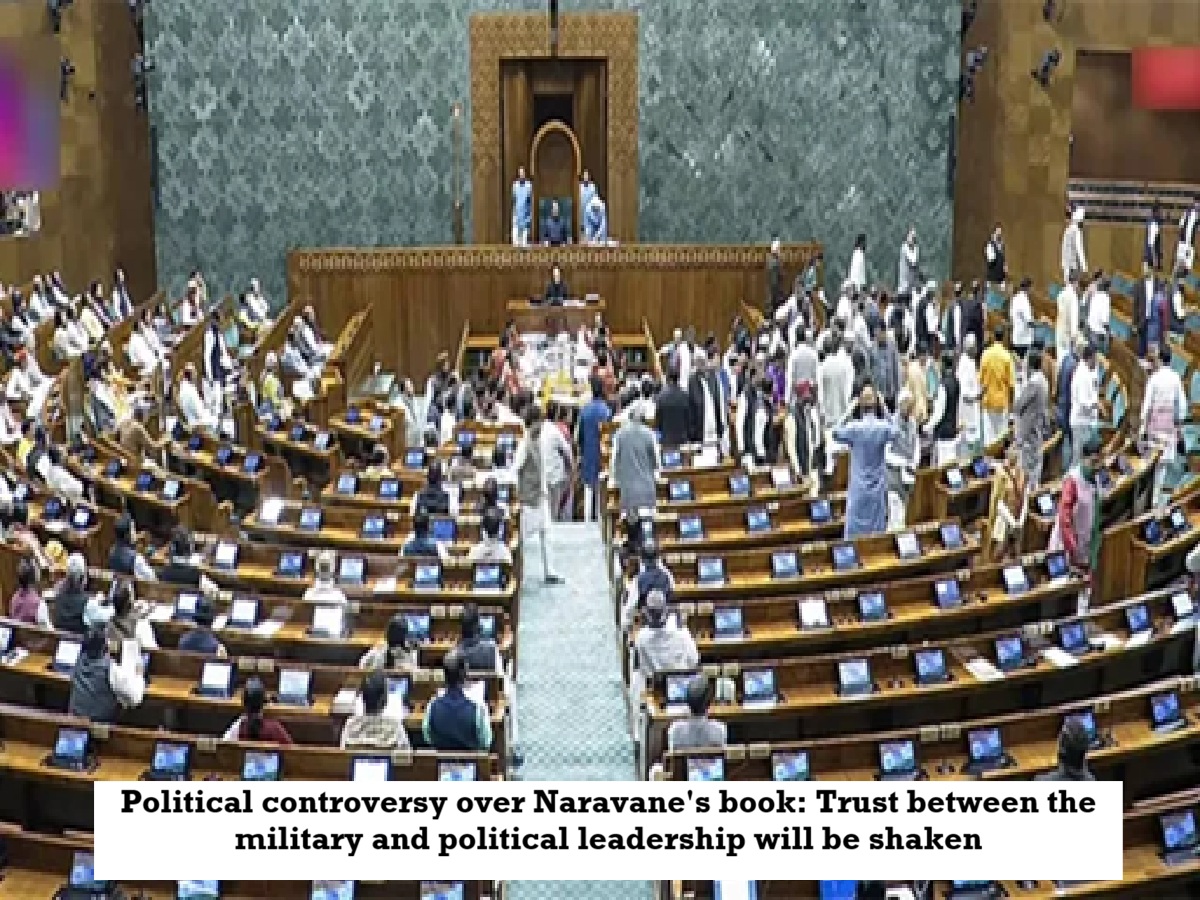
News Topical, Digital Desk : The controversy that erupted in Parliament over the unpublished book by former Army Chief General Manoj Mukund Naravane clearly shows that politics is now taking a toll on issues related to the military and national security.
Based on this unpublished book, Leader of Opposition in the Lok Sabha Rahul Gandhi is attempting to portray the decision to be left to the Army Chief during the Chinese Army's advance in the Kailash Range of eastern Ladakh in 2020 as a weakness of the top government leadership.
While the government accuses it of violating parliamentary decorum and politicizing a sensitive issue related to national security, making every military decision a subject of political debate could damage the future fabric of trust between the military and the political leadership.
The way Rahul Gandhi is questioning the government by citing Naravane's unpublished book implies that any military action on the border is decided not by the deployed military commanders or top military leadership, but at the level of the government and the Prime Minister. Rahul Gandhi came to Parliament on Wednesday with a copy of Naravane's book in hand to further this debate.
Naravane's book claims that in 2020, when the Chinese army was advancing with four tanks in the Kailash Range, after receiving information from the Northern Sector Commander, the Army Chief had sought instructions from Defence Minister Rajnath Singh.
When a response was delayed, he called Foreign Minister S. Jaishankar and National Security Advisor Ajit Doval. He then called the Defense Minister again, who spoke with the Prime Minister and told him that the top leadership had instructed him to do whatever he deemed appropriate.
Rahul alleged that when a serious crisis was looming on the border, the political leadership delayed for more than two hours and, instead of fulfilling its responsibility, left the decision to the Army Chief. This demonstrates a serious weakness of political leadership.
The ruling party dismisses this argument as baseless and an attempt to drag the military into a political debate. It maintains that the strategy for responding to challenges on the front is determined at the military level. Therefore, the advice given to Naravane was within the established operational framework between the military and the government and was part of the military-political decision-making process.
Of course, in our federal system, the military is completely subordinate to the government, but this does not mean that every strategic decision is made by the political leadership. Sometimes, in crisis situations, the political leadership sets broad policy and direction, leaving immediate decisions on the ground to the Army Chief and his commanders.
The ruling party argues that the Prime Minister's "do as you deem fit" directive was part of this established process. To portray this as a leadership failure is to deny the established system of working between the government and the military.
Using the army and national security as a political weapon is also not appropriate from the point of view that if the responsibility of taking a decision as per the ground situation in the Kailash Range was given to the Army Chief, then this could also be a part of strategic-tactical discretion.
In such a situation, it cannot be ignored that the Prime Minister's move, which Rahul Gandhi is calling a weakness, may have been part of a strategy to counter the strategic challenge posed by China. Of course, it is the opposition's responsibility to question the government on important issues, but maintaining a balance between national security, the military, and political accountability is equally important.
Read More: Why has the government shifted its focus from commercial LPG to PNG? Learn the real reason.
--Advertisement--