







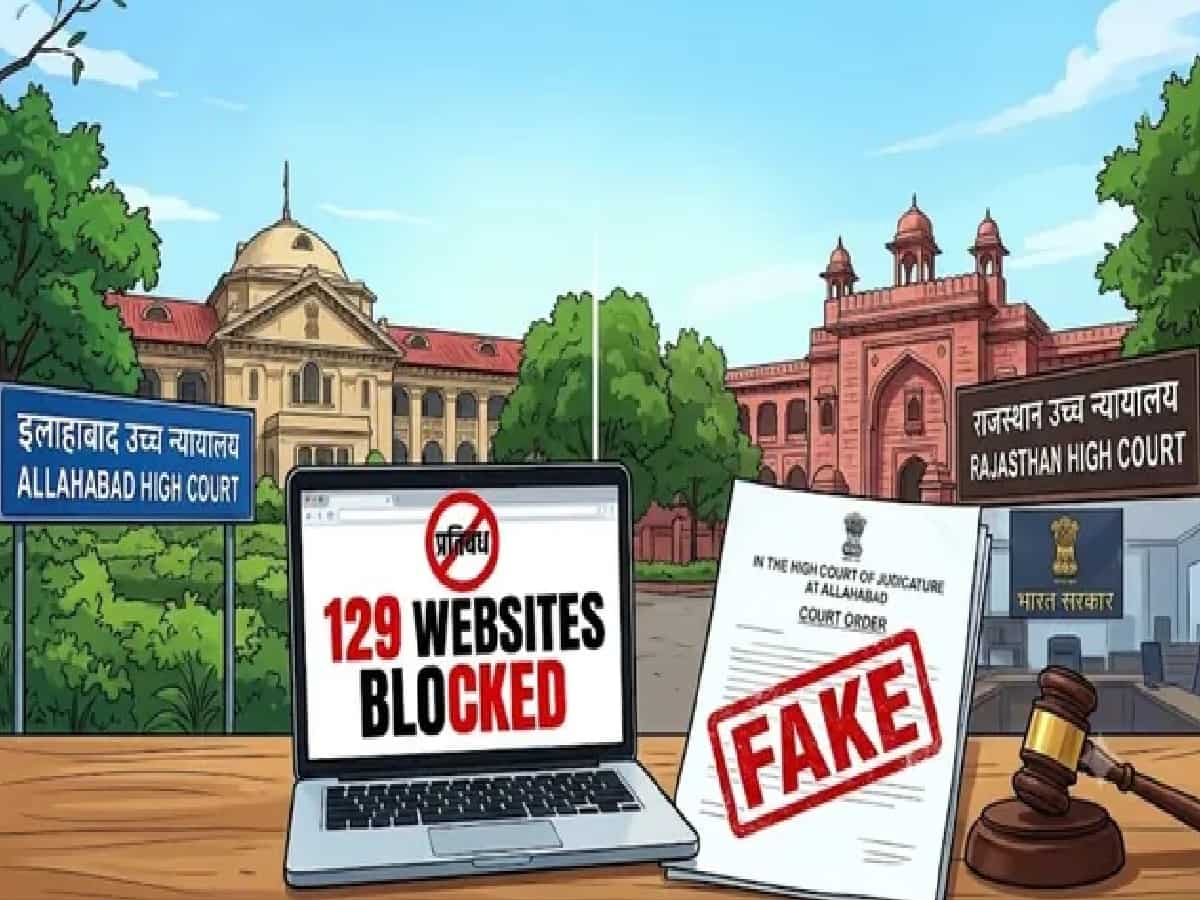
129 Websites Blocked Over Fake Allahabad, Rajasthan HC Orders
A major breach involving forged judicial documents and regulatory verification lapses has come to light across New Delhi, Rajasthan, and Uttar Pradesh after an investigation revealed that 129 betting and gambling websites were blocked in India on the basis of fabricated High Court orders. Acting on two separate sets of fraudulent court directives that impersonated the Rajasthan High Court and the Allahabad High Court, the Union Department of Telecommunications (DoT) instructed internet service providers (ISPs) across the country to restrict public access to the platforms on July 21 and September 2, 2026. Both forged documents were crafted with remarkable visual precision, featuring authentic-looking blue ink court seals, the national emblem of India, judicial typography, and even a deceptive verification QR code designed to mislead telecom officials. Following independent cross-checks by Reuters and internal digital audits by court authorities, both High Courts confirmed that no such orders ever existed on their official servers. The revelations have triggered a criminal investigation by the Prayagraj Police in Uttar Pradesh and raised urgent questions regarding potential Artificial Intelligence misuse and the absence of direct judicial authentication mechanisms within central ministries.
The Rajasthan High Court Forgery: 34 Betting Sites Blocked in July
The first phase of the digital deception unfolded in mid-July 2026, targeting central telecom administrators in New Delhi through urgent electronic correspondence. On the evening of July 19 at exactly 8:59 PM, an email landed in the official inbox of the Department of Telecommunications containing a purported judicial order attributed to the Rajasthan High Court. The document demanded immediate compliance within a strict 24-hour window and bore the purported signature of an individual named Aryan Chaudhary, who identified himself as an advocate-on-record. To lend institutional credibility to the demand, the attached PDF carried a blue judicial stamp bearing the national emblem closely resembling official court stationery.
Relying on the apparent authenticity of the submission without independently verifying the docket with the court registry in Jodhpur or Jaipur, the Department of Telecommunications processed the request swiftly. Within forty-eight hours, on July 21, the central department issued formal directives to internet service providers nationwide to block access to 34 online betting websites. When subsequent journalistic inquiries attempted to reach the email address used by the supposed advocate, the electronic messages bounced back undelivered. Upon formal verification, the Registrar of the Rajasthan High Court confirmed that the purported order was completely fraudulent, did not exist anywhere on the court’s digital servers, and warranted strict legal action against the perpetrators.
Fabricated Allahabad HC Order and the Deceptive QR Code
Encouraged by the success of the July takedown, fraudsters executed a far larger second operation the following month, this time misusing the name and institutional authority of the Allahabad High Court in Prayagraj. On August 22, 2026, an individual identifying himself as advocate Kartikey Pandey emailed a purported court order to telecom officials, seeking the immediate blocking of 95 gambling and betting websites. Dated August 14, 2026, the fabricated document falsely cited the name of sitting judge Justice Garima Prashad and claimed to be a judicial directive passed in Writ Petition No. 30480 of 2026.
To overcome potential scrutiny by government officials, the creators of the forged Allahabad High Court order incorporated a sophisticated digital trap. Alongside the official court logo and blue seal, the document contained an embedded QR code ostensibly designed for instant online verification. However, technical scrutiny revealed that scanning the QR code did not direct users to the official Allahabad High Court e-courts portal. Instead, it routed browsers to a generic, unrelated webpage that simply displayed a bare case number without any verified judicial metadata. After internal email exchanges among telecom officials over roughly ten days in late August, the DoT accepted the document as genuine and issued a fresh blocking order on September 2 covering all 95 websites, bringing the cumulative number of blocked portals to 129.
Internal Court Probe: Digital Server Audit Exposes the Scam
The elaborate fraud began unraveling when technology correspondents from Reuters contacted the Allahabad High Court administration seeking clarification regarding the authenticity of the August 14 directive. Recognizing the gravity of an impersonated judicial order being used to exercise state censorship powers, the matter was immediately placed before the Chief Justice of the Allahabad High Court. Acting on the Chief Justice’s instructions, the Registrar General directed the High Court’s computer section to conduct a comprehensive forensic audit of all judicial databases, filing registries, and daily cause lists.
System Manager Arindam Lahiri examined the court’s central servers and digital archives, submitting an official technical verification report on November 3, 2026. The audit established conclusively that Writ Petition No. 30480 of 2026 was entirely fictitious, had never been registered in the filing section, and did not exist in the court’s electronic records. Furthermore, server logs proved that no such order had been uploaded to the official court portal on August 14, 2026. Providing secondary confirmation, the private secretary to Justice Garima Prashad submitted a written statement verifying that the judge had never heard any such petition nor passed any directive ordering the blocking of websites.
Prayagraj Police FIR: Criminal Case Registered Under BNS and IT Act
Armed with conclusive evidence of institutional forgery, the Allahabad High Court administration initiated swift criminal proceedings to unmask the syndicate behind the fake orders. On November 5, following directives from the Chief Justice, the Registrar General ordered the registration of a formal police complaint. The following day, November 6, the Joint Registrar (Civil) of the Allahabad High Court lodged a detailed written complaint at the Cantt Police Station in Prayagraj.
Based on the court’s complaint, Uttar Pradesh Police registered a First Information Report (FIR) against unidentified individuals under stringent criminal provisions, including Sections 318(2), 336(2), 336(3), 337, 338, and 340(2) of the Bharatiya Nyaya Sanhita (BNS), 2023—which govern cheating, forgery of court records, and fraudulently using forged documents as genuine—alongside relevant sections of the Information Technology Act. Deputy Commissioner of Police (City) Sagar Jain confirmed that specialized cybercrime and technical investigation teams have been deployed to trace the originating IP addresses, email headers, and computer systems used to fabricate the documents and transmit them to New Delhi.
AI Forgery Fears and Gaps in Government Verification Protocols
Beyond the immediate criminal investigation in Prayagraj and potential legal action in Jaipur, the incident has exposed critical vulnerabilities in India’s digital governance framework. Legal analysts and cybersecurity experts note that the ease with which unknown actors replicated High Court seals, judicial phrasing, and functional QR codes underscores the growing threat of generative Artificial Intelligence and advanced desktop publishing tools being weaponized to counterfeit official state instruments. Whether motivated by commercial rivalry among offshore betting operators or deliberate attempts to test regulatory loopholes, the episode demonstrates how easily fabricated documents can trigger nationwide internet blocks.
Cyber law specialists have emphasized that central ministries, particularly the Department of Telecommunications, must urgently overhaul their standard operating procedures for processing website takedown requests. Rather than acting on unverified PDF attachments received via external email accounts, government departments must establish direct, encrypted digital verification pipelines with High Court registries across India. As police investigators work to trace the digital footprints of the individuals behind the fake personas of Aryan Chaudhary and Kartikey Pandey, the scandal stands as a stark reminder that robust institutional verification is essential to safeguard both judicial integrity and digital governance.




