







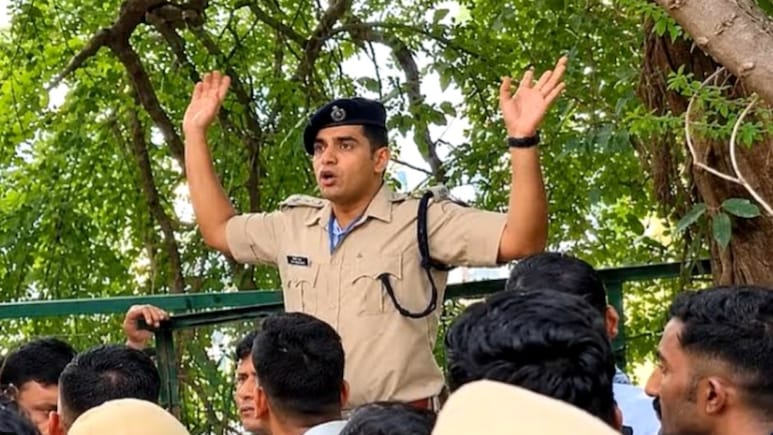
What is a DANIPS Officer? Structure, Roles, and Differences From IPS
When aspirants prepare for the prestigious Civil Services Examination conducted by the Union Public Service Commission (UPSC), the conversation typically revolves around the Indian Administrative Service (IAS) and the Indian Police Service (IPS). However, several vital Group A and Group B central services play an equally crucial role in governance and law enforcement. Among them, DANIPS is one of the most sought-after uniformed services. Understanding what a DANIPS officer does, how the service operates, and how it differs from the IPS helps clarify its unique position in India’s administrative framework.
What Does DANIPS Stand For?
DANIPS stands for the Delhi, Andaman and Nicobar Islands, Lakshadweep, Daman and Diu, and Dadra and Nagar Haveli Police Service. It is an organized Group 'A' and Group 'B' civil-cum-police service administered by the Ministry of Home Affairs (MHA). Officers belonging to this cadre are primarily responsible for maintaining public order, crime prevention, traffic management, and handling security operations across India's specified Union Territories, most notably the capital city of Delhi.
Recruitment and Training of DANIPS Officers
Candidates who wish to join DANIPS do not write a separate, standalone exam; instead, they clear the prestigious UPSC Civil Services Examination (CSE). Based on their rank, preferences, and category, successful candidates are allotted to the DANIPS cadre.
Following selection, unlike direct IPS probationers who undergo foundational training at the Lal Bahadur Shastri National Academy of Administration (LBSNAA) and Sardar Vallabhbhai Patel National Police Academy (SVPNPA), DANIPS probationers receive specialized training geared toward urban and territorial policing. Their training typically takes place at local police training establishments, such as the Delhi Police training academy, followed by rigorous field postings under senior supervision.
Key Differences Between DANIPS and IPS Officers
While both DANIPS and IPS officers wear uniforms, handle law enforcement, and are recruited through the UPSC Civil Services Examination, several fundamental distinctions set them apart:
-
Cadre Scope and Jurisdiction: An IPS officer belongs to an All India Service and can be assigned to any state or joint cadre across the country, eventually holding top-tier leadership positions like Director General of Police (DGP). Conversely, DANIPS is a Union Territory-specific police service. Officers are restricted to serving within Delhi and other designated UTs like Andaman and Nicobar Islands, Chandigarh, and Lakshadweep.
-
Entry Level Ranks: Directly recruited DANIPS officers typically begin their careers at the entry grade as an Assistant Commissioner of Police (ACP) in Delhi or a Deputy Superintendent of Police (DSP) in other Union Territories. In contrast, direct IPS officers start as Assistant Superintendents of Police (ASP) before rising rapidly to command districts as Superintendents of Police (SPs).
-
Promotions and Career Progression: While DANIPS officers have a defined internal promotion trajectory—moving up to Additional Deputy Commissioner of Police and Deputy Commissioner of Police (DCP) grades—they operate on a separate, localized track. However, a significant career milestone for high-performing DANIPS officers is their eventual induction into the Indian Police Service (IPS). Once inducted into the IPS (under the AGMUT cadre), they enjoy the same service conditions, career heights, and postings as direct IPS officers.
Core Responsibilities of a DANIPS Officer
DANIPS officers form the backbone of day-to-day law enforcement in high-density regions like the National Capital Region. Their duties span a wide spectrum of operational and administrative responsibilities:
-
Managing local police sub-divisions as Sub-Divisional Police Officers (SDPOs) or ACPs.
-
Overseeing criminal investigations, maintaining public order during major events, and managing law-and-order challenges.
-
Heading specialized branches, including traffic units, crime branches, district lines, and security wings.
Ultimately, DANIPS serves as a critical pillar of metropolitan and territorial policing, offering dynamic career growth and an active role in maintaining security in India's most sensitive administrative zones.




