desk
desk Share
Share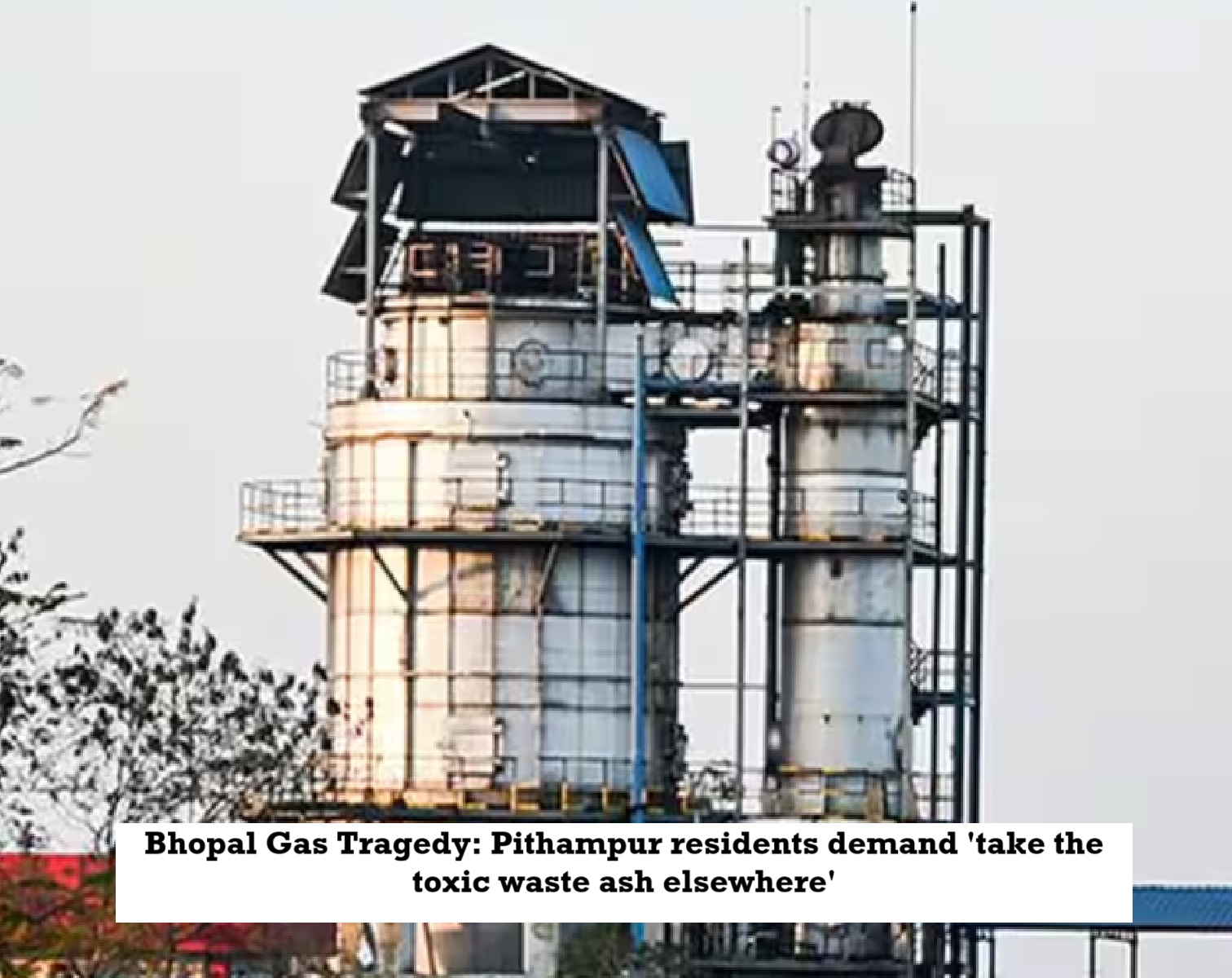
News Topical, Digital Desk : Today (December 3) marks the 41st anniversary of the Bhopal gas tragedy. Residents of Pithampur have demanded that the state government dispose of the approximately 900 tons of ash generated after the Union Carbide factory's toxic waste was incinerated at a waste disposal plant in the industrial area.
According to officials, the ash is currently safely stored in a leak-proof storage shed at a plant in Pithampur. They said the plant completed the incineration of a total of 358 tons of the consignment, including 337 tons of toxic waste from the Union Carbide factory, 19 tons of contaminated soil, and 2.2 tons of packaging material, in stages, in early July this year.
Serious damage can be caused to the environment
According to officials, the state government had planned to dispose of the ash by dumping it into a special multi-layered landfill cell under construction at the Pithampur plant. Local residents are now expressing concerns about the ash's aftermath after it is burned. They argue that the toxic ash from the Union Carbide factory should be disposed of in a remote location rather than at the Pithampur plant, as any disruption to the landfill cell could cause serious damage to human populations and the environment.
' The ashes of the garbage should be taken somewhere else '
This plant in Madhya Pradesh's Dhar district is adjacent to Tarpura village in the Pithampur industrial area. Prakash Sarkate, who has lived in the village of about 20,000 for nearly 30 years, told PTI that his home is just 500 meters from the plant. He said, "We demand that the government, in response to public concerns, remove the Union Carbide waste ash from the plant adjacent to our village and relocate it."
Sarkate said that the local people had also strongly opposed the burning of Union Carbide waste at its Pithampur plant, but it did not yield any results.
The villagers often suffer from colds and flu.
Nirmala Panwar, who also lives in Tarpura, claimed that villagers often suffer from colds, fevers, and eye irritation. " We don't drink water from the water sources near our homes," the villager said. "The water looks dirty, and drinking it causes sore throats."
Waste from the Union Carbide factory in Bhopal, which has been closed since the gas tragedy, was transported to the Pithampur plant, about 250 kilometers from the state capital, on January 2. This led to several protests in Pithampur.
State Pollution Control Board officials claim that while burning the Union Carbide factory waste, the emissions from the plant were found to be within the standard limits of particulate matter, sulphur dioxide, carbon monoxide, hydrogen sulphide, hydrogen fluoride and oxides of nitrogen as well as mercury, cadmium and other heavy metals.
The matter of disposal of Union Carbide waste at the Pithampur plant is pending in the Madhya Pradesh High Court and the disposal process is being carried out under court supervision.
On October 8, the Jabalpur-based principal bench of the High Court had rejected the proposal to dispose of the waste ash in the 'landfill cell' being built on the premises of the plant, saying that the unit is very close to human habitation and the current disposal site of toxic ash near human habitation is not acceptable to this court.
In its order, the court cited an interim application from an intervener, who stated that tests had found mercury levels in the ash to be above permissible limits. The high court also directed the state government to submit a report outlining alternative sites for the disposal of the ash.
Pithampur social activist Anil Dwivedi said, "We want the state government to follow the court's directive. Instead of the Pithampur plant, Union Carbide's waste ash should be disposed of at a location where there is no risk of harm to the human population or the environment."
The Bhopal disaster was a highly toxic gas leak from the Union Carbide factory on the night of December 2-3, 1984. At least 5,479 people were killed and thousands more were maimed. It is considered one of the world's worst industrial disasters.
--Advertisement--