







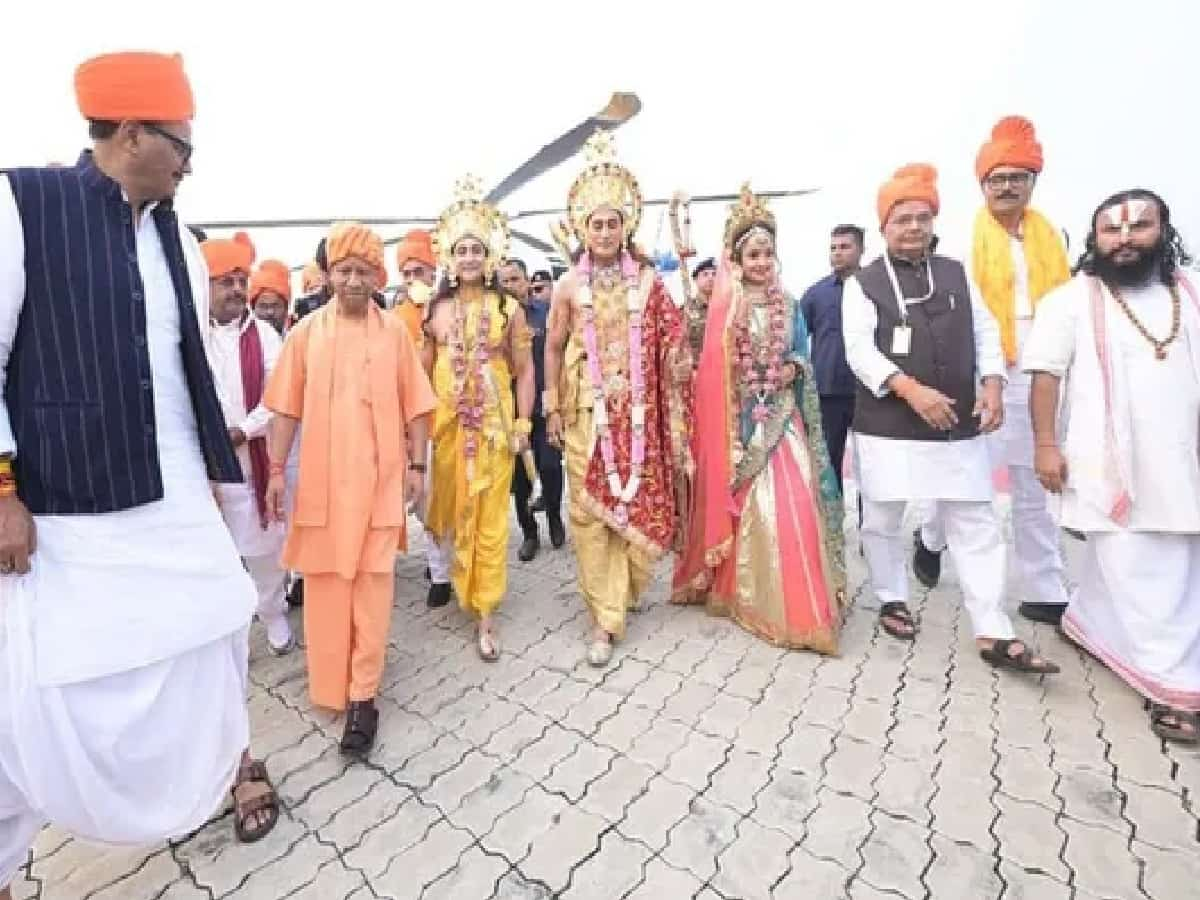
CM Yogi Welcomes Lord Ram from Pushpak Viman at Ayodhya Deepotsav
The banks of the holy Saryu River transformed into a vibrant tableau of spiritual fervor on Saturday, November 7, 2026, as the ancient city of Ayodhya brought to life the legendary homecoming of Maryada Purushottam Shri Ram. Against the backdrop of the landmark tenth edition of Deepotsav, the temple town witnessed the symbolic descent of Lord Ram, Mata Sita, Lakshman, and Lord Hanuman from a decorated helicopter representing the mythical Pushpak Viman. Standing at the riverfront landing site with hands folded in deep reverence, Uttar Pradesh Chief Minister Yogi Adityanath received the divine entourage, formally welcoming them with traditional garlands and vermilion tilak amidst deafening chants of "Jai Shri Ram" echoing from thousands of pilgrims, sadhus, and devotees. The ceremonial reenactment marked the emotional peak of the daytime festivities, setting the stage for an evening that saw the sacred city illuminated by millions of flickering earthen lamps.
The Symbolic Descent: Pushpak Viman Lands Along the Saryu
The ceremonial arrival revived the pivotal episode of the Valmiki Ramayana, wherein Lord Ram returns triumphant to Awadhpuri following his fourteen-year forest exile and the vanquishing of the demon king Ravana. As the specialized aircraft hovered over the city and touched down near the Saryu riverfront, the atmosphere turned electric with devotional intensity. Devotees waving saffron flags, elderly pilgrims with folded hands, and ascetics from historic akharas watched as artists embodying the sacred quartet stepped out onto the sacred soil of Ayodhya.
Chief Minister Yogi Adityanath stepped forward onto the reception carpet to perform the traditional state welcome. Bowing before the artists depicting Lord Ram, Mata Janaki, Lakshman, and Bajrangbali, Adityanath applied the auspicious sandalwood and vermilion tilak to their brows, offered fresh yellow marigold garlands, and presented them with ceremonial shawls. The arrival was greeted by showers of rose and marigold petals released over the staging area, creating a visual spectacle that evoked the ancient Treta Yuga. For the vast congregation lining the riverbanks, the ritual ceremony served as an emotional reminder of Ayodhya’s civilizational identity and its foundational history of righteousness and filial duty.
Pulling the Ram Rath: A Gesture of Reverence Alongside Seers
Following the formal reception, the divine figures were escorted to the majestic Ram Rath—a grand chariot decorated with fresh floral garlands, traditional brass bells, and golden silks. In a moment that resonated deeply across the gathered crowd, Chief Minister Adityanath stepped alongside leading mahants and spiritual heads to take the chariot's heavy ropes into his own hands. Walking barefoot alongside revered saints, the Chief Minister personally helped pull the Ram Rath through the ceremonial pathway leading toward Ramkatha Park.
The procession moved through lanes enveloped in the fragrance of incense and the sound of blowing conch shells. As the chariot advanced, helicopters and elevated platforms showered rose petals over the procession, coating the path in crimson and yellow blossoms. The sight of the state's administrative head joining ascetic masters in pulling the holy chariot was widely embraced by devotees as a powerful symbol of spiritual humility and cultural solidarity. Vedic chants recited by temple scholars intertwined with classic Awadhi bhajans, creating an immersive acoustic environment where the sacred name of Ram resonated across the banks of the Saryu.
Devotion at Ramkatha Park: Honoring Ayodhya's Spiritual Guardians
The grand yatra culminated at Ramkatha Park, where a multi-tiered stage had been erected to receive the deities. Once Lord Ram, Mata Sita, Lakshman, and Hanuman ji were seated on the royal throne of the Ram Darbar, the gathering rose in unison to witness the formal proceedings. The Chief Minister turned his attention to the large assembly of saints, sadhus, and mahants who had gathered in front of the royal stage. Walking down to the front enclosure, Adityanath bowed before the senior leaders of Ayodhya's historic Vaishnava mutts and akharas, congratulating them on the auspicious occasion and offering traditional greetings.
The interaction underscored the symbiotic partnership between the state administration and the monastic community that has preserved Ayodhya's sacred heritage through centuries of adversity. Seers from Sugriva Fort, Haridham Peeth, Udasin Ashram, and Bawan Ji Temple bestowed their blessings on the proceedings, commending the governance model that has revived the cultural dignity of Awadhpuri. The atmosphere within the pavilion was charged with spiritual joy as thousands of devotees remained fixed on the royal dais, taking in the sight of the Ram Darbar amidst the rhythmic beating of traditional nagadas and temple bells.
Visualizing the Ramayana: The Tourism Department Photo Exhibition
Prior to participating in the chariot procession, Chief Minister Adityanath spent considerable time inspecting a curated exhibition and photo gallery organized by the Uttar Pradesh Department of Tourism. Set up adjacent to the main festival grounds, the pavilion showcased artistic works, high-definition photography, and traditional paintings capturing significant milestones from the seven kandas of the Ramayana.
Walking through the curated galleries, the Chief Minister observed detailed visual depictions that brought to life the virtues of truth, sacrifice, and governance embodied by Lord Ram. The exhibition traced the epic journey from Ram’s divine birth in Ayodhya to the forest exile, the alliance with Sugriva in Kishkindha, the construction of the ocean bridge, and the final coronation in Awadhpuri. Adityanath commended the artists and cultural historians for presenting the moral philosophy of the epic in an accessible, visually compelling format designed to educate younger generations about India’s rich literary and philosophical traditions.
Awadhpuri on the Global Stage: Cultural Renaissance of Ramnagari
The pageantry of the Pushpak Viman and the Ram Rath yatra forms the cultural cornerstone of an Ayodhya that is steadily asserting itself as an international spiritual hub. Under the leadership of Chief Minister Yogi Adityanath and the double-engine governance framework, Deepotsav has expanded far beyond a municipal festival, evolving into an internationally celebrated event that attracts foreign diplomats, international Ramlila troupes, and pilgrims from around the world. The daytime festivities served as a prelude to the evening's main event: the simultaneous lighting of over 30 lakh earthen lamps across 56 ghats along the Saryu, complemented by synchronized laser projections and an aerial display featuring over 2,100 indigenous drones.
Beyond the grand spectacles and world-record numbers, the emotional response to Saturday’s events demonstrates that Lord Ram remains the cultural heartbeat and ethical compass of the Indian subcontinent. By harmonizing ancient religious rituals with massive infrastructure expansion—from four-lane arterial roads like Ram Path to the Maharishi Valmiki International Airport—the state administration has restored the physical and spiritual splendor of Awadhpuri. As twilight gave way to the golden glow of millions of clay lamps, the city of Ayodhya offered a living testament that its civilizational heritage, preserved through millennia, continues to illuminate the global stage with timeless values of righteousness, unity, and hope.




