







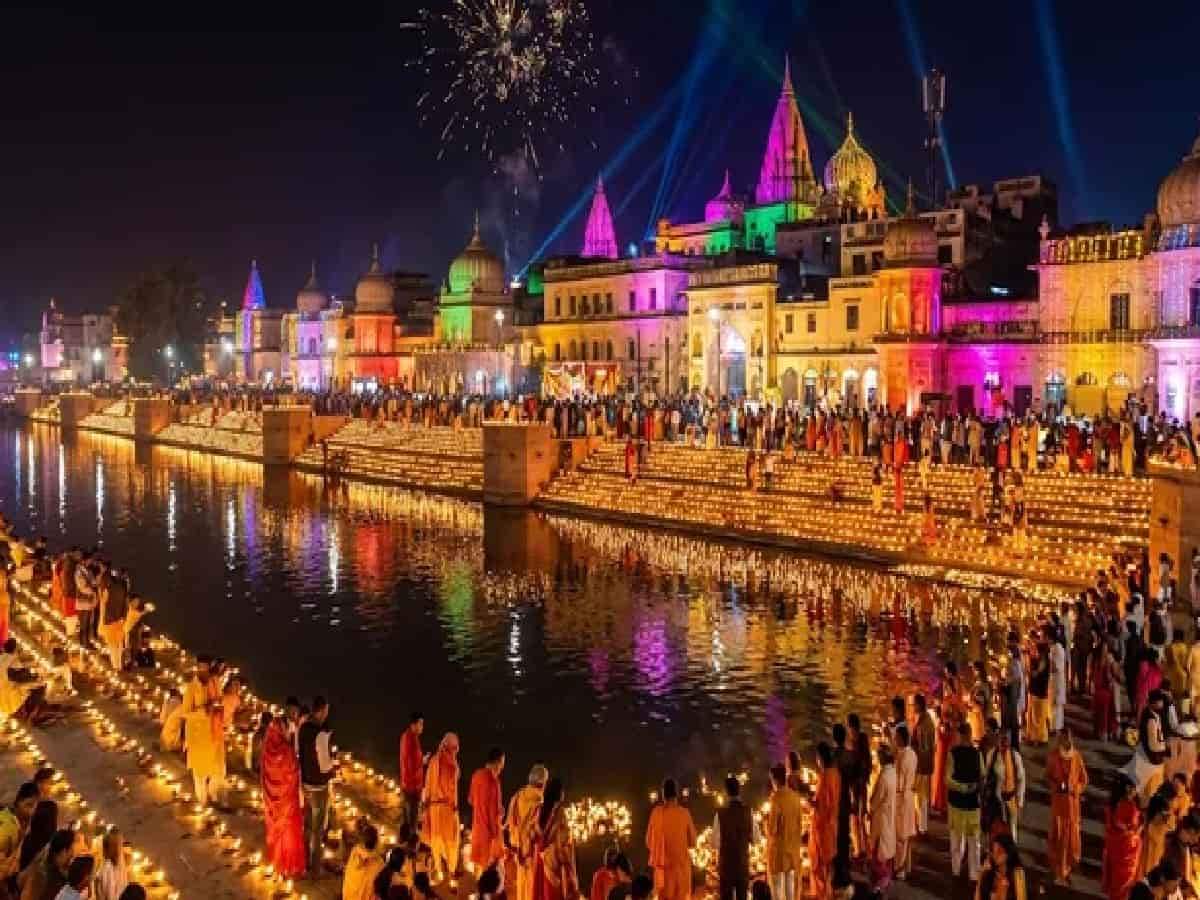
Ayodhya Deepotsav: 3 Million Diyas to Recreate Treta Yuga Glory
The sacred city of Ayodhya is set to recreate the celestial grandeur of the Treta Yuga on Saturday, November 7, 2026, as the tenth edition of its historic Deepotsav unfolds across the banks of the holy Saryu River. Transforming into an illuminated amphitheater of faith, heritage, and state-of-the-art visual artistry, the ancient pilgrimage center will witness the simultaneous lighting of more than 30 lakh (3 million) earthen lamps across 56 riverfront ghats. Vice President C.P. Radhakrishnan and Uttar Pradesh Chief Minister Yogi Adityanath will lead the proceedings, welcoming Lord Shri Ram, Mata Sita, and Lakshman upon their symbolic return from 14 years of exile. Accompanied by Deputy Chief Ministers Keshav Prasad Maurya and Brajesh Pathak, alongside union and state dignitaries, the leaders will perform the ceremonial Rajyabhishek (coronation) and a grand Maha Aarti at Ramkatha Park, signaling the beginning of a celebration that projects India's civilizational legacy onto the global stage.
Recreating Treta Yuga: Pushpak Viman and Ram's Royal Coronation
The centerpiece of Saturday’s festivities is the dramatic reenactment of Lord Ram’s triumphant homecoming to Awadhpuri following the vanquishing of Ravana. At the main stage erected in Ramkatha Park, a specialized state helicopter symbolizing the mythical aerial chariot, the Pushpak Viman, will touch down carrying artists portraying Lord Ram, Mata Janaki, and Lakshman. Upon their descent, Chief Minister Yogi Adityanath and Vice President C.P. Radhakrishnan will formally receive the divine entourage, garlanding them with sacred yellow stoles, washing their feet in a traditional ritual of reverence, and pulling the ceremonial chariot toward the royal dais.
Following time-honored Vedic protocols conducted by senior priests of the Ayodhya monastic fraternity, the dignitaries will perform the Rajyabhishek, placing the royal crown upon Lord Ram’s brow amidst the blowing of conch shells, beating of traditional drums, and Vedic chantings. Both the Vice President and the Chief Minister will perform the royal aarti, anointing the deities with fragrant sandalwood paste, unbroken rice grains, and rose water. The ceremony revives the foundational episode of the Valmiki Ramayana, symbolizing the restoration of ethical governance, righteousness, and collective harmony across the state and the country.
3 Million Earthen Lamps Across 56 Saryu River Ghats
As twilight settles over the temple town, Ayodhya will set another global benchmark by illuminating over 30 lakh earthen lamps across 56 designated ghats along the Saryu, with the primary concentration gracing Ram Ki Paidi. Coordinated by Dr. Ram Manohar Lohia Avadh University in conjunction with local youth associations, the National Cadet Corps (NCC), and community non-profits, over 35,000 volunteers have meticulously measured, laid out, and primed the lamps with pure mustard oil and handmade cotton wicks. The synchronized lighting process, scheduled to begin in the early evening, will transform the riverbanks into a continuous ribbon of golden light stretching across several kilometers.
Simultaneously, the sanctified grounds of the grand Shri Ram Janmabhoomi Mandir will be illuminated with more than one lakh special lamps, casting a warm glow over its carved pink sandstone architecture. The event will be closely monitored by official observers from Guinness World Records, who have deployed drone mapping and spot verification grids to document the milestone. Beyond the statistical achievement, the procurement of millions of lamps has provided direct economic livelihood to rural potter communities (kumhars) across the Awadh region, turning the celebration into a self-reliant economic engine that empowers local craftsmen.
Saryu Maha Aarti: 2,147 Women in Yellow and Ramayana Tableaux
The visual splendor of the riverbank will be heightened by a choreographed Saryu Maha Aarti. On Saturday evening, 2,147 women and young girls, dressed in traditional yellow (pitambari) attire, will assemble along the waterfront to perform the multi-tiered river aarti alongside the Chief Minister and visiting dignitaries. The color yellow, traditionally associated in Hindu philosophy with wisdom, knowledge, and the planet Jupiter (Brihaspati), creates a unified visual aesthetic across the riverfront, highlighting women-led participation in the state’s cultural preservation.
Complementing the riverside rituals is a vibrant cultural procession featuring 21 large-scale mechanical and artistic tableaux (jhankis). Originating from Saket College and traversing the newly renovated Ram Path toward Ramkatha Park, the floats depict key narratives from the Ramayana, including the childhood of the four brothers, Sita Swayamwar, the construction of Ram Setu, and the epic battle of Lanka. Each tableau blends classical scriptural art with modern developmental themes, illustrating Uttar Pradesh’s infrastructure expansion, clean energy initiatives, and rural women's empowerment alongside its ancient civilizational heritage.
High-Tech Meets Tradition: 2,100 Drones and 220-Ton Sand Art
While Deepotsav remains grounded in ancient rituals, the 2026 edition incorporates advanced multimedia technology to engage modern audiences. Over 2,100 indigenous Indian drones will lift off simultaneously into the night sky above Ram Ki Paidi, performing a coordinated aerial light show. The drones will dynamically map scenes from the Ramayana directly onto the night canvas, forming intricate celestial portraits of Lord Ram wielding his bow, the loyal devotee Hanuman carrying the Sanjeevani mountain, and the newly constructed Ram Janmabhoomi temple.
Supplementing the aerial spectacle is an architectural 3D laser-mapping projection that will illuminate the facade of Ram Ki Paidi and surrounding heritage ghats, projecting high-definition animations of Treta Yuga history accompanied by traditional symphonic scores. Nearby at Ramkatha Park, devotees will encounter a monumental Ram Darbar sand sculpture crafted by renowned sand artists using 220 tons of fine sand. The artwork, which depicts Lord Ram flanked by Janaki, Lakshman, Bharat, Shatrughna, and Hanuman, serves as a major photographic and devotional attraction for visiting pilgrims.
Cultural Universality: 151-Year-Old Sahibganj Ramlila and Global Troupes
Deepotsav 2026 also emphasizes the cultural continuity and global relevance of the Ramayana tradition. For the very first time on the Ayodhya stage, artists will present the historic 151-year-old Sahibganj Ramlila, bringing a century-and-a-half-old theatrical heritage from eastern India to the heart of Awadh. The performance showcases archaic folk dialogue, traditional stagecraft, and ancestral musical arrangements preserved through multiple generations of rural performers.
Underscoring the international resonance of the epic, cultural delegations and theater ensembles from Southeast Asian and neighboring countries—including Thailand, Indonesia, Sri Lanka, and Nepal—will stage their own classical adaptations of the Ramayana. The Thai Khon masked dance and Indonesian shadow-puppetry interpretations demonstrate how the teachings of Lord Ram transcend national and linguistic boundaries, illustrating the ancient diplomatic and cultural ties linking India with the wider maritime world.
Awakening Awadhpuri: Spiritual Rejuvenation and Economic Transformation
The comprehensive scale of the tenth Deepotsav illustrates how Ayodhya has evolved over the past decade from a quiet district center into an international spiritual destination. Through major infrastructure upgrades like Ram Path, Bhakti Path, the Maharishi Valmiki International Airport, and upgraded rail links, the city now seamlessly welcomes millions of pilgrims each year.
As the first flames are lit on Saturday morning and continue through the nighttime spectacle, the message emanating from the banks of the Saryu is one of unity, cultural revival, and forward-looking economic vitality. By harmonizing ancient devotional practices with modern civic planning, sustainable local trade, and high-tech storytelling, Ayodhya’s Deepotsav 2026 demonstrates that the ideals of Ramrajya—rooted in compassion, duty, and shared prosperity—remain deeply relevant to modern India.




