







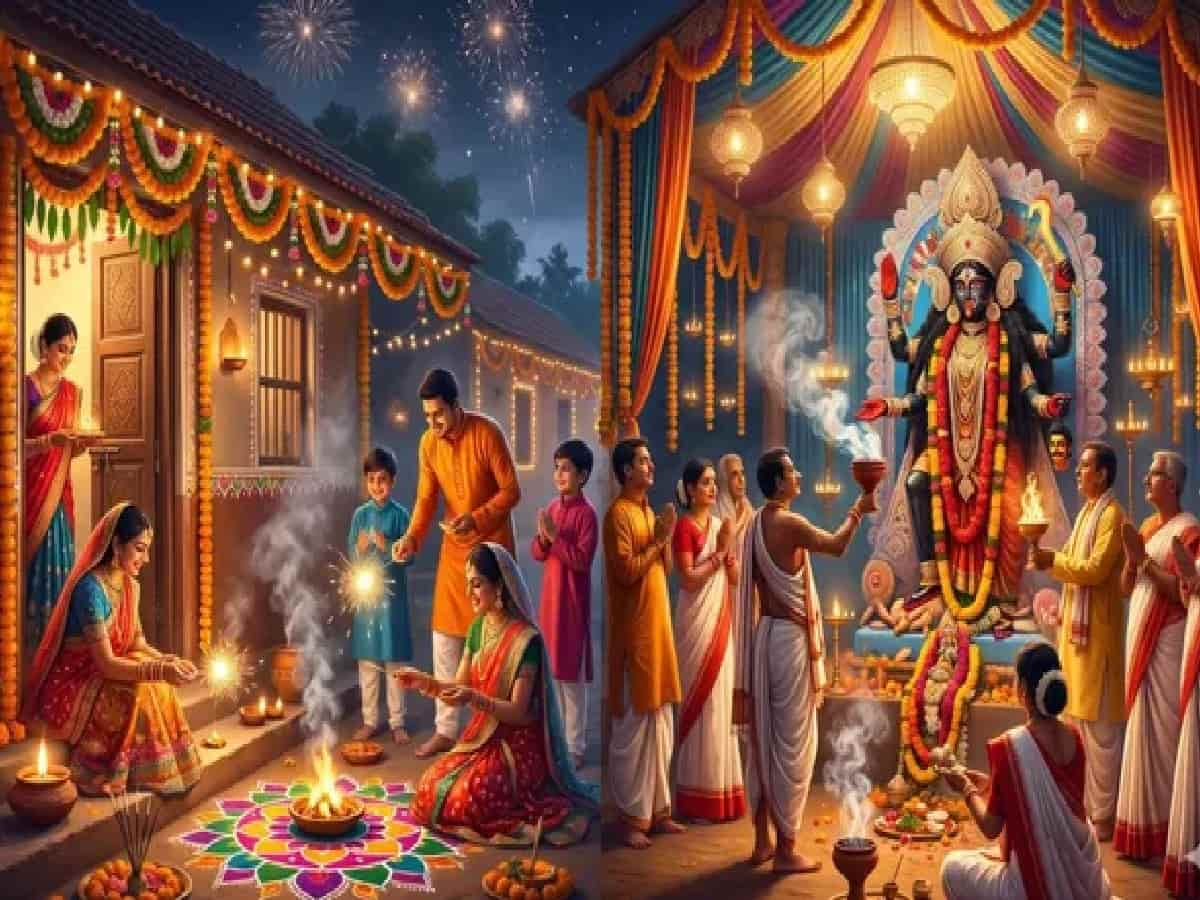
Kali Chaudas vs Kali Puja: Meaning, Dates, and Rituals Explained
As the sacred month of Kartik culminates in the five-day festival of lights, Indian households prepare for some of the most spiritually charged nights of the Hindu calendar. While the vast majority of Northern, Central, and Southern India gears up to welcome Goddess Lakshmi and Lord Ganesha into illuminated courtyards on Diwali night, millions of devotees across Western and Eastern India observe powerful rites dedicated to the fierce goddess of time and transformation, Mahakali. However, across regional boundaries, there is frequent confusion regarding two major observances: Kali Chaudas, celebrated predominantly in Gujarat, Maharashtra, and Rajasthan, and Kali Puja (also revered as Shyama Puja), which transforms the cultural landscape of West Bengal, Assam, and Odisha. Though both traditions venerate the same supreme manifestation of Adi Parashakti, they differ significantly in their astrological tithis, underlying mythologies, spiritual objectives, and ritualistic temperaments. While one tradition focuses on warding off negative energies and evil spirits, the other celebrates the cosmic manifestation of the Divine Mother.
Tithi and Timing: Kartik Krishna Chaturdashi vs Amavasya
The foundational divergence between the two sacred observances begins with the Hindu lunar calendar (Panchang), specifically the division between the fourteenth day of the waning moon and the subsequent new moon night. Kali Chaudas is observed on Kartik Krishna Chaturdashi, the fourteenth lunar day of the dark fortnight, which coincides with Narak Chaturdashi or Chhoti Diwali. In contrast, the grand ceremonial worship of Kali Puja in Bengal takes place on Kartik Amavasya, the deepest new moon night of the year, precisely when other regions conduct Lakshmi Puja.
For the festive calendar of 2026, this calendar distinction places Kali Chaudas on Saturday, November 7, followed by Bengal's Kali Puja on Sunday, November 8. Astrologically, both rituals are conducted during Nishith Kaal—the profound midnight window considered most receptive to Tantric sadhana and divine invocation. However, the energy associated with Chaturdashi leans toward cleansing, protection, and defensive spiritual shielding, whereas the Amavasya night is revered as the ultimate threshold of cosmic dissolution and re-creation, providing the metaphysical stage for Goddess Kali's supreme appearance.
Kali Chaudas in Western India: Warding Off Evil Spirits and Ghosts
In Western India, particularly across Gujarat, Rajasthan, and parts of Maharashtra, Kali Chaudas is traditionally observed as a night of spiritual fortification and protection against unseen negative influences. Folk tradition and esoteric texts associate the night of Chaturdashi with heightened supernatural activity, where wandering souls, malevolent entities, and negative energies are believed to move close to the earthly realm. Consequently, the primary objective of Kali Chaudas rituals is to establish psychic boundaries, neutralize ancestral afflictions, and seek immunity from malefic forces.
On this evening, families prepare traditional offerings of sesame seeds, puffed rice, sweets, and mustard oil lamps, placing them at crossroads, thresholds, or quiet outdoor perimeters to appease ancestral spirits and ward off evil omens. It is also customary to apply homemade kajal (kohl)—derived from the soot of a mustard oil diya lit before Mahakali—to children's eyes to protect them from the evil eye (nazar dosha). In several Gujarati communities, devotees worship Lord Hanuman alongside Mahakali, reciting the Hanuman Chalisa or Sunderkand to invoke unwavering courage against fear. Among practitioners of Tantra, this night holds significant importance for esoteric sadhanas conducted near riverbanks, crossroads, or cremation grounds (shamshan), aimed at subduing negative planetary influences and mastering the mystical elements symbolized by the Veer and Vetala.
Bengal’s Grand Kali Puja: Celebrating the Cosmic Mother’s Manifestation
Shift thousands of kilometers east to the plains of West Bengal, and the atmosphere shifts from defensive caution to ecstatic devotional reverence. In Bengali culture, the new moon of Diwali is not dedicated to the quiet invocation of wealth via Goddess Lakshmi, as Lakshmi is formally worshipped earlier during Kojagari Purnima. Instead, the entire Diwali festival in Bengal is dedicated to Shyama Kali, the compassionate yet formidable protector of the universe.
The historical foundation of public Kali Puja in Bengal traces back to the 18th century, championed by spiritual luminaries such as Krishnananda Agambagisha, composer Ramprasad Sen, and Maharaja Krishnachandra of Nadia, before being elevated to international prominence through the teachings of Sri Ramakrishna Paramahamsa and Swami Vivekananda. Mythologically, Amavasya marks the cosmic moment when Goddess Kali manifested in her four-armed, terrifying form—standing atop Lord Shiva with her tongue outstretched, brandishing a curved scimitar and a severed demon head—to annihilate the demonic forces that threatened the cosmic order. In cities like Kolkata, Howrah, and Barasat, the night is celebrated with sprawling artistic pandals, monumental idols of Dakshina Kali, fireworks, night-long community feasts (bhog of khichuri and labra), and Vedic-Tantric rituals that honor the goddess as the supreme mother who destroys ego and fear.
Bhoot Chaturdashi: The Connecting Thread of the 14 Diyas
Despite their distinct theological nuances, Eastern and Western traditions share a fascinating cultural link on the night of Chaturdashi. In West Bengal, the eve of Kali Puja is celebrated as Bhoot Chaturdashi. While the name explicitly references ghosts and ethereal spirits, the Bengali observance carries a tender ancestral dimension.
According to Bengali tradition, the veil between the physical realm and the ancestral sphere (Pitru Loka) thins dramatically on Kartik Chaturdashi. Families believe that fourteen generations of departed ancestors visit their earthly descendants on this night. To guide these souls home and prevent malevolent spirits from entering the household, families light exactly fourteen earthen lamps (Choddo Prodeep) and place them in every corner of the dwelling. Concurrently, tradition mandates the consumption of fourteen distinct leafy seasonal greens (Choddo Shaak), a ritual deeply rooted in Ayurvedic immunity-building during the seasonal transition from autumn into winter. This dual focus on dispelling darkness and honoring forebears demonstrates how ancient communities across both east and west recognized the liminal, spiritual intensity of this specific lunar day.
Spiritual Synthesis: Transforming Fear into Divine Grace
Ultimately, examining the differences between Kali Chaudas and Kali Puja reveals the multifaceted depth of Indian spiritual heritage. Where Western Indian traditions approach the fierce feminine principle through the lens of protection, spiritual shielding, and the dispelling of fear, the Eastern Shakta school embraces that exact same ferocity as the boundless love of a mother defending her creation. The outward differences in customs—from the talismanic soot of Gujarat to the grand temple pandals of Kolkata—reflect localized pathways leading toward the same metaphysical truth.
Whether lighting a single lamp to dispel negative energies on Saturday’s Kali Chaudas or offering hibiscus flowers at midnight during Sunday’s Kali Puja, both celebrations guide the seeker toward inner liberation. Mahakali represents Kala—the inexorable march of time that consumes all worldly illusions—and Abhaya, the divine assurance of fearlessness. By confronting the deepest darkness of the Kartik night with prayer, self-discipline, and light, devotees across India transform dread into spiritual clarity, preparing the soul to welcome the new year with renewed purity and moral resolve.




