desk
desk Share
Share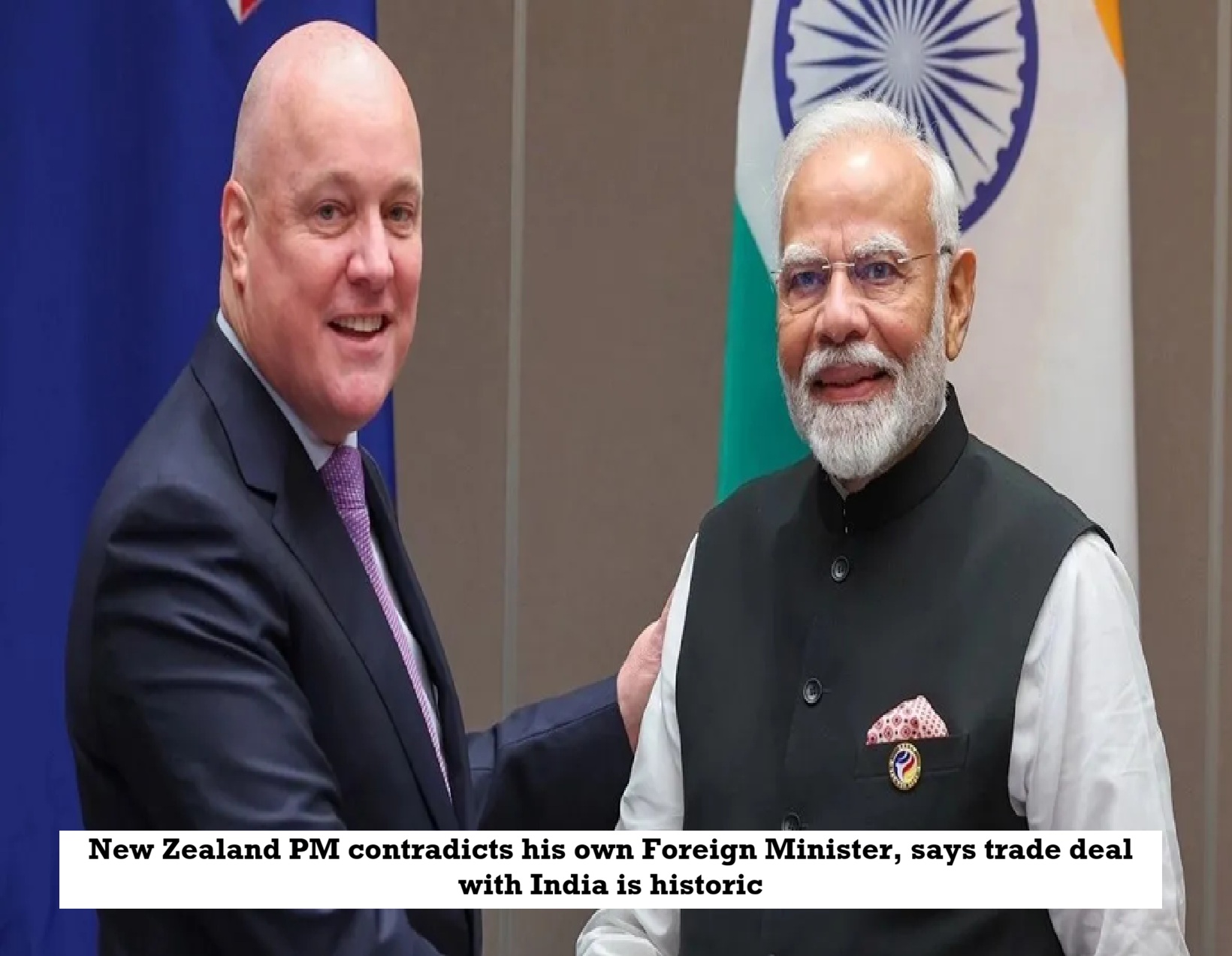
News Topical, Digital Desk : A free trade agreement has been reached between India and New Zealand. Recently, Prime Minister Modi sealed the FTA deal with New Zealand over a phone call. Meanwhile, New Zealand Prime Minister Christopher Luxon has called the free trade agreement with India a landmark deal.
He also said that this deal between the two countries means more jobs and greater income. He also said that the new FTA deal will also enable greater exports from Indian markets.
What did New Zealand PM say on FTA?
"We said we would have a free trade agreement with India in my first term, and we've delivered," the New Zealand PM wrote on the social media platform X. “This landmark deal means more jobs, more income, and more exports, opening the door to 1.4 billion Indian consumers.”
Talks on FTA were made between the two countries this month.
It is noteworthy that on December 22nd, India and New Zealand signed a comprehensive, balanced, and forward-looking Free Trade Agreement (FTA). This represents a major economic and strategic milestone in India's engagement with the Indo-Pacific region.
This FTA is considered one of India's fastest-completed FTAs, aligned with the national vision of a Developed India 2047. Negotiations officially began on March 16th, 2025, during a meeting between Commerce and Industry Minister Piyush Goyal and New Zealand's Trade and Investment Minister Todd McClay.
New Zealand's Foreign Minister had expressed objection
However, New Zealand Foreign Minister Winston Peters had strongly criticised the recently announced India-New Zealand Free Trade Agreement (FTA), calling it neither free nor fair.
He said that while New Zealand would fully open its market to Indian products, India had not agreed to reduce significant tariffs on New Zealand's key dairy exports. He described this outcome as indefensible to farmers and rural communities, saying, "Unfortunately, this is a bad deal for New Zealand."
What is FTA?
It is noteworthy that the FTA creates a high-quality economic partnership that boosts employment, facilitates skill mobility, enhances growth through trade and investment, promotes innovation for agricultural productivity, and increases the participation of MSMEs to strengthen long-term economic resilience.
This FTA eliminates 100 percent of tariff lines in trade between the two countries, providing duty-free access to all Indian exports. According to the Indian Commerce Ministry, this market access will enhance the competitiveness of India's labor-intensive sectors such as textiles, apparel, leather, footwear, marine products, gems and jewelry, handicrafts, engineering goods, and automobiles, directly supporting Indian workers, artisans, women, youth, and MSMEs, and integrating them more deeply into global value chains
Read More: 'No Iranian ship will be able to leave,' JD Vance warns Tehran
--Advertisement--