







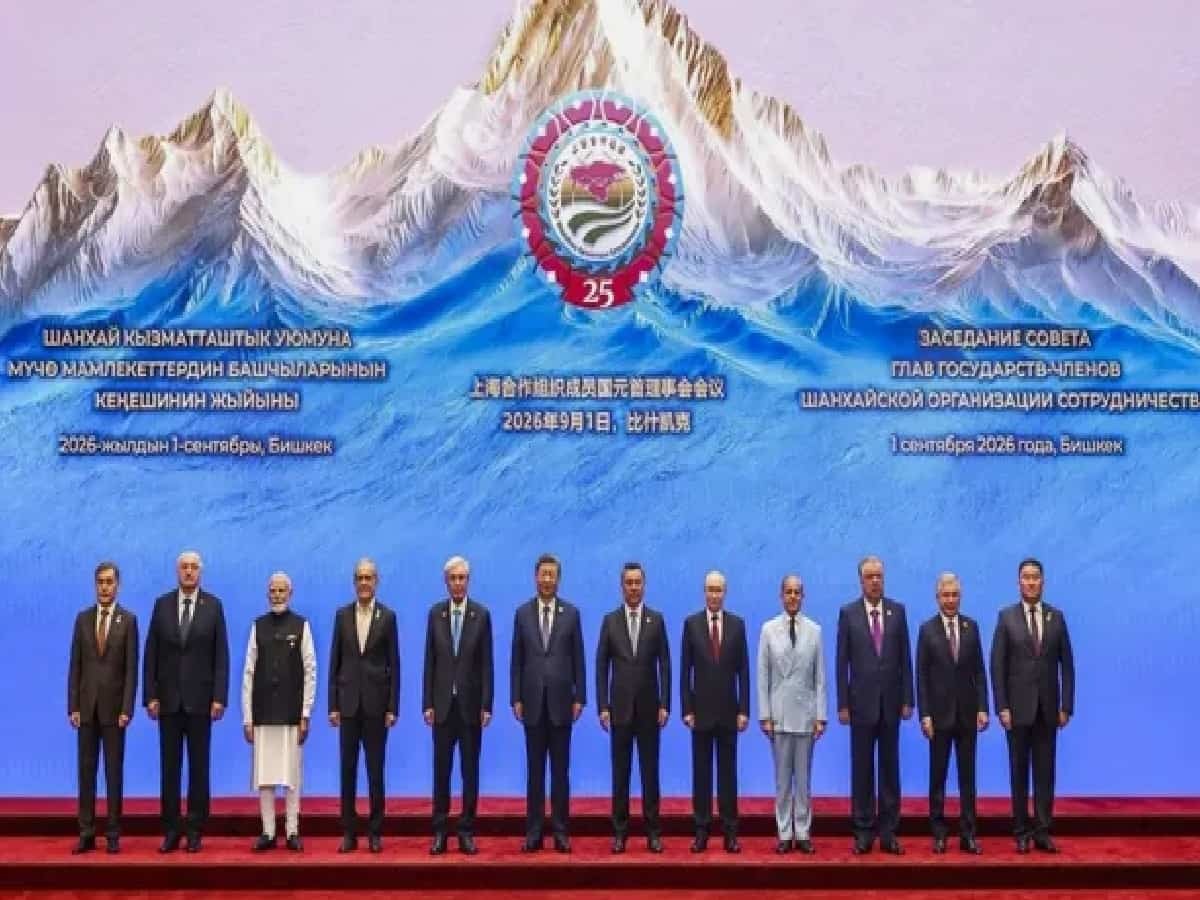
'What Changed Since Pahalgam' Congress Slams Pak Invite to Delhi SCO Meet
A fierce political row has erupted in New Delhi after Pakistan formally accepted India's invitation to participate in the inaugural Shanghai Cooperation Organisation (SCO) Civilisational Dialogue Forum, scheduled to be hosted by India at the historic Purana Qila in New Delhi from November 20 to 22, 2026. Over the weekend, Islamabad announced that its Minister for Climate Change, Musadik Malik, will travel to the Indian capital to represent Pakistan at the three-day multilateral cultural gathering—marking the first ministerial-level visit from Pakistan to India in more than three years, and the first since last year's deadly Pahalgam (Baisaran) terror attack and India's subsequent military retaliation under Operation Sindoor. While New Delhi has maintained that invitations were extended to all SCO member states in accordance with established multilateral protocol, the development triggered sharp criticism from the opposition Congress party. Senior Congress MP Manish Tewari questioned what had fundamentally changed on the ground since innocent civilians were targeted and killed in the name of religion at Baisaran in Pahalgam, asserting that Pakistan has taken zero credible action to dismantle cross-border terrorist infrastructure. Former External Affairs Minister Salman Khurshid echoed the critique, accusing the central government of lacking clarity and consistency in its foreign policy toward Islamabad. In response, Bharatiya Janata Party (BJP) leaders and Union Culture and Tourism Minister Gajendra Singh Shekhawat defended multilateral engagement under the SCO banner, noting that Pakistan separated from the Indian subcontinent less than eight decades ago in 1947 and shares a common civilizational evolution, even as BJP veteran Dilip Ghosh warned that Islamabad must abandon terrorism for its own survival. For citizens, strategic affairs observers, and political watchers across New Delhi, Lucknow, Kanpur, Varanasi, Prayagraj, Srinagar, Jammu, Chandigarh, Mumbai, Bengaluru, and Kolkata, the controversy underscores the delicate balance between India's multilateral obligations within the SCO and domestic demands for accountability on cross-border terrorism.
Congress Questions Centre's Pakistan Policy After Pahalgam and Operation Sindoor
Leading the opposition charge, Lok Sabha MP Manish Tewari acknowledged that the SCO is a multilateral forum where member nations routinely send representatives, but argued that New Delhi cannot treat diplomatic engagement with Islamabad as business as usual following the Pahalgam terror attack. "From that Baisaran incident until now, what has actually changed? Has any action been taken against the terrorist infrastructure that Pakistan has woven within its own borders? Absolutely not," Tewari told reporters, stressing that India's core demand—an immediate halt to state-sponsored cross-border terrorism—remains completely unaddressed.
Former External Affairs Minister Salman Khurshid similarly criticized the government's approach, stating that the Centre's policy on Pakistan appears ambiguous and inconsistent. Khurshid argued that the government must articulate a transparent, coherent doctrine regarding when and how it chooses to engage Islamabad so that Parliament and the nation can evaluate its diplomatic stance clearly.
How the BJP and Union Culture Minister Defended the Multilateral SCO Invite
Responding to the opposition's attack, Union Culture and Tourism Minister Gajendra Singh Shekhawat—whose ministry is jointly organizing the SCO Civilisational Dialogue Forum with the Ministry of External Affairs following Prime Minister Narendra Modi's proposal at the 2025 Tianjin SCO Summit—explained that invitations were issued across the board to all 10 permanent SCO members and dialogue partners. Addressing media queries ahead of the Purana Qila event, Shekhawat remarked that Pakistan came into existence less than 80 years ago after the 1947 Partition and evolved out of the same civilizational matrix, leaving little room for civilizational divergence despite bilateral geopolitical disputes.
| Key Stakeholder / Dimension | Official Position & Recent Developments |
| Event & Venue | Inaugural SCO Civilisational Dialogue Forum at Purana Qila, New Delhi (November 20–22, 2026); inaugurated by PM Narendra Modi |
| Pakistan's Delegation | Climate Change Minister Musadik Malik confirmed to attend—first Pakistani ministerial visit to India since May 2023 and post-Operation Sindoor |
| Congress Critique (Manish Tewari & Salman Khurshid) | Questioned what changed since the Pahalgam (Baisaran) terror attack; accused Centre of lacking a clear policy on Pakistan while terror infrastructure persists |
| Government & BJP Response | Gajendra Singh Shekhawat cited multilateral SCO protocol and shared pre-1947 heritage; Dilip Ghosh warned Pakistan to abandon terrorism or face internal collapse |
| Broader SCO Context | Pakistan holds the 2026–27 SCO rotating chair; India's SCO National Coordinator Alok Dimri visited Islamabad in September 2026 for preparatory talks |
Meanwhile, BJP leader Dilip Ghosh hit back at both the opposition and Islamabad, stating that abandoning terrorism is in Pakistan's own interest and pointing out that militant groups nurtured by Pakistan are now attacking Pakistani police stations and military personnel, leaving the country gripped by lawlessness and economic flight.
Understanding the Shanghai Cooperation Organisation (SCO) and Bilateral Protocol
Founded in 2001 in Shanghai by Russia, China, Kazakhstan, the Kyrgyz Republic, Tajikistan, and Uzbekistan, the Shanghai Cooperation Organisation (SCO) expanded in 2017 to admit both India and Pakistan as full permanent members (later joined by Iran and Belarus). Because SCO rules require host nations to invite all member states to official bloc events, multilateral engagement has occasionally continued despite frozen bilateral ties—including External Affairs Minister S. Jaishankar's visit to Islamabad for the SCO Council of Heads of Government meeting in October 2024 and SCO National Coordinator Alok Dimri's recent preparatory visit to Islamabad in September 2026 ahead of Pakistan's 2026–27 chairmanship. Even so, New Delhi has consistently used every SCO platform to demand decisive, zero-tolerance action against cross-border terrorism and terror financing.




