







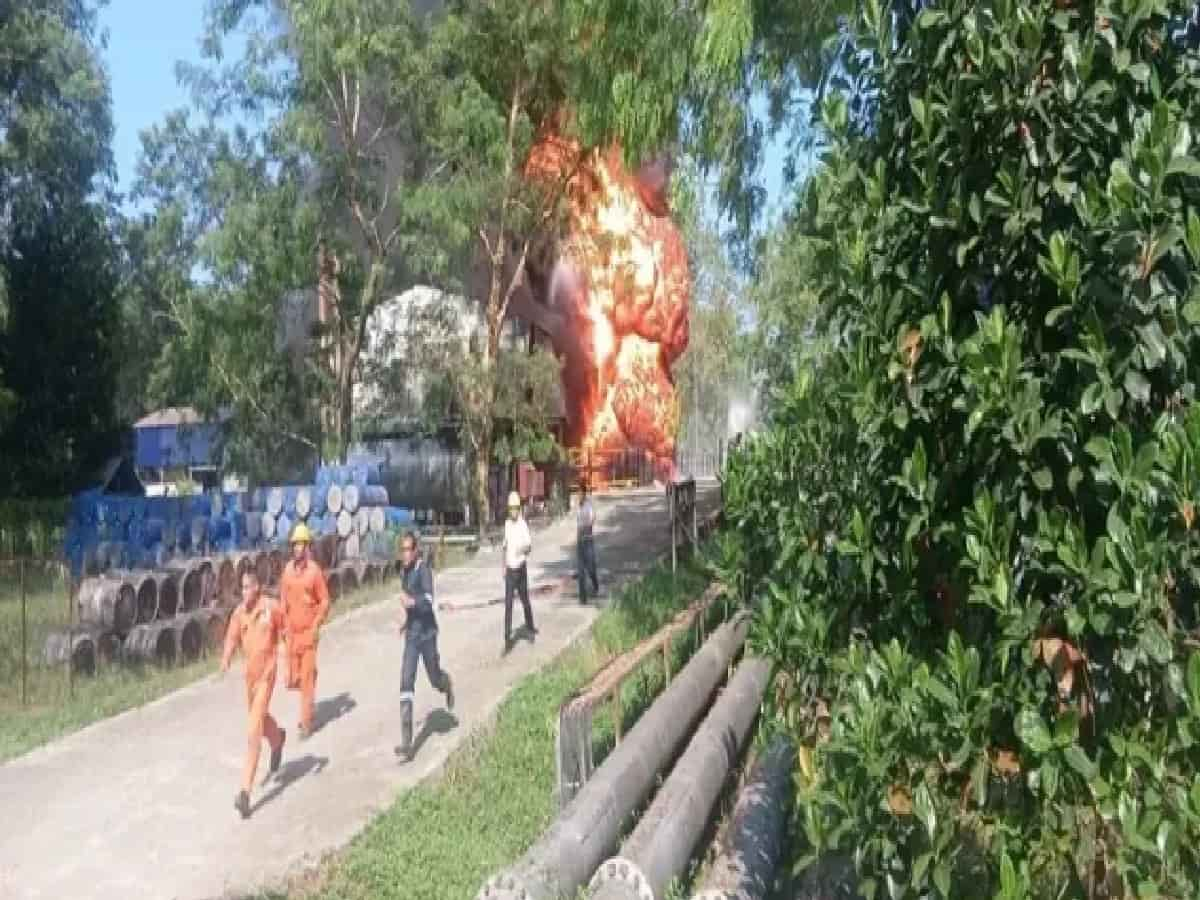
1 Dead, 6 Hurt in Blast at OIL Tank Farm in Assam's Dibrugarh
A catastrophic explosion followed by a massive fire tore through the Intermediate Tank Farm (ITF) operated by Oil India Limited (OIL) in the Tengakhat area of Assam's Dibrugarh district on Friday morning, November 6, 2026, leaving one worker dead and six others seriously injured. The high-intensity blast sent shockwaves across the surrounding rural belt, generating thick plumes of black smoke that billowed high into the Upper Assam sky and triggering an immediate industrial emergency across regional energy installations. The fatal accident occurred within the high-security crude oil storage sector of the facility while specialized technicians were actively engaged in technical maintenance work on critical line valves. As emergency fire tenders from Oil India Limited and the state fire services rushed to contain the blaze, local administrative officials and specialized rescue teams converged on the site to initiate urgent life-saving operations, salvage damaged containment infrastructure, and prevent the fire from spreading to neighboring crude reservoirs.
The incident unfolded during the early working hours when the tank farm, which serves as a pivotal collection and transit junction for crude extracted from oilfields across eastern Assam, was operating under standard morning shifts. Preliminary investigations indicate that the explosion was triggered during a mechanical maneuver involving a crude oil storage valve, where pressurized hydrocarbon vapors are believed to have encountered an unexpected ignition source. The sheer kinetic force of the detonation ripped through heavy metal assemblies, shattering nearby pipeline fittings and hurling debris across the operating yard. Workers in the immediate vicinity absorbed the brunt of the thermal flash and concussive pressure wave, resulting in severe burns, traumatic injuries, and immediate chaos across the installation floor before automated emergency containment protocols could fully isolate the damaged quadrant.
Technical Maintenance Operation Turns Fatal in Crude Storage Wing
Providing critical insight into the events leading up to the disaster, Kamal Phukan, Area Manager of Mumbai-based engineering firm Spectron Engineers Private Limited—which had been contracted by Oil India Limited to conduct regular technical overhauls—confirmed that the team was carrying out routine servicing when the blast occurred. According to Phukan, the operation involved standard periodic maintenance that is mandated on a monthly and quarterly schedule to inspect mechanical integrity, lubricate actuator assemblies, and calibrate pressure-regulating valves within the crude oil pipeline network. Technicians were positioned directly around the machine units when the system suddenly suffered a catastrophic failure, sparking an uncontrollable blaze that instantly engulfed the work crew.
Initial reports from field supervisors reveal that handling volatile crude valves always carries intrinsic hydrocarbon hazard risks, especially when residual gases linger within pipeline joints despite isolation procedures. As the valve mechanism was being manipulated, an abrupt pressure surge or spark ignited flammable vapor pockets, creating a devastating fireball that caught the maintenance crew completely off-guard. Phukan noted that while industrial protocols dictate strict cold-work permits and zero-spark environments during hydrocarbon equipment servicing, the suddenness of the flashover left no time for the workers to deploy manual suppression gear, resulting in instantaneous injuries and extensive physical displacement of personnel stationed around the manifold platform.
Emergency Evacuations to AMCH and Search for Missing Technician
The explosion left several workers severely incapacitated, prompting a rapid medical evacuation organized by Oil India Limited’s disaster management wing and local police forces. Five of the critically injured technicians were rushed directly to the emergency trauma wing of the Assam Medical College and Hospital (AMCH) in Dibrugarh, while another severely wounded worker was transported to the specialized Oil India Hospital in the nearby industrial township of Duliajan for intensive medical stabilization. Medical authorities at AMCH confirmed that the victims suffered complex thermal injuries and trauma caused by structural shrapnel, with specialized surgical and burn care units mobilized to attend to their needs.
The injured personnel have been formally identified as Tapas Gogoi, 40, a resident of Milan Nagar in Dibrugarh town, along with four residents of the Tengakhat locality: Shailen Gogoi, 45, Kumud Gogoi, 38, Golap Dutta, 58, and Indra Gogoi, 40. Meanwhile, emergency personnel launched an exhaustive search-and-rescue operation across the periphery of the Intermediate Tank Farm to locate another worker who went missing immediately following the detonation. Eyewitness accounts and initial assessments indicate that the intense shockwave blew the missing employee several meters away from the primary blast epicenter, potentially into thick foliage or drainage canals surrounding the industrial perimeter. Dedicated rescue teams equipped with specialized gear continue combing the perimeter to track down the missing technician, while hospital authorities monitor the condition of the surviving workers around the clock.
Comprehensive Inquiries Launched into Safety Lapses Across Upper Assam Oilfields
The fatal Tengakhat explosion has cast an intense spotlight on operational safety standards, contractor oversight, and hazardous risk mitigation across India's premier onshore hydrocarbon producing zone. Both Oil India Limited and the Dibrugarh district administration have initiated high-level technical inquiries to determine whether standardized standard operating procedures (SOPs), gas detection checks, and line-purging guidelines were strictly observed prior to the valve operation. Industrial safety bodies, including the Directorate General of Mines Safety (DGMS) and the Petroleum and Explosives Safety Organization (PESO), are expected to inspect the charred wreckage to isolate the exact mechanical or electrical fault that initiated the combustion.
The Tengakhat facility remains an indispensable node in the energy infrastructure of the Northeast, channeling massive volumes of crude from regional oilfields toward major refineries in Numaligarh, Guwahati, and Bongaigaon. Local community leaders and regional labor unions have expressed deep grief over the loss of life, demanding transparent investigations into third-party contractor compliance, rigorous safety audits of aging pipeline networks, and comprehensive financial compensation packages for the bereaved family and injured laborers. As industrial safety investigators comb through operational logs, the tragic event serves as a stark reminder of the volatile perils faced daily by frontline technical crews maintaining the lifeline of India's domestic oil and gas production.




