







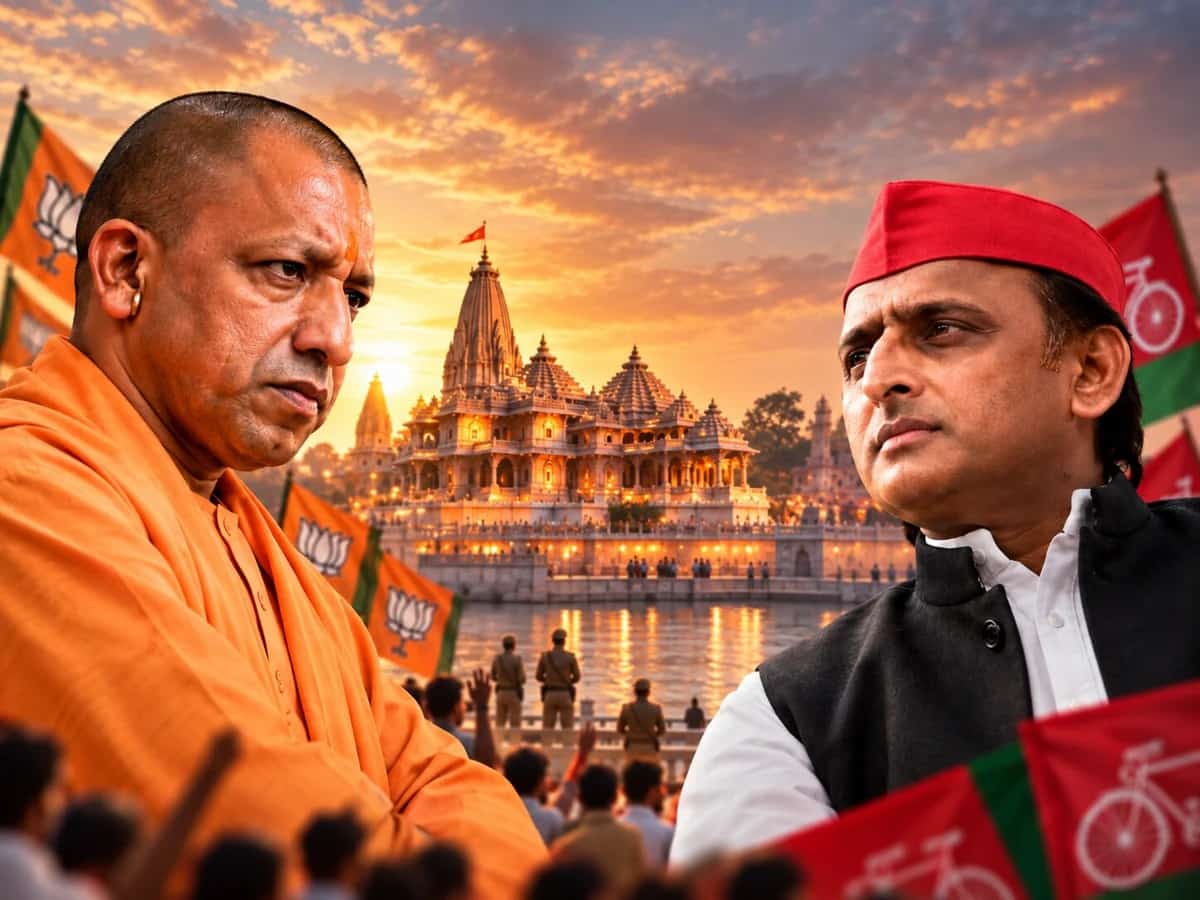
Yogi vs Akhilesh in Ayodhya: 7-Election Data Exposes Shifting Ground Ahead of 2027
Nearly two years after the high-stakes 2024 Lok Sabha elections sent shockwaves across Uttar Pradesh's political landscape, the temple city of Ayodhya has once again become ground zero for an intense high-profile duel between Chief Minister Yogi Adityanath and Samajwadi Party (SP) president Akhilesh Yadav. With both leaders and their respective cadres trading direct public challenges to contest the Ayodhya assembly seat in the upcoming 2027 assembly elections, the political temperature across the state has surged. While the Bharatiya Janata Party (BJP) has largely held ideological and electoral dominance over Ayodhya for the better part of the last three decades, the Samajwadi Party's historic victory in the parent Faizabad parliamentary constituency in 2024 has energized the opposition. However, an exhaustive statistical analysis of the past seven assembly elections reveals that Ayodhya has rarely been a monolithic bastion; instead, it has remained a volatile battleground characterized by sharp vote share contractions, shifting margins, and fiercely contested local dynamics.
From 1991 Ram Wave to the 2012 Shock: Tracking 30 Years of Fluctuating Vote Shares
The historical trajectory of the Ayodhya assembly constituency illustrates a gradual compression of the BJP's traditional fortress. In 1991, at the peak of the Ram Janmabhoomi movement, BJP stalwart Lallu Singh secured an overwhelming landslide, polling 51.3 percent of the popular vote and recording a decisive victory margin of 30,400 votes. By the 1993 assembly elections, conducted shortly after the Babri structure demolition, Lallu Singh retained the seat, but the party’s vote share receded to 47.24 percent while the SP captured 39.8 percent, narrowing the victory margin sharply to 9,238 votes. The subsequent decade witnessed a continuous erosion in the saffron tally: the BJP secured 45.61 percent against SP's 29.4 percent in 1996, plummeted to 38.72 percent against SP's 24.11 percent in 2002, and fell further to roughly 37 percent in 2007 against SP's 33.4 percent. The cumulative anti-incumbency culminated in a historic upset during the 2012 assembly elections amid broader public anger against the Mayawati-led BSP administration, enabling SP candidate Tej Narayan alias Pawan Pandey to secure 28.74 percent of the vote and defeat Lallu Singh (who was relegated to 25.9 percent) by 5,404 votes, temporarily shattering the BJP’s two-decade hegemony.
The 2022 Margin Contraction and the Fragile 4,667-Vote Lead in the 2024 Parliamentary Shock
The BJP reclaimed the constituency during its 2017 sweep when party nominee Ved Prakash Gupta secured 49.56 percent of the vote, defeating SP's Pawan Pandey by a commanding margin of 50,440 votes as the opposition settled at 26 percent. However, the 2022 assembly contest revealed renewed vulnerability for the ruling party; although Ved Prakash Gupta retained the seat with 49.3 percent of the vote, his victory cushion shrank drastically to 19,990 votes as Pawan Pandey rallied the Samajwadi Party's vote share up to a formidable 40.4 percent. This tightening contest set the stage for the dramatic June 4, 2024 parliamentary verdict: despite unanimous exit poll predictions on June 1 forecasting an unhindered sweep across Uttar Pradesh, the BJP tally crashed to 33 seats, headlined by its most damaging loss in Faizabad where three-time MP Lallu Singh was unseated by SP’s Awadhesh Prasad. Crucially, a granular booth-level breakdown of the Faizabad constituency's five assembly segments revealed that while the Samajwadi Party built insurmountable leads across Dariyabad, Rudauli, Milkipur, and Bikapur, the BJP clung to the core Ayodhya urban assembly segment by a razor-thin margin of just 4,667 votes, demonstrating that even post-temple consecration, the ruling party's urban stronghold remains acutely contested.
Caste Fault Lines and Civic Grievances: Why the 2027 Ayodhya Contest Is Wide Open
Heading into the 2027 state elections, the electoral arithmetic of Ayodhya is being fundamentally reshaped by intricate social coalitions and evolving local economic concerns. The constituency features a formidable concentration of Dalit voters alongside decisive blocs of Brahmins, Muslims, and Yadavs. While the Samajwadi Party maintains an unbroken grip on its core Muslim-Yadav base and significantly widened its Dalit outreach under the PDA (Pichhda, Dalit, Alpasankhyak) coalition during the 2024 parliamentary election, its reliance on local Brahmin heavyweight Pawan Pandey poses a direct challenge to the BJP's traditional upper-caste hegemony. To safeguard its territory, the BJP must maintain total cohesion among its upper-caste base while consolidating support among non-Yadav Other Backward Classes, including the Kurmi, Nishad, Maurya, and Rajbhar communities. Compounding these delicate social equations are acute urban anxieties arising from large-scale corridor redevelopment, displacement of heritage shopkeepers, property compensation disputes, and municipal transition pains, ensuring that whether Yogi Adityanath or Akhilesh Yadav chooses to lead the charge directly, the battle for Ayodhya will be determined by grassroots economic realities as much as religious symbolism.




