







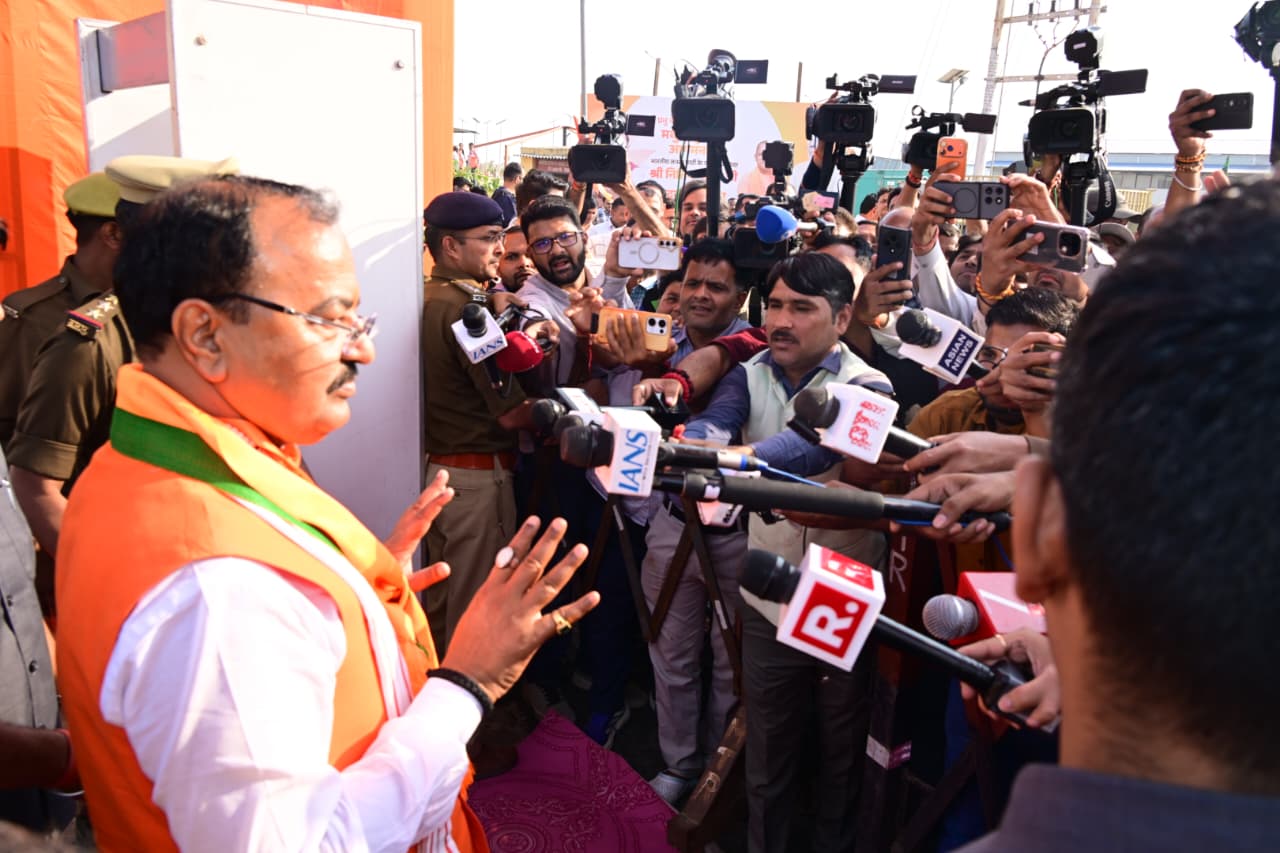
The Congress and the Samajwadi Party are opposed to the poor, the backward classes, and the Dalits; these parties can never work for the welfare of the poor: Keshav Prasad Maurya
Uttar Pradesh Deputy Chief Minister Shri Keshav Prasad Maurya stated that the Congress and the Samajwadi Party are enemies of the poor. They are opposed to the backward classes and Dalits; therefore, one cannot expect any welfare for the poor from these parties. Throughout their history, they have viewed the poor, the marginalized, and the exploited merely as a 'vote bank.' In contrast, the central government, under the leadership of Prime Minister Shri Narendra Modi, has worked to provide the poor with dignity, security, and self-reliance.
Regarding the Samajwadi Party's reaction to religious slogans, Shri Maurya remarked that the SP chief gets anxious when the chant 'Jai Shri Ram' is raised, and now, even the chant 'Radhe-Radhe' has begun to trouble him. 'Radhe-Radhe' is not just a slogan; it is a medium to express faith, devotion, and the spirit of Sanatan culture. When we said, "Radhe-Radhe, let the lotus bloom," the Samajwadi Party failed to notice their own 'punctured bicycle' (the party's election symbol); instead, they claimed to see a 'withered lotus.' This reflects a flaw in their thinking and perspective—they ought to get their eyes checked.
Shri Maurya noted that since the formation of the government under the leadership of Prime Minister Shri Narendra Modi, approximately 500 million (50 crore) people have been lifted above the poverty line. This is not merely a statistic; it is a historic achievement representing India's development and a positive transformation in the lives of the poor. This achievement has also been acknowledged by the World Bank; it is not just a claim made by the government itself. It serves as a global message that when power is exercised with honesty and responsibility, the lives of millions can be transformed. Congratulating the Prime Minister on this historic milestone, he expressed his gratitude and affirmed that the commitment to improving the lives of the poor, ensuring the economic prosperity of impoverished families, and integrating every person in need into the mainstream of development has been—and will continue to be—a core priority.




