







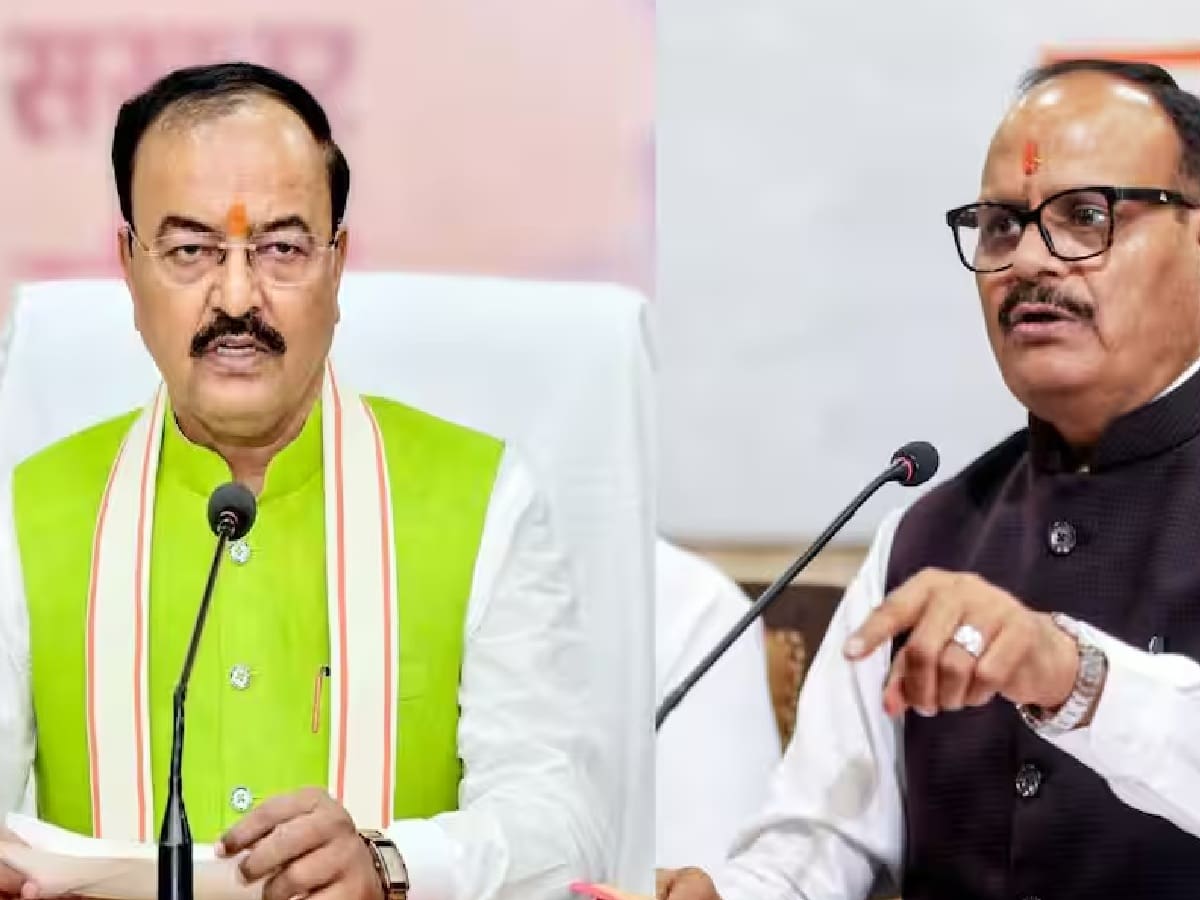
UP Deputy CMs Keshav Maurya, Brajesh Pathak Clash With SP on 'Radhe-Radhe'
A fierce political exchange has broken out across Uttar Pradesh ahead of the 2027 State Assembly elections, as Deputy Chief Ministers Keshav Prasad Maurya and Brajesh Pathak strongly countered Samajwadi Party (SP) national president Akhilesh Yadav over his remarks targeting the Bharatiya Janata Party's (BJP) newly coined campaign slogan, "Radhe-Radhe, Kamal Khila De" ("Hail Radha, make the lotus bloom"). According to political reports circulating on Sunday, November 22, 2026, the controversy began after the BJP concluded its two-day Chintan Shivir in Mathura earlier this week—attended by BJP national president Nitin Nabin, Chief Minister Yogi Adityanath, and both Deputy Chief Ministers—where the party unveiled "Radhe-Radhe, Kamal Khila De" to anchor its outreach across the Braj region. Reacting to the slogan during a press conference in Lucknow on Saturday, Akhilesh Yadav mocked the BJP's refrain by suggesting that "Radhe-Radhe" is traditionally uttered during farewells (vidai) and claiming the slogan was an admission that the BJP's lotus symbol had "wilted" and the party was heading for an electoral exit. Hitting back sharply on Sunday, Deputy Chief Minister Keshav Prasad Maurya accused the Samajwadi Party of practicing appeasement politics, stating that those who previously felt uneasy hearing "Jai Shri Ram" were now uncomfortable hearing "Radhe-Radhe"—a sacred devotional greeting through which millions across the Braj region inquire after one another's well-being. Dismissing Yadav's "wilted lotus" jibe, Maurya remarked that SP leaders unable to see their "punctured bicycle" needed to get their eyes examined, asserting that the lotus would bloom once more as the BJP forms a third consecutive government in 2027 and keeps the SP out of power until 2047. Joining the counter-offensive, Deputy Chief Minister Brajesh Pathak questioned Akhilesh Yadav's familiarity with Sanatana culture, pointing to the 1990 firing on unarmed karsevaks in Ayodhya during the erstwhile SP regime and challenging Yadav over his visits to Ram Lalla in Ayodhya and Krishna Janmabhoomi in Mathura. Meanwhile, SP leaders including Akhilesh Yadav and Mainpuri MP Dimple Yadav maintained their critique, arguing that the BJP was invoking religious slogans to deflect from governance issues, administrative bias, and local civic concerns. For voters, political observers, and citizens across Lucknow, Mathura, Ayodhya, Unnao, Kanpur, Sitapur, and Gorakhpur, the clash signals that cultural symbolism alongside governance records will sit squarely at the heart of Uttar Pradesh's 2027 electoral battleground.
UP Political Clash Over 'Radhe-Radhe' Slogan (Nov 2026): BJP vs. Samajwadi Party Positions
To bring together the verified statements from BJP leaders Keshav Prasad Maurya and Brajesh Pathak alongside the counter-arguments raised by Samajwadi Party leaders Akhilesh Yadav and Dimple Yadav, the tables below summarize both sides of the political debate:
Chronology & Core Arguments in the 'Radhe-Radhe' Political Debate
| Political Development / Speaker | Party & Designation | Key Statement & Political Framing |
| Launch of "Radhe-Radhe, Kamal Khila De" | Bharatiya Janata Party (BJP) — Mathura Chintan Shivir (Nov 16–17, 2026) | Unveiled following the two-day strategy meeting in Mathura to connect Braj's devotional greeting with the party's lotus symbol ahead of the 2027 UP Assembly polls. |
| Akhilesh Yadav's Counter-Attack | Samajwadi Party (SP) — National President (Lucknow Press Briefing, Nov 21) | Mocked the slogan by saying "Radhe-Radhe" signifies a farewell (vidai) and claimed the BJP's lotus has "wilted," while accusing officials of partisan conduct and demanding Election Commission scrutiny. |
| Keshav Prasad Maurya's Rebuttal | BJP — Deputy Chief Minister of Uttar Pradesh | Stated "Radhe-Radhe" is an expression of devotion in Braj, accused SP of appeasement politics, told SP leaders to "get their eyes treated" over the "wilted lotus" remark, and predicted a third consecutive BJP government in 2027 (and SP out of power until 2047). |
| Brajesh Pathak's Sharp Response | BJP — Deputy Chief Minister of Uttar Pradesh | Questioned Akhilesh Yadav's understanding of Sanatana culture, cited the 1990 firing on unarmed karsevaks under past SP rule, and challenged him over visiting Ayodhya's Ram Lalla and Mathura's Krishna Janmabhoomi. |
Regional Focus Areas & Electoral Themes Highlighted by Both Camps
| Theme / Region | BJP's Campaign Narrative | Samajwadi Party's Counter-Narrative |
| Ayodhya & Mathura (Braj) | "Both 'Jai Shri Ram' and 'Radhe-Radhe' will resonate"; highlights cultural heritage, welfare delivery, and a third straight mandate in 2027. | Akhilesh Yadav and Dimple Yadav accused the BJP of politicizing faith while raising questions over land deals, Yamuna pollution in Mathura, and local infrastructure. |
| 2027 Election Outlook & Administration | Projects confidence in winning a thumping majority for the third time backed by development and cultural pride. | Claims anti-incumbency will unseat the BJP, promises to scrap the Agniveer scheme if voted to power, and plans a formal Election Commission representation over alleged bureaucratic bias. |
How Mathura's 'Radhe-Radhe' Slogan Became the Latest Flashpoint Before 2027
Following the BJP's two-day brainstorming session in Mathura earlier this week, party leaders sought to extend their cultural messaging from Ayodhya into the Braj heartland with the slogan "Radhe-Radhe, Kamal Khila De." When Samajwadi Party chief Akhilesh Yadav ridiculed the phrase in Lucknow as a sign of a "wilted lotus" and an impending political farewell, both Deputy Chief Ministers Keshav Prasad Maurya and Brajesh Pathak swiftly turned the remark into an ideological counter-offensive—accusing the SP of disrespecting Braj's traditional greeting and rehearsing appeasement politics.
What Both Sides' Statements Signal for Uttar Pradesh's Political Landscape
While Keshav Prasad Maurya asserted that "Jai Shri Ram" in Ayodhya and "Radhe-Radhe" in Braj reflect living devotion rather than mere political slogans—and Brajesh Pathak invoked past SP-era controversies in Ayodhya to question Akhilesh Yadav's outreach to temples—the Samajwadi Party leadership continues to press its PDA (Pichhda, Dalit, Alpsankhyak) coalition, governance critiques, and seat-sharing talks ahead of 2027. With months to go before Uttar Pradesh heads to the polls, Sunday's sharp exchanges show that both cultural identity and administrative performance will remain fiercely contested across the state.




