







Ayodhya Deepotsav 2026: Ramkatha Park Decked to Welcome CM Yogi
The sacred temple town of Ayodhya has transformed into an open-air artistic sanctuary as final preparations conclude for the historic tenth edition of Deepotsav. Ahead of the grand celebrations, the primary approach route leading to the festival’s nerve center at Ramkatha Park has been decorated with street art, sprawling rangolis, and traditional Vedic motifs to welcome Uttar Pradesh Chief Minister Yogi Adityanath. The stretch originating near Hotel Saryu Yatri Niwas and extending straight to the entrance gates of Ramkatha Park has been covered in murals depicting blossoming lotus flowers, sacred Mangal Kalash (auspicious urns), and illuminated earthen lamps. Conceived as a celebration of faith, local artistry, and administrative coordination, the visual transformation of the thoroughfare underscores the cultural scale that has turned Ayodhya’s Deepotsav into a globally recognized heritage spectacle.
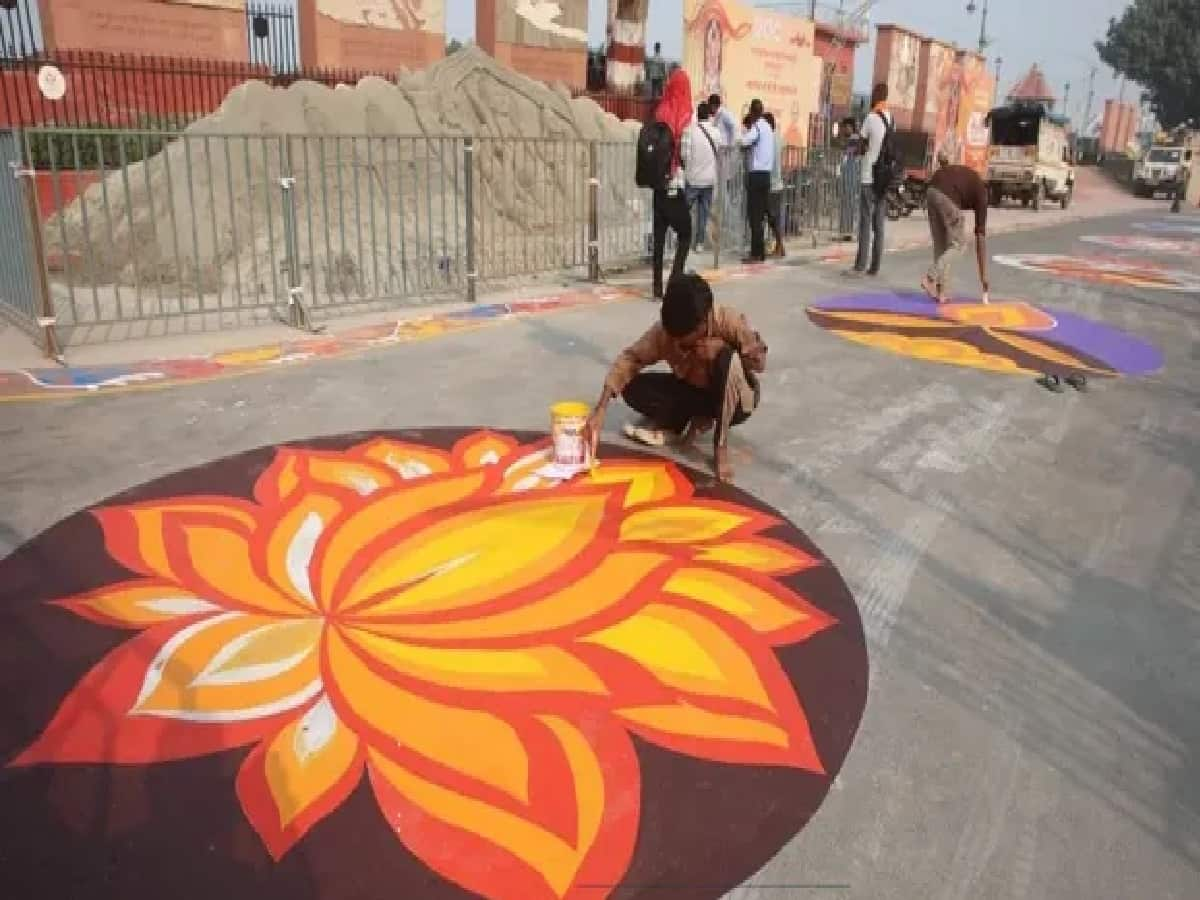
Living Canvas: Ramkatha Park Route Transformed with Vedic Art
The road leading to Ramkatha Park—the ceremonial venue through which Chief Minister Yogi Adityanath and visiting dignitaries will formally enter the Deepotsav grounds—has been reimagined by dozens of folk painters, traditional rangoli specialists, and fine arts students from across the state. Utilizing eco-friendly powdered pigments, liquid paints, and floral embellishments, the artisans have adorned the asphalt with intricate geometric layouts and classical iconography. The path is lined with multi-hued representations of the Mangal Kalash, crowned with green mango leaves and sacred coconuts wrapped in kalava threads, offering a visual invocation of auspiciousness and good fortune.
Interspersed among the sacred urns are large renditions of the Indian lotus (Kamal), whose pink and crimson petals stand out against bright yellow and deep ochre borders. Flanking the central promenade are detailed floor paintings of traditional terracotta lamps (diyas) emitting radiating halos of golden light, symbolizing the eternal triumph of illumination over spiritual ignorance. Classical Swastika symbols have been incorporated at regular intervals to sanctify the pathway, transforming an ordinary municipal road into a ceremonial corridor that prepares visitors for the spiritual grandeur awaiting them inside the main park enclosure.
The Milestone Tenth Edition: A Decade of Ayodhya's Deepotsav Legacy
The vibrant beautification of the Ramkatha Park perimeter carries heightened historical significance in 2026, marking a decade since the modern Deepotsav celebrations were formally instituted by Chief Minister Yogi Adityanath in 2017. What began as an ambitious civic effort that illuminated 1.71 lakh earthen lamps along the ghats of the sacred Saryu has steadily expanded into a global cultural phenomenon. Over the past ten editions, the festival has repeatedly rewritten the Guinness World Records, with this year's administrative plans targeting the illumination of more than 26 to 30 lakh earthen lamps across 56 interconnected riverfront ghats.
Within this expansive multi-day festival, Ramkatha Park functions as the spiritual and civic anchor of the entire celebration. It is here that the grand arrival of Lord Rama, Devi Sita, and Lakshmana is symbolically reenacted through aerial helicopter descents, followed by a formal Rajyabhishek (coronation ritual) performed by the Chief Minister and revered seers from across India. Furthermore, for the 2026 milestone, the Uttar Pradesh Culture Department has organized a major historical exhibition at Ramkatha Park tracing Ayodhya's 500-year civilizational journey and the evolution of the Ram Temple movement. The artwork adorning the access corridor acts as an introduction to this retrospective, setting an elevated tone before guests encounter the historical archives, interactive displays, and cultural presentations inside.
Sacred Iconography: The Deeper Spiritual Meaning of the Motifs
The choice of artistic motifs along the Ramkatha Park corridor reflects deliberate cultural and scriptural intentionality. In Vedic philosophy, the lotus represents purity, spiritual non-attachment, and divine consciousness. Rooted in mud yet blossoming unsullied above murky water, the lotus mirrors the human soul rising above worldly illusions, while also serving as the sacred seat of Goddess Mahalakshmi and Lord Vishnu. Placing the lotus prominently along the welcome route symbolizes purity of purpose and the arrival of divine prosperity into the holy city.
Similarly, the Mangal Kalash is venerated across Sanatana Dharma as an emblem of cosmic completeness and life-giving hydration. Housing water that represents the primordial ocean of creation, its foliage and decorative coconut symbolize fertility, agricultural sustenance, and universal harmony. When paired with the ancient motif of the clay lamp, the visual ensemble acts as a continuous prayer for the health, peace, and material well-being of the realm. The artists have paid meticulous attention to symmetry and tonal balance, ensuring that every brushstroke aligns with traditional proportions while enduring the footfall of incoming festival processions.
Grassroots Artistry and Administrative Harmony on Dalal and Ghats
The aesthetic transformation of the Ramkatha Park route showcases an organic partnership between state institutions and community artisans. Working through late evening and pre-dawn shifts to beat the afternoon sun, local craftspeople have collaborated closely with municipal teams from the Ayodhya Nagar Nigam and the Ayodhya Development Authority. While civic sanitary workers scrubbed and leveled the street surfaces, youth volunteers and freelance artists drafted grid frameworks using chalk before laying down layers of weatherproof acrylics and dry rangoli powders.
Senior administrative officials and police commanders overseeing festival security have conducted regular on-site walkthroughs of the Saryu Yatri Niwas stretch to inspect the progress of the decorations while managing security arrangements. Special pedestrian barricades and non-intrusive security cordons have been deployed to protect the intricate pavement artworks from being prematurely smudged by passing pilgrim traffic. This collaborative energy, which unites town planners, security personnel, local hoteliers, and teenage art students, illustrates how Deepotsav has grown into a community celebration where every resident takes personal pride in the welcome accorded to the city's guests.
A Global Heritage Stage: Ayodhya’s Cultural Renaissance
The artistic adornment of Ramkatha Park reflects Ayodhya's broader evolution into an international spiritual tourism destination following the historic consecration of the Shri Ram Janmabhoomi Mandir. Over the course of the five-day Deepotsav festival, the city will host international Ramleela troupes from Southeast Asian nations including Thailand, Cambodia, and Indonesia, alongside mega aerial drone shows, 3D architectural projection mapping across historic ghats, and eco-friendly fireworks.
Yet, amid the cutting-edge laser technologies and world-record lamp counts, it is the artisanal, human touch evident along the streets of Ramkatha Park that captures the authentic essence of the festival. The hand-painted lotuses, the carefully outlined kalash motifs, and the vibrant clay-lamp rangolis remind visitors that the heart of Deepotsav resides in devotion, cultural memory, and hospitality. As Chief Minister Yogi Adityanath prepares to walk this sanctified corridor, the street art stands as a vibrant tribute to a city celebrating its ancient heritage on a truly monumental scale.




