







BJP's 2027 Master Plan: Winning Western UP's 126 Assembly Seats
The road to power in Lucknow runs straight through the fertile agricultural heartland of Western Uttar Pradesh. Encompassing 126 crucial assembly segments that stretch across the Upper Doab and the sugarcane belt—from Ghaziabad and Meerut to Muzaffarnagar, Baghpat, Shamli, Bulandshahr, and Aligarh—this politically volatile region has historically dictated the rise and fall of ruling coalitions in India’s most populous state. Following a noticeable electoral dent in the 2022 assembly elections, the Bharatiya Janata Party (BJP) has rolled out a comprehensive master plan ahead of the 2027 Uttar Pradesh Assembly polls to reclaim its lost turf. By forging an ironclad political partnership with the Rashtriya Lok Dal (RLD), conferring the nation's highest civilian honor on legendary agrarian patriarch Chaudhary Charan Singh, and accelerating tangible welfare schemes for sugarcane growers, the ruling party is systematically executing an outreach designed to unite Jat voters, farming communities, and rural cooperatives under the National Democratic Alliance (NDA) umbrella.
Reclaiming the Heartland: The Electoral Math Behind 126 Assembly Seats
The strategic urgency guiding the saffron party's renewed focus on the western districts stems from clear numerical lessons observed over the past two assembly election cycles. In its historic 2017 landslide victory, the BJP swept Western Uttar Pradesh by securing an astounding 100 out of the 126 regional seats, an overwhelming mandate built on broad-based social engineering across agrarian and non-agrarian communities. However, the political landscape underwent significant friction in the lead-up to the 2022 assembly elections. Months of protracted farmers' protests, localized rural discontent over input expenditures, and the consolidation of rural voters behind the Samajwadi Party (SP) and Rashtriya Lok Dal (RLD) coalition exacted a heavy electoral toll.
When the votes were counted in March 2022, the BJP's regional seat tally fell by 15 seats, dropping from 100 to 85. While the party successfully retained overall power in the state with a comfortable 255-seat majority, internal post-poll evaluations highlighted persistent vulnerabilities in rural constituencies dominated by the farming community. The losses underscored a fundamental political reality: the party cannot afford complacency in a region where agrarian sentiment and community mobilization can rapidly alter election outcomes. To establish a decisive lead for the 2027 assembly elections and ensure an unassailable majority in the 403-member state legislature, party strategists have concluded that reversing the 2022 deficit and pushing their tally back toward the 100-seat benchmark is non-negotiable.
The RLD Factor: Rewriting the Social Equation Across the Sugar Belt
The cornerstone of the BJP's 2027 roadmap is the structural transformation of regional alliance dynamics. In 2022, the Rashtriya Lok Dal, under the leadership of Jayant Chaudhary, fought alongside Akhilesh Yadav's Samajwadi Party, consolidating the traditional Jat-Muslim-agrarian axis and delivering severe blows to the ruling party in districts like Muzaffarnagar, Meerut, and Shamli. Today, that entire equation has pivoted. The RLD has formally joined the National Democratic Alliance, transforming a former challenger into a key strategic asset on the ground.
By bringing the RLD into the NDA fold, the BJP has effectively disrupted the opposition's regional arithmetic. The synergy between the BJP's grassroots organizational machinery and the RLD’s deep-rooted influence among Jat farming families creates a formidable electoral combination. The alliance neutralizes historical community friction and presents a unified front in rural panchayats. Rather than competing for the same rural vote bank, local party workers and regional leadership are conducting joint coordination sessions to ensure complete transferability of votes across every village booth, presenting the opposition with a united front ahead of the upcoming electoral contest.
Honoring Chaudhary Charan Singh: Agrarian Pride and Symbolic Politics
A pivotal breakthrough in mending relations with the agrarian community in Western Uttar Pradesh came with the central government’s decision to confer the Bharat Ratna upon former Prime Minister Chaudhary Charan Singh. Widely revered across northern India as the patron saint of farmers, Chaudhary Charan Singh’s political philosophy centered on the dignity of rural labor, land reforms, and the economic primacy of the peasantry. His legacy remains an emotional touchstone for millions of agrarian households across the Doab region.
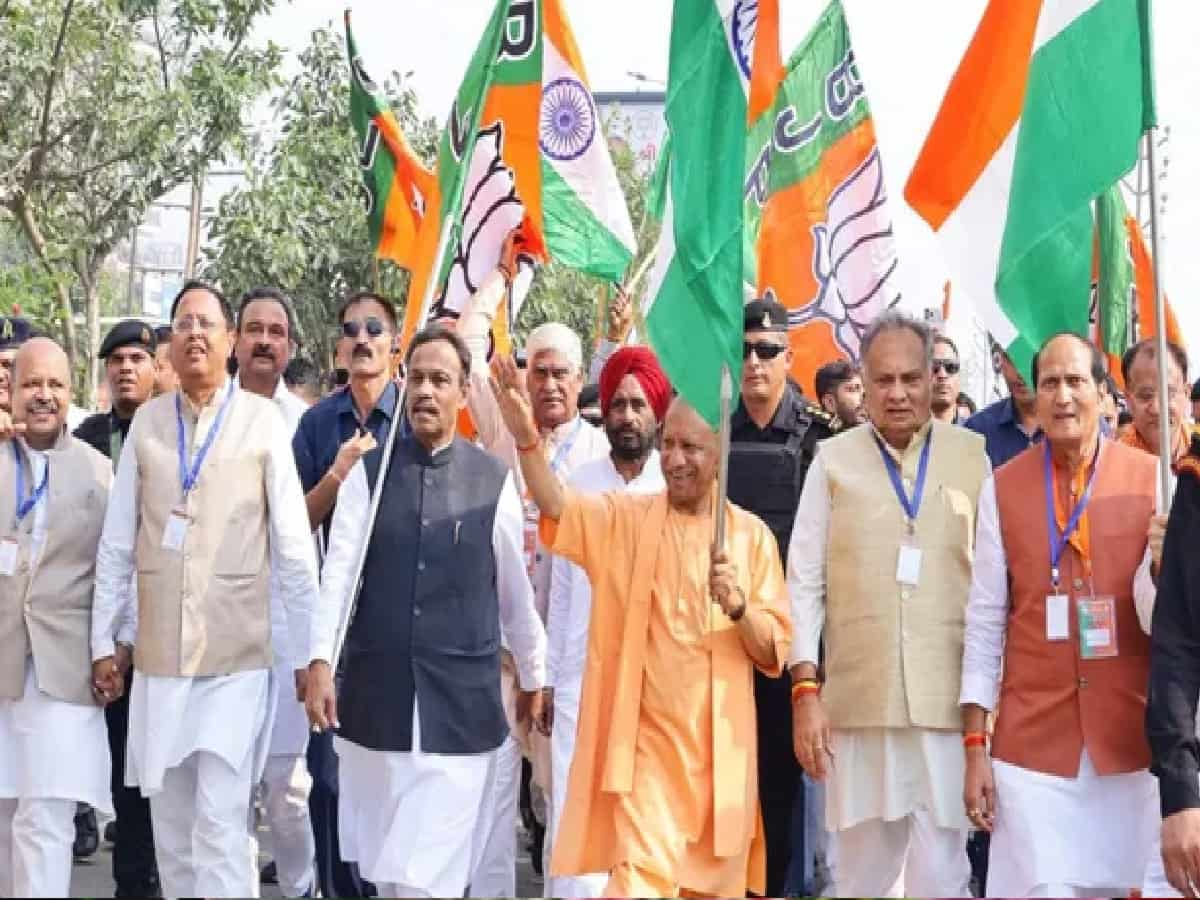
During a recent political march in Ghaziabad, Chief Minister Yogi Adityanath invoked Chaudhary Charan Singh's memory, framing the highest civilian honor not merely as an individual award, but as a long-overdue national tribute to the farmers of Uttar Pradesh. The Chief Minister pointed out that while previous political regimes frequently exploited agrarian symbols for electoral leverage, Prime Minister Narendra Modi’s administration took concrete steps to place farmers at the very top of the national development agenda. This strategic acknowledgment of Jat pride and historical agrarian leadership has effectively blunted opposition attacks, replacing past grievances with a growing sentiment of cultural recognition and mutual respect.
Delivering for the Peasantry: Welfare Schemes Replace Agrarian Discontent
Beyond symbolic outreach, the BJP's blueprint for winning over the 126 western seats relies on delivering practical economic relief to rural households. Chief Minister Yogi Adityanath has consistently highlighted transformative agricultural welfare measures, led by the direct cash assistance of the Pradhan Mantri Kisan Samman Nidhi (PM-KISAN), which provides direct income support into bank accounts without administrative leakage. Additional structural interventions—such as the distribution of Soil Health Cards, modern agricultural technology subsidies, micro-irrigation grants, and solar water pumps under the PM-KUSUM initiative—are designed to enhance farm productivity and lower out-of-pocket production costs for smallholders.
Crucially, the government has addressed the central economic issue of Western Uttar Pradesh: the sugarcane economy. In previous decades, delayed payments by private and cooperative sugar mills were a chronic source of rural distress, forcing farmers to wait months, and sometimes years, for their rightful dues. Under the current state administration, modernized recovery mechanisms and computerized weighbridges have ensured record cane price clearances, infusing tens of thousands of crores directly into the regional rural economy. Furthermore, the provision of free electricity for agricultural tube-wells and massive investments in rural highway connectivity have eliminated daily logistical bottlenecks, giving farmers tangible reasons to align with administrative stability.
The Ghaziabad March: Demonstrating NDA Unity on the Ground
The operational manifestation of this united front was on full display during the "Save Democracy, Remove Anarchy" march organized in Ghaziabad. Flanked by top leaders of both parties, Chief Minister Yogi Adityanath led a high-energy padayatra that sent a decisive message across the political spectrum. Walking side-by-side with senior RLD leaders, including National General Secretary Trilok Tyagi, the joint leadership demonstrated that the NDA alliance in Western Uttar Pradesh is an active, cohesive partnership operating directly among the people.
The visible camaraderie between BJP and RLD cadres during the Ghaziabad event provided a blueprint for how the alliance intends to campaign over the next twelve months. By presenting a seamless alignment between state administrative leadership and regional grassroots representatives, the march signaled an end to past divisions. As political observers in Lucknow and New Delhi track the unfolding developments, one reality remains clear: the battle for Western Uttar Pradesh’s 126 seats has begun in earnest, and the BJP’s master plan of combining alliance arithmetic, agrarian pride, and targeted economic governance has firmly established the battlefield on its own terms.




