







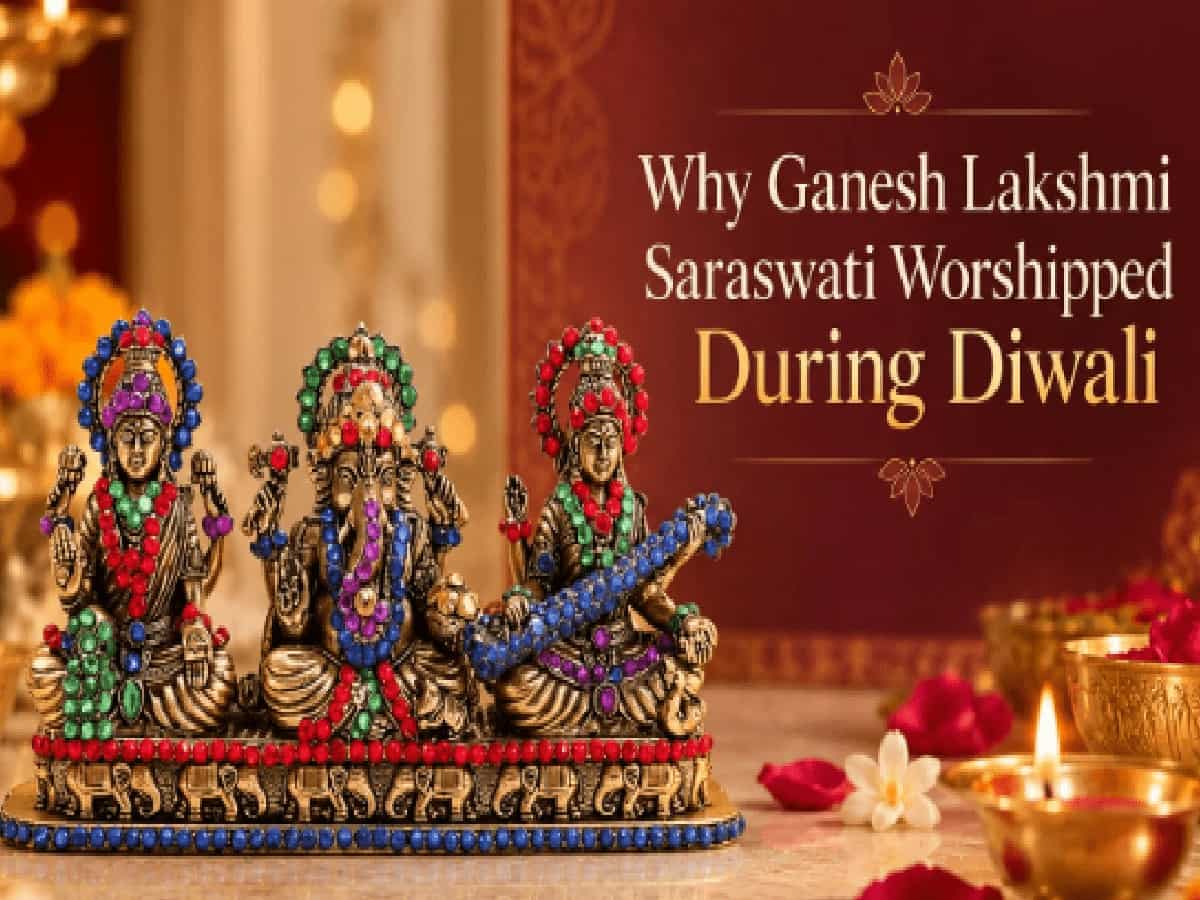
Why Worship Lakshmi, Ganesha & Saraswati on Diwali
As millions of residences and commercial establishments across the country glow under the warm radiance of clay diyas on Sunday, November 8, 2026, the celebration of Diwali reaches its spiritual peak. Falling annually on the auspicious Kartik Amavasya, the festival of lights is universally celebrated as the triumphant return of Lord Rama to Ayodhya after fourteen years of forest exile. Yet, when families gather around sacred altars for the central evening puja, the divine focus turns not exclusively to the epic heroes of the Ramayana, but to a revered trinity: Goddess Mahalakshmi, Lord Ganesha, and Goddess Saraswati. To the casual observer, invoking the deities of wealth, auspicious intellect, and pure wisdom side by side might appear as a customary ritual convention. However, ancient Vedic philosophy, Puranic legends, and profound psychological metaphors reveal an interconnected science: wealth without discerning wisdom leads to ruin, and material prosperity without cultural and ethical knowledge descends into spiritual blindness.
The Symbolic Trio: Balancing Wealth, Wisdom, and Knowledge
In Sanatan tradition, each deity embodies cosmic archetypes that govern both human consciousness and societal balance. Goddess Mahalakshmi reigns supreme as the divine dispenser of Dhana (material wealth), Aishwarya (prosperity), and Vaibhav (grandeur). As the consort of Lord Vishnu—the preserver of the universe—her energy fuels physical sustenance and economic activity. Yet, scriptures consistently warn that Lakshmi is Chanchala, or inherently fickle and transient by nature; she flows constantly and departs as swiftly as she arrives if not received with purity and managed with steady responsibility.
This is precisely where Lord Ganesha and Goddess Saraswati enter the sacred sanctum of Diwali night. Lord Ganesha, hailed as Vighnaharta (remover of obstacles) and Buddhidata (bestower of intellect and discernment), provides the mental sharpness, prudence, and ethical restraint required to earn and safeguard assets. Simultaneously, Goddess Saraswati, the embodiment of Vidya (learning), fine arts, truthful speech, and moral conscience, ensures that the prosperity gained through Lakshmi is utilized for constructive, righteous (dharmic), and creative pursuits. Without Saraswati's purifying consciousness, accumulated riches frequently breed arrogance, hedonism, and ethical degradation. Thus, invoking all three deities creates a spiritual equilibrium: Lakshmi provides the resources, Ganesha provides the wisdom to administer them, and Saraswati provides the moral purpose to share them.
The Sacred Mythological Bond: How Ganesha Became Lakshmi's Adopted Son
Beyond the philosophical alignment of intellect and riches, ancient Puranic narratives preserve a touching story that explains the eternal ritual pairing of Goddess Lakshmi and Lord Ganesha. According to mythological lore, during an exchange in the celestial realms, Goddess Lakshmi was subtly overcome with pride regarding her universal sovereignty. Recognizing that both gods and mortals constantly sought her favor, she viewed herself as the sole sustainer of terrestrial joy and fulfillment.
Lord Vishnu, seeking to gently dispel this nascent ego, observed that despite possessing all the treasures of creation, a woman’s journey of completeness remains unfulfilled without experiencing the unconditional warmth and selflessness of motherhood. Sensing the truth in Vishnu’s words, a remorseful Lakshmi approached Goddess Parvati in deep distress. Understanding Lakshmi’s maternal longing, Parvati graciously offered her own younger son, the elephant-headed Ganesha, to be adopted by Lakshmi as her spiritual son (Dattaka Putra). Overjoyed by Parvati’s benevolence, Goddess Lakshmi declared that all her wealth, fortune, and boons would forever be intertwined with Ganesha. She decreed that whoever worshipped her without first paying homage to Ganesha would never receive her lasting blessings, as a mother’s true grace flows naturally through her child. Hence, on Diwali night, tradition mandates that Ganesha is honored first, assuring that Lakshmi’s entry into a household is rooted in maternal love and righteous guardianship.
Why Ganesha Sits on Lakshmi's Right and Saraswati's Quiet Presence
The spatial arrangement of the deities on the Diwali puja chauki reflects intricate social and spiritual rules codified over centuries:
-
The Mother-Son Placement: In Vedic rituals, a wife sits to the left of her husband during ceremonial sacrifices. Because Lord Ganesha is recognized as Goddess Lakshmi’s adopted son and not her spouse, standard iconography and puja vidhi dictate that Lord Ganesha is seated to the right hand of Goddess Lakshmi, underscoring their sacred maternal bond.
-
The Role of Goddess Saraswati: While traditional merchants historically placed special emphasis on Saraswati for the consecration of newly opened ledger books (Chopda Pujan or Sharda Pujan), her image sits quietly beside Lakshmi and Ganesha to remind worshippers that true literacy involves discerning right from wrong. In many business communities, Saraswati's presence ensures that commercial contracts remain honest and accounts stay untainted by deceit.
-
The Exclusion of Extravagant Ego: By placing Saraswati alongside Lakshmi, scripture reminds householders that scholarship and wealth must coexist in mutual respect, preventing intellectual arrogance from scorning material well-being, and preventing raw commercial power from devaluing intellectual and artistic pursuits.
Economic and Psychological Realities: Ancient Wisdom for Modern Prosperity
The centuries-old practice of worshipping Lakshmi, Ganesha, and Saraswati on Deepavali holds relevance that resonates with contemporary economic and psychological challenges. Financial experts and behavioural economists frequently observe that sudden wealth, when acquired without strategic discipline and financial literacy, often leads to rapid depletion and personal distress. By mandating that seekers of wealth first cultivate Ganesha's analytical focus and Saraswati's reflective insight, the festival offers a practical framework for sustainable prosperity.
True prosperity (Lakshmi) is meaningless if one lacks the wisdom (Ganesha) to protect it from speculative risks and destructive impulses. Similarly, wealth fails to bring peace if an individual lacks the inner culture and emotional refinement (Saraswati) to find contentment and elevate their community. On this Diwali night, as prayers rise alongside glowing lamps, the collective worship of this divine trinity serves as an enduring reminder that the highest victory of light over darkness occurs when material success, intellectual clarity, and spiritual purity walk hand in hand.




