







Chhath Puja 2026: Hidden Faith in 'Kaanch Hi Baans Ke Bahangiya'
As the sacred four-day festival of Chhath Puja 2026 approaches—beginning with Nahay Khay on Friday, November 13, and culminating with Usha Arghya on Monday, November 16—an unmistakable wave of devotion sweeps across North India and beyond. From the bustling riverbanks of Patna, Gaya, and Darbhanga in Bihar to the historic ghats of Varanasi, Prayagraj, Gorakhpur, and Lucknow in Uttar Pradesh, as well as community ponds in New Delhi and Mumbai, millions of households immerse themselves in preparations for the grand festival of folk faith. More than elaborate temple rituals, it is the soulful melody of traditional folk songs echoing from neighborhood courtyards to riverbank ghats that defines the emotional atmosphere of Chhath Mahaparva. Among these timeless hymns, none resonates more deeply than "Kaanch Hi Baans Ke Bahangiya, Bahangi Lachkat Jaaye"—a beloved folk classic immortalized for generations of devotees. Far beyond poetic beauty, this iconic song encodes the foundational spiritual rules of Chhath Puja, revealing why newly cut bamboo, the shoulder-borne Bahangi, the woven Daura, and the flat Soop stand at the very heart of worshipping Surya Dev and Chhathi Maiya.
Decoding 'Kaanch Hi Baans': Why Fresh Bamboo Symbolizes Sacred Purity
The opening phrase of the folk song—"Kaanch Hi Baans"—literally translates to fresh, green, or raw bamboo that has never been used for any prior purpose. In the strict spiritual discipline of Chhath Puja, purity (pavitra) is not merely a preference; it is the absolute bedrock of every ritual. Devotees are instructed to prepare all offerings using untouched, natural, and freshly sourced materials, ensuring that no item carries any trace of prior household consumption or impurity. By celebrating "Kaanch Hi Baans," the folk song reminds every household that vessels crafted from newly harvested bamboo represent pristine nature untouched by synthetic processing.
Beyond ritual cleanliness, bamboo carries profound symbolic resonance in Indian cultural and Vedic traditions. In rural Bihar and eastern Uttar Pradesh, bamboo is revered as a living emblem of resilience, rapid growth, and continuity. Because a single bamboo grove continuously sends forth sturdy new shoots season after season, bamboo is closely associated with Vansha Vriddhi—the flourishing and longevity of a family’s lineage. When mothers and elders observe the arduous 36-hour waterless Chhath fast (nirjala vrat) for the health, prosperity, and protection of their children, offering prayers in vessels woven from fresh bamboo becomes a silent, deeply felt prayer for unbroken family growth and harmony.
The Spiritual Journey of the Bahangi: Humility and Selfless Service
As the folk song continues with the evocative line "Bahangi Lachkat Jaaye"—describing how the bamboo palanquin bends and sways gently under its heavy load—it paints one of the most moving scenes of Indian devotion. Historically and even today in many towns and villages, a Bahangi consists of a sturdy, flexible bamboo pole balanced across a devotee’s shoulders, with two large bamboo baskets suspended securely from either end using natural ropes. Packed brimming with seasonal fruits, sugarcane stalks, coconuts, and freshly prepared thekua, the Bahangi bends rhythmically with every step taken toward the water body.
The verses of the song vividly capture the collective reverence surrounding this procession. In the lyrics, passersby and family members walk ahead of the Bahangi, sweeping the pathway clean so that not even a speck of dust touches the sacred offerings meant for Lord Surya. Carrying a heavy Bahangi barefoot along crowded streets or muddy river paths strips away all distinctions of wealth, status, and ego. Whether a corporate professional in Lucknow or Delhi or a farmer in rural Purvanchal, every devotee who shoulders the Bahangi embraces complete humility, transforming physical exertion into an act of joyful, selfless seva (service) before the divine.
Why the Bamboo Daura Is Central to Chhath Puja Rituals
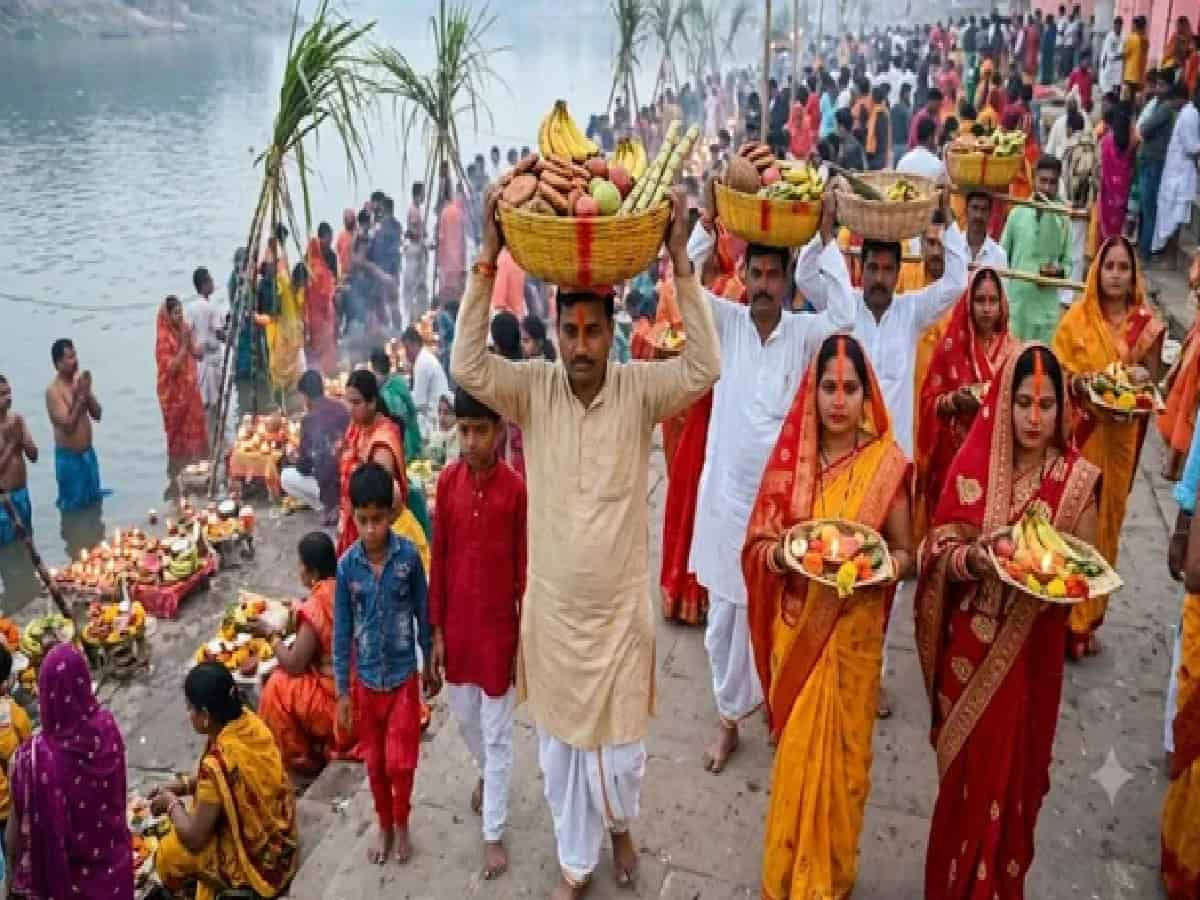
Closely linked to the Bahangi is the Daura (also known regionally as Dala), the large, deep, round basket woven skillfully from sturdy bamboo strips by traditional artisan communities. Within the architecture of Chhath Puja, the Daura serves as the sacred vessel that gathers and protects all the elements of the household’s devotion in one unified place. Inside the Daura, fasting women (vratis) meticulously arrange multiple soop trays, whole coconuts, bunches of bananas, apples, sweet limes, raw turmeric roots, fresh ginger with green shoots, radishes, sprouted Bengal gram, and golden-brown thekua fried in pure ghee.
The ritual journey of the Daura from the family home to the riverbank ghat embodies the spirit of shared family responsibility. Customarily, a male member of the household lifts the heavy Daura onto his head and walks barefoot to the ghat, escorted by women singing Chhath folk hymns in chorus. Carrying the offerings atop one’s head—the highest point of the human body—symbolizes absolute surrender and respect toward Surya Dev and Chhathi Maiya. Through this simple yet powerful gesture, the Daura turns an individual fast into a deeply unifying family pilgrimage.
The Sacred Role of the Bamboo Soop During Sandhya and Usha Arghya
When the procession reaches the riverbank or community ghat at dusk on Sunday, November 15 for Sandhya Arghya, and again before dawn on Monday, November 16 for Usha Arghya, the Soop (or Supali) takes center stage. Crafted as a wide, flat winnowing tray from finely split strips of natural bamboo, the Soop is the direct medium through which sacred offerings are presented to the Sun God. Every element placed inside the Soop—fruits, flowers, sacred vermilion, burning incense, and lit earthen lamps (diyas)—represents a direct harvest from Mother Earth, returned in gratitude to the solar energy that sustains all life on the planet.
Standing waist-deep in cool sacred water, the fasting vrati cradles the lamp-lit Soop in both hands, facing the setting or rising sun while family members gently pour offerings of pure water and raw cow’s milk over the edges of the bamboo tray. Because bamboo is entirely porous, natural, and biodegradable, water flows freely through its woven fibers back into the river without obstructing the sacred Arghya stream. In every gentle sway of the Bahangi, every barefoot step beneath the Daura, and every glowing lamp balanced inside the bamboo Soop, the timeless wisdom of "Kaanch Hi Baans Ke Bahangiya" endures—reminding generations of devotees that true faith flourishes through purity, gratitude toward nature, and humble devotion.




