







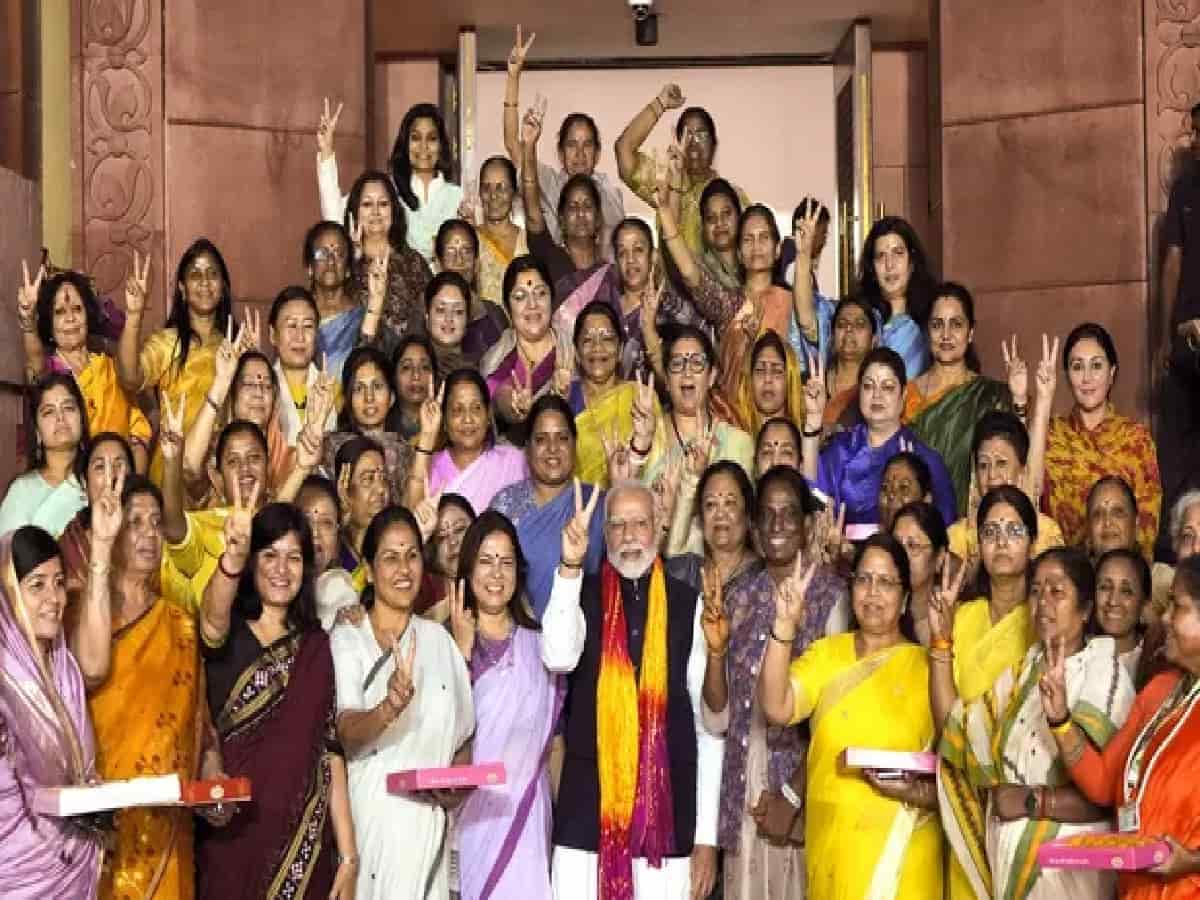
Women Make Up 49% of India's Population, Just 14% of Parliament
As Parliament prepares to debate the Centre's Delimitation and Constitutional Amendment Bills—which propose a 50 percent expansion in the total strength of the Lok Sabha and state legislative assemblies to clear the path for 33 percent reservation for women ahead of the 2029 general elections—stark demographic data underscores the scale of India's gender representation gap. Although women comprise roughly 49 percent of India's total population and cast ballots in record numbers every election cycle, they hold just 14 percent of seats in the current Lok Sabha. Even more tellingly, an analysis by the Association for Democratic Reforms (ADR) reveals that out of 4,666 sitting MPs and MLAs across India's national and state legislatures combined, only 464—barely 10 percent—are women.
Seventy-Five Years of Slow Gains in Lok Sabha Representation
A look back at India's parliamentary history since the first general election in 1951–52 shows that while women's participation as voters and candidates has steadily expanded, their actual share inside the Lok Sabha has risen at a remarkably gradual pace:
-
1951–52 First Lok Sabha: Only 22 women were elected to the inaugural Lok Sabha, representing roughly 5 percent of the House.
-
2019 Lok Sabha Peak: After seven decades of incremental change, women's representation reached its highest mark so far in 2019, when 78 women MPs were elected (approximately 15 percent).
-
2024 Lok Sabha Dip: In the 2024 general elections, the tally slipped slightly to 75 women MPs—roughly 14 percent of the 543-member House.
-
Global Ranking Gap: According to Inter-Parliamentary Union (IPU) rankings as of October, India stood at 152nd position globally in female parliamentary representation, trailing far behind the global average of 27 percent women in national legislatures.
| Election / Benchmark | Women Elected / Share | Key Takeaway |
| First Lok Sabha (1951–52) | 22 women MPs (~5%) | Modest post-independence starting point |
| 17th Lok Sabha (2019) | 78 women MPs (~15%) | Highest female representation in Lok Sabha history to date |
| 18th Lok Sabha (2024) | 75 women MPs (~14%) | Slight dip despite 800 women contesting nationwide |
| All MPs & MLAs Combined (ADR) | 464 out of 4,666 legislators (~10%) | State assemblies lag even further behind Parliament |
| Proposed 2029 Framework | 33% reserved seats (in expanded 850-seat Lok Sabha) | Could raise female Lok Sabha strength to nearly 280 MPs |
Party-Wise Tally and the Financial Barrier Facing Women Candidates
Current party-wise figures in the Lok Sabha reflect how heavily female electoral success depends on major party nominations and institutional backing. Among the 75 sitting women MPs, the Bharatiya Janata Party (BJP) accounts for the largest share with 31 women MPs, followed by the Indian National Congress with 13, and the Trinamool Congress (TMC) with 11, with the remainder distributed across regional parties.
While 800 women contested the 2024 Lok Sabha elections—a dramatic jump compared to just 45 women candidates in 1957—not a single woman won as an independent candidate. Political researchers and ADR findings highlight that limited access to campaign finance remains one of the single biggest structural hurdles preventing women from contesting and winning elections independently, alongside party ticket-distribution biases. Globally, more than 130 countries have adopted constitutional or party-level electoral quotas to overcome precisely these structural barriers.
How the 2026 Delimitation Bills Could Reshape 2029 Elections
With the Union Cabinet clearing the Delimitation (Second) Bill, 2026 and the accompanying Constitution (132nd Amendment) Bill, 2026 for introduction in Parliament's special session, the legislative roadmap aims to operationalize the Nari Shakti Vandan Adhiniyam before the 2029 Lok Sabha polls. By expanding the Lok Sabha's ceiling from 543 to 850 seats—and increasing state assembly strengths by 50 percent while preserving existing inter-state seat ratios—a 33 percent quota would guarantee roughly 280 women MPs in the lower house of Parliament alone, alongside hundreds of women MLAs across Uttar Pradesh, Maharashtra, Tamil Nadu, West Bengal, Bihar, and every other state.
If enacted and implemented on schedule, the reform will finally bridge the decades-old gap between women's 49 percent demographic share and their voice in India's highest lawmaking chambers.




