







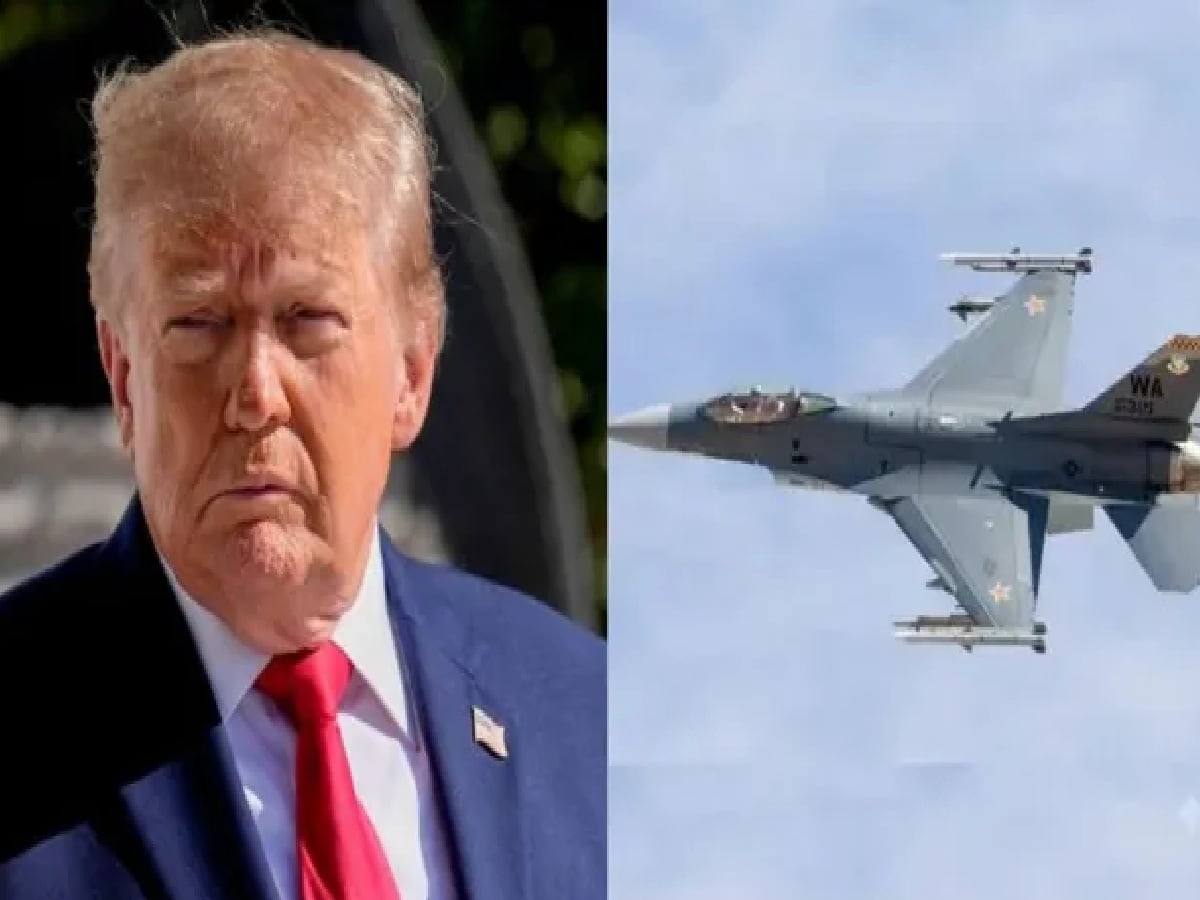
'You Couldn't Pay Me': US Pilot Picks F-16 Over F-35 in Trump Call
When US President Donald Trump asked a frontline American fighter pilot deployed in the Middle East how the fourth-generation F-16 Fighting Falcon stacks up against America's premier fifth-generation stealth jets—the F-22 Raptor and the F-35 Lightning II—he received an unmistakable, unfiltered answer. Speaking from his Mar-a-Lago residence in Florida during a Thanksgiving Day phone call with deployed service members, Trump heard US Air Force Lieutenant Colonel Brent Smith declare the F-16 the "world's greatest fighter jet," insisting that nobody could pay him enough money to switch cockpits. Stationed with the 510th Expeditionary Fighter Squadron at Prince Sultan Air Base in Saudi Arabia amid active US military operations against Iran, Smith's candid endorsement—alongside his assessment that Tehran is beginning to run low on military hardware—has drawn global defense attention from Washington to New Delhi.
Why Lt. Col. Brent Smith Refuses to Trade the F-16 for an F-35 or F-22
During Thursday's holiday call with troops serving overseas, President Trump pressed Lt. Col. Smith—who has been deployed in Saudi Arabia for more than nine months while his squadron logged over 2,000 sorties this year—to compare the combat aircraft he flies against newer stealth platforms.
Without hesitation, Smith replied, "The F-16 all day," adding that he would not change aircraft even if offered money to do so. While acknowledging that both the F-22 and F-35 are formidable machines with vital roles in modern warfare, the veteran aviator pointed to two decisive qualities that keep the F-16 unmatched in the eyes of its pilots:
-
Unrivaled multirole versatility: Smith explained that the F-16 Viper can execute virtually every mission profile—from air-to-air defense and suppression of enemy air defenses to precision strikes—and executes each task reliably.
-
Pure flying agility and pilot connection: Describing the aircraft's handling, Smith remarked that the F-16 is simply "a lot of fun" to fly, reflecting the bubble-canopy visibility, 9-G maneuverability, and responsive flight controls that have endeared the jet to air forces worldwide for decades.
Visibly surprised by the pilot's emphatic preference over the Pentagon's stealth flagships, Trump responded, "Really? Is that right?" before commending the 510th Expeditionary Fighter Squadron for its operational tempo, praising the unit for "knocking them out left and right, knocking out the launchers, knocking out the missiles".
Fourth-Generation Workhorse vs. Fifth-Generation Stealth Fighters
| Fighter Jet | Generation & Primary Role | Key Strengths Highlighted in Combat |
| F-16 Fighting Falcon (Viper) | 4th-Generation Multirole Fighter | High agility, lower operating cost, proven versatility across diverse strike & air-defense missions |
| F-35 Lightning II | 5th-Generation Multirole Stealth Fighter | Radar-evading stealth, advanced sensor fusion, electronic warfare |
| F-22 Raptor | 5th-Generation Air-Superiority Stealth Fighter | Supercruise speed, extreme stealth, air-dominance engagements |
Defense analysts note that Smith's remarks highlight a recurring operational reality in active theater campaigns: while fifth-generation stealth jets like the F-22 and F-35 are indispensable for penetrating heavily defended airspace early in a conflict, agile workhorses like the F-16 carry immense day-to-day sortie loads once contested skies open up.
What the Frontline US Pilot Said About Iran's Military Capabilities
Beyond comparing aircraft, President Trump used the Thanksgiving conversation to ask Lt. Col. Smith for an on-the-ground assessment of Iran's military strength compared with the opening stages of the US-Iran conflict.
Smith stated that he had observed a noticeable shift in Tehran's operational capacity since the early phase of hostilities, concluding that Iranian forces appear to be depleting their stockpiles. "Absolutely. I think my assessment is they're starting to run out of things," Smith told the Commander-in-Chief—prompting Trump to reply, "Yep, I think they are".
For defense watchers across India and the wider Indo-Pacific, the candid Thanksgiving exchange offers both a rare glimpse into frontline cockpit culture and a direct indicator of how US airpower is performing in active Middle Eastern operations.




