







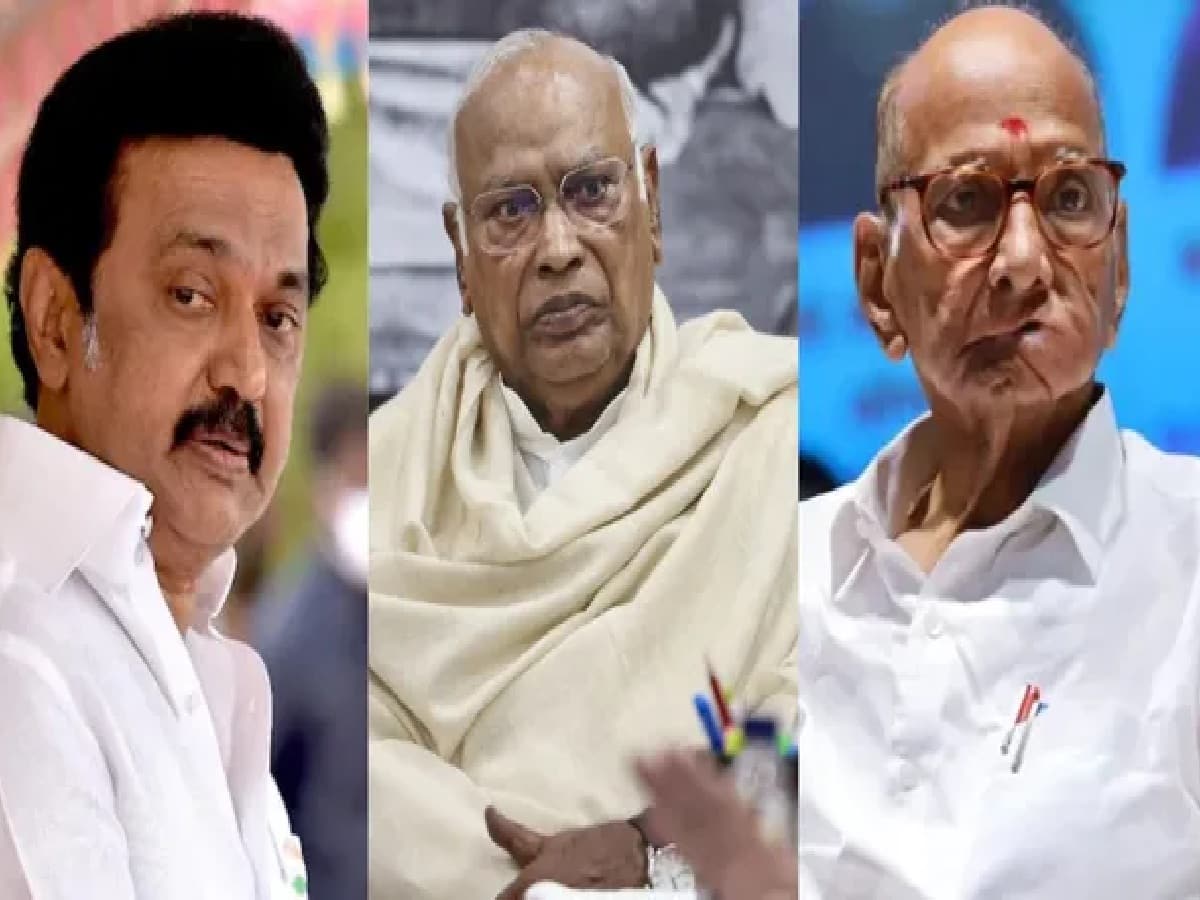
Delimitation Bill Tests INDIA Bloc; Kharge to Meet Stalin, Pawar
The opposition INDIA bloc faces a critical test of coalition coordination ahead of Monday's special session of Parliament, with Congress President Mallikarjun Kharge scheduled to hold separate meetings in Chennai with DMK chief and Tamil Nadu Chief Minister M. K. Stalin and in Mumbai with NCP (Sharadchandra Pawar) president Sharad Pawar on Sunday, November 29, 2026. According to reports by news agency ANI and media outlets, Congress Parliamentary Party chairperson Sonia Gandhi and Leader of the Opposition in the Lok Sabha Rahul Gandhi are also expected to join Kharge during the outreach, as the Congress leadership seeks to bridge sharp policy divergences after both the DMK and NCP (SP) signaled support for the Centre's revised delimitation legislative package.
Congress Leadership Steps In Ahead of November 30 Special Parliament Session
The high-level outreach comes just one day before Parliament convenes on Monday, November 30, to take up three key pieces of legislation—the Constitution (One Hundred and Thirty-Second Amendment) Bill, 2026, the Delimitation (Second) Bill, 2026, and the Union Territories Laws (Amendment) Second Bill, 2026. Following a strategy huddle of INDIA bloc floor leaders at Kharge's residence in New Delhi on Saturday evening, senior Congress leaders—reportedly accompanied by southern party leaders including Karnataka Deputy Chief Minister D. K. Shivakumar, Telangana Chief Minister Revanth Reddy, and Kerala Leader of the Opposition V. D. Satheesan—planned visits to Chennai and later Mumbai to discuss a coordinated opposition approach.
While the Congress, Samajwadi Party (which has issued a whip directing its MPs to vote against the bills), and several other opposition constituents have opposed linking women's reservation to a 50 percent expansion of parliamentary seats, the supportive posture adopted by two of the bloc's most prominent regional pillars—the DMK in Tamil Nadu and the NCP (SP) in Maharashtra—has underscored differing regional priorities within the alliance.
Why the DMK Decided to Support the Revised Delimitation Legislation
The DMK's decision to back the legislation followed a meeting of its Members of Parliament chaired by M. K. Stalin at Anna Arivalayam in Chennai on Saturday, as well as discussions between a DMK parliamentary delegation—including T. R. Baalu, Kanimozhi, Dayanidhi Maran, A. Raja, and P. Wilson—and Union Home Minister Amit Shah.
-
Safeguarding Tamil Nadu's parliamentary share: Speaking to reporters, DMK MP Kanimozhi stated that her party chose to support the Delimitation Bill because its core demands—specifically protecting Tamil Nadu's proportional parliamentary representation and freezing inter-state seat ratios for the next 25 years—were incorporated into the revised legislative text.
-
Seat increase from 39 to 59: DMK leaders noted that under the proposed framework, Tamil Nadu's Lok Sabha tally is projected to rise proportionately from 39 to 59 seats without reducing the state's relative weight in Parliament.
-
Stalin's three-year campaign: Chief Minister M. K. Stalin described the incorporation of these safeguards as a milestone for Tamil Nadu's rights, noting that the DMK had been the first party to flag concerns over population-based delimitation affecting southern states and had never opposed delimitation itself, only any exercise that penalized states with successful population stabilization.
NCP (SP) Position and Reactions Within Maharashtra and New Delhi
In Maharashtra, Sharad Pawar's NCP (SP) has similarly indicated support for the revised bills, creating friction with its Maha Vikas Aghadi (MVA) allies—the Congress and Shiv Sena (UBT), whose MP Sanjay Raut publicly criticized Pawar's stance. NCP (SP) representatives have maintained that their position reflects the specific provisions included in the revised draft and that final voting decisions will follow formal introduction of the bills in Parliament.
| INDIA Bloc Constituent | Key Leader(s) | Current Stance on 2026 Delimitation Bills | Primary Stated Rationale |
| Indian National Congress | Mallikarjun Kharge, Sonia Gandhi, Rahul Gandhi | Opposed to current draft; seeking ally consensus | Demands 33% women's quota within existing 543 seats without waiting for seat expansion |
| Dravida Munnetra Kazhagam (DMK) | M. K. Stalin, Kanimozhi, T. R. Baalu | Announced support for revised bills | Key demands met, including 25-year freeze on state ratios and proportionate rise from 39 to 59 seats |
| NCP (Sharadchandra Pawar) | Sharad Pawar | Indicated support for the bills | Evaluates provisions favorably; maintains independent legislative assessment |
| Samajwadi Party (SP) | Akhilesh Yadav, Dharmendra Yadav | Opposed; whip issued to vote against bills | Objects to the Centre's delimitation and constitutional amendment framework |
Rahul Gandhi Downplays Alliance Rift While Urging Broader Opposition Unity
Responding to media questions on whether the NCP (SP)'s support for the legislation would alter Sharad Pawar's standing inside the opposition coalition, Leader of the Opposition Rahul Gandhi sought to play down talk of a split. Gandhi stated that Sharad Pawar's position within the INDIA alliance remains unchanged even if his party backs the bill, emphasizing that alliance partners remain committed to broader constitutional and democratic goals.
Commenting on the DMK's decision and the wider debate over delimitation, Rahul Gandhi framed the issue as a broader contest over democratic representation and also appealed to ruling NDA allies, including the Telugu Desam Party (TDP), to weigh the long-term implications of the legislation. Meanwhile, DMK MP Kanimozhi pushed back against criticism directed at parties backing the bill, reiterating that her party's stance was guided strictly by safeguarding Tamil Nadu's representation.
As Mallikarjun Kharge, Sonia Gandhi, and Rahul Gandhi engage directly with M. K. Stalin in Chennai and Sharad Pawar in Mumbai, political observers across New Delhi, Lucknow, Chennai, and Mumbai note that Sunday's parleys will clarify whether the INDIA bloc can project floor coordination—or whether constituent parties will adopt divergent voting positions when the bills are tabled in the Lok Sabha on Monday.




