







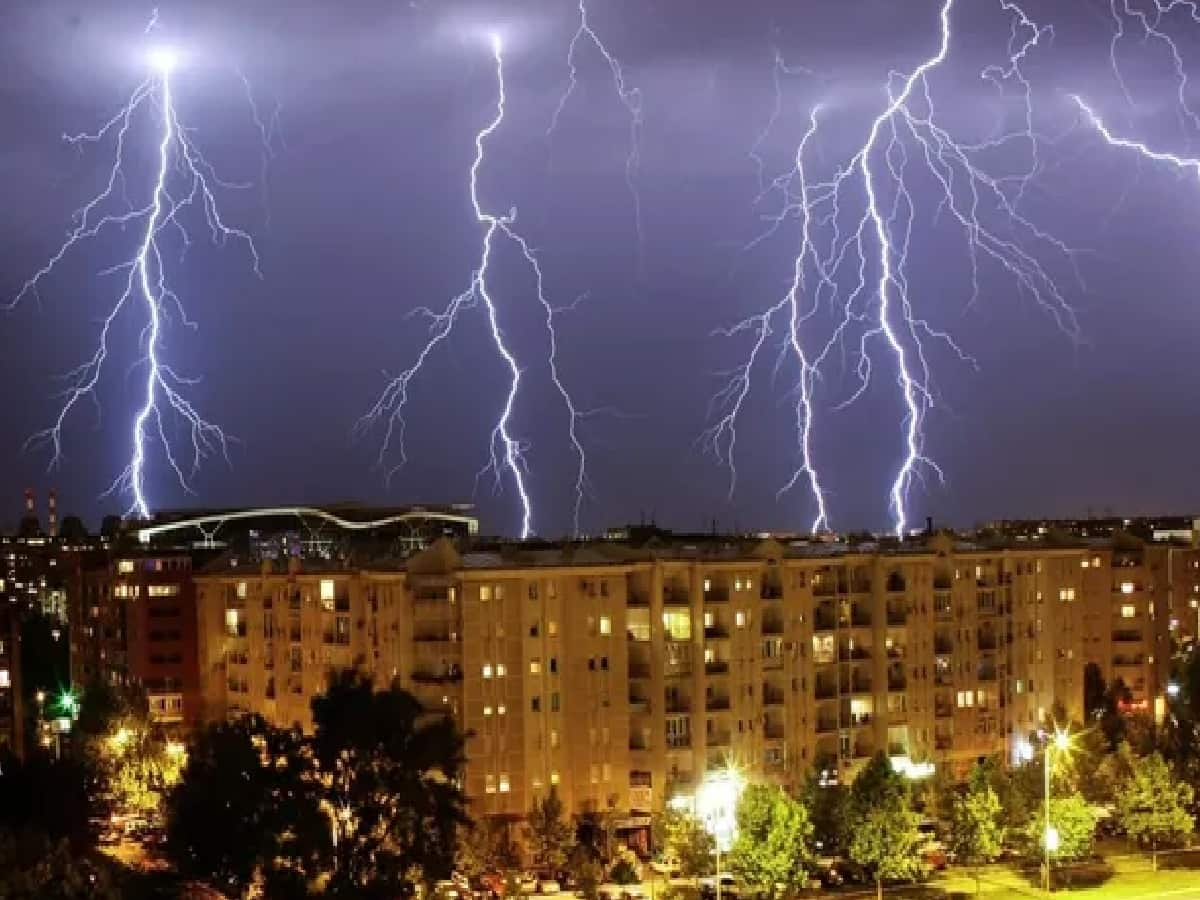
Climate Change Could Boost Global Lightning Strikes by Up to 140%
Global cloud-to-ground lightning strikes could surge by 76 to 140 percent by the end of the century if greenhouse gas emissions remain on a high trajectory, according to new climate modeling published in the American Geophysical Union journal Earth's Future. Led by Earth-system scientist Andreas Krause at the Technical University of Munich in Germany, the study indicates roughly a 30 percent jump in lightning frequency for every degree Celsius of global warming—far exceeding earlier scientific projections.
Global Projections Far Outpace Earlier Climate Estimates
Compared with the 1995–2014 historical baseline, the research team's models show cloud-to-ground lightning density more than doubling across wide swaths of the planet by 2100 under high-emission scenarios. Previous climate studies generally projected an 8 to 17 percent increase in lightning strikes per degree Celsius of warming. By pairing updated mathematical modeling with a newer, higher-resolution global lightning dataset, Krause and colleagues found a sensitivity closer to 30 percent per degree.
Even the researchers behind the paper noted the scale of the shift. Andreas Krause of the Technical University of Munich School of Life Sciences acknowledged that he had expected far smaller changes before running the forward projections. Because cloud-to-ground bolts already ignite forest fires, damage power transmission lines and wind turbines, and cause thousands of human fatalities and hundreds of millions of tree deaths worldwide each year, a doubling of strike frequency carries serious implications for disaster preparedness and grid resilience.
Tropical Hotspots vs. Arctic Surge: Where Strikes Will Climb Most
While lightning will not increase uniformly across every continent, the study highlights two distinct geographic patterns—one driven by sheer volume in the tropics and another by dramatic percentage spikes near the poles:
-
Tropical regions: In absolute numbers, the steepest increases are projected in regions that already experience intense thunderstorm activity, including the Amazon basin, Southeast Asia, and Oceania. For densely populated tropical nations such as India and its neighbors across South and Southeast Asia, heightened convective storm activity raises seasonal risks to agriculture, power infrastructure, and rural communities during pre-monsoon and monsoon months.
-
High-latitude regions: The sharpest proportional increases occur in northern latitudes where thunderstorms have historically been rare. Across Alaska—where most of the state averaged fewer than one cloud-to-ground strike per square kilometer annually between 1995 and 2014—projected increases range between 116 percent and 594 percent by 2100.
Higher lightning activity in boreal regions like Alaska and northern forests poses particular ecological danger. Coniferous trees in northern latitudes tend to suffer more severe structural damage from direct strikes than many tropical broadleaved species, and frequent dry lightning in warming Arctic landscapes can spark fast-moving wildfires in carbon-rich peatlands and forests.
How a Warming Atmosphere Fuels Stronger Thunderstorms
Forecasting future lightning has long challenged atmospheric scientists because global warming influences the two core ingredients of thunderstorm electrification in competing ways. When air near Earth's surface heats up, it becomes buoyant and rises rapidly into the cooler upper atmosphere through a process called convection. Stronger surface warming accelerates these updrafts, creating intense turbulence inside storm clouds.
Inside frigid mid-level clouds, turbulent updrafts drive collisions among tiny ice crystals and graupel particles, transferring electrical charges between them. Lighter, positively charged ice particles are carried toward the top of the cloud, while heavier, negatively charged particles sink toward the base. Once the electrical potential between these separated charge regions—or between the cloud base and the ground—grows strong enough to overcome air resistance, a lightning bolt discharges.
At the same time, a warmer atmosphere can reduce the volume of ice crystals forming high aloft, which could theoretically dampen charge separation in some regions. Weighing these competing mechanisms, the new Earth's Future analysis concludes that intensified surface-driven convection outweighs upper-level ice loss across most land areas, pointing toward a markedly more electrified atmosphere by the end of the century unless global greenhouse gas emissions are curbed.




