







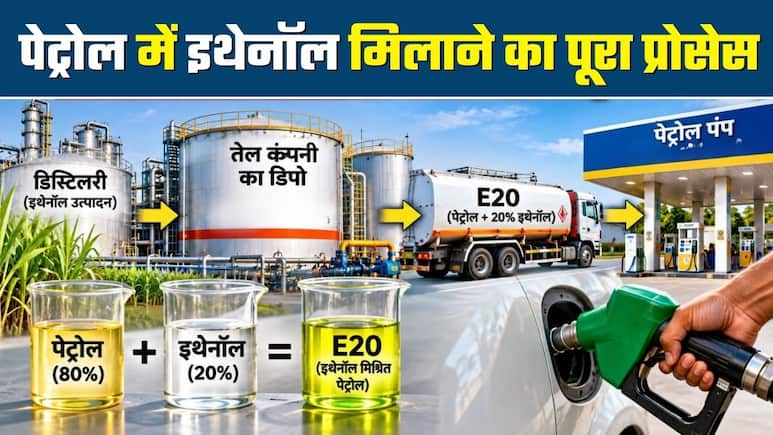
Where and How Is Ethanol Mixed in Petrol? The True Process Explained
As India aggressively scales its green energy initiatives and expands the nationwide rollout of the E20 fuel mandate (petrol blended with 20% ethanol), public curiosity and regulatory discussions have skyrocketed. Recent debates and state-level survey findings—such as those stirring political and administrative discussions in Karnataka regarding fuel sample concentrations—have brought a fundamental question to the forefront: Where, when, and how exactly is ethanol mixed into petrol? Is it manually poured into delivery trucks at the terminal, or is it adjusted at local retail fuel stations? Understanding the precise scientific, industrial, and logistical frameworks behind fuel blending clears up widespread misconceptions.
Where Does Ethanol Mixing Actually Take Place?
A common myth among motorists is that local fuel station operators or tanker truck drivers manually blend ethanol into underground storage tanks at neighborhood petrol pumps. In reality, fuel blending never happens at retail petrol pumps.
Public sector oil marketing companies (OMCs)—including Indian Oil Corporation (IOCL), Bharat Petroleum Corporation Limited (BPCL), and Hindustan Petroleum Corporation Limited (HPCL)—manage the entire blending procedure inside highly regulated, centralized bulk terminals and fuel depots. Ethanol is supplied to these oil terminals directly by various private and cooperative distilleries that produce it from sugarcane molasses, maize, and surplus food grains. Once stored in designated terminal tanks, it is systematically mixed with standard motor spirit (petrol) under strict laboratory oversight before being dispatched via pipeline or dedicated tanker trucks to retail outlets.
The Technical Process: How Blending Is Controlled
The blending of fuel is not left to rough estimates or manual measurements; it is governed by automated, high-precision engineering protocols. Refineries and major fuel depots utilize two primary technical methods for incorporating biofuels:
-
In-Line Blending: This advanced, automated process injects precise quantities of ethanol directly into a continuous stream of base petrol as it flows through high-pressure industrial pipelines toward loading bays. Automated flow meters and calibration systems continuously monitor and adjust the ratios in real time.
-
Splash Blending: In specific terminal configurations, measured quantities of base petrol and ethanol are combined sequentially inside large storage tanks or directly into compartmentalized bulk transport tankers under strict supervision to ensure homogeneity.
Under India's national guidelines, the final product must strictly adhere to Bureau of Indian Standards (BIS) specifications, ensuring that the chemical composition, density, and octane ratings remain stable across distribution channels.
Why the Ethanol Blending Program Matters
India's push toward higher ethanol integration forms a cornerstone of the nation's broader economic and environmental strategy. By substituting a significant portion of imported crude oil with domestically produced biofuels derived from agricultural produce, the country saves billions of dollars in foreign exchange reserves. Furthermore, the initiative provides a lucrative alternate revenue stream for domestic sugarcane and grain farmers while curbing harmful carbon emissions to meet aggressive climate commitments.
Addressing Quality Control and Regulatory Oversight
Recent controversies, such as state-backed sample surveys alleging higher-than-authorized ethanol concentrations in select regional markets, have triggered intense scrutiny between state agencies and federal oil refiners. While state testing bodies have reported instances where samples exceeded the standard 20% threshold, public sector oil marketing companies have firmly defended their quality assurance mechanisms, citing rigorous compliance with IS 17021 standards across thousands of tested batches nationwide. Maintaining transparency in testing methodologies and reinforcing terminal-level automation remain critical to sustaining consumer trust as India navigates its clean energy transition.




