







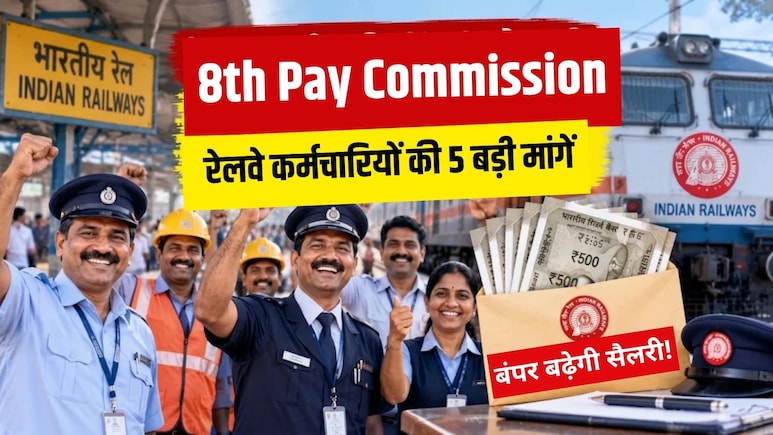
Railway Unions Push for ₹69,000 Minimum Salary and 5 Promotions Under 8th Pay Commission
Central government employees, particularly millions of workers within the expansive network of the Indian Railways, are eyeing major financial upgrades as deliberations for the 8th Pay Commission gather momentum. Prominent railway federations, including the National Federation of Indian Railwaymen (NFIR), have formally presented a comprehensive charter of demands to the commission. At the forefront of these proposals is a massive upward revision in the minimum basic salary to ₹69,000 per month, alongside enhanced annual increments, assured career progressions, and structural adjustments to dearness allowance calculations.
The Core Demand: A ₹69,000 Minimum Basic Pay and 3.833 Fitment Factor
The cornerstone of the current union proposals centers on recalibrating the basic pay matrix using a higher multiplier. Under the preceding 7th Pay Commission, the minimum basic pay for central government employees was pegged at ₹18,000 per month based on a fitment factor of 2.57.
To bridge the gap caused by rising living costs, inflation, and shifting urban economic standards, railway federations have proposed a robust fitment factor of 3.833. Applying this multiplier to the baseline figure drives the projected minimum basic salary directly to ₹69,000 per month. While this figure represents the formal submission and expectations of employee representatives rather than an officially approved government payout, it has generated widespread optimism across the workforce.
Restructuring Annual Increments and Career Promotions
Beyond baseline pay adjustments, the employee memorandum addresses long-standing concerns regarding stagnation and slow career growth within various departmental cadres. Key structural revisions proposed by the unions include:
-
Doubling the Annual Increment: Unions have pressed for the annual increment rate to be raised from the current 3% to 6%, accompanied by a guaranteed minimum financial benefit of ₹10,000 to ensure meaningful year-on-year wage progression.
-
Assured Career Promotions: To eliminate stagnation where employees remain locked in a single grade pay for extended periods, the proposal demands a minimum of five structured promotions across an employee's service tenure.
-
DA Merger Threshold: Representatives have suggested that Dearness Allowance (DA) should be automatically merged with basic pay whenever cumulative inflation adjustments touch or exceed 25%, protecting allowances and retirement calculations from erosion.
Upgraded Retirement Benefits and Allowances
The comprehensive wishlist extends deep into retirement and social security frameworks. Employee associations have advocated for restoring the Old Pension Scheme (OPS) for all eligible personnel, alongside recalibrating regular pension payouts to 67% of the final basic salary. Furthermore, demands include increasing family pension provisions to 50%, reducing the commuted pension recovery period, and introducing specialized risk and hardship allowances for frontline operational staff such as track maintainers, keymen, gatemen, and running loco pilots.
Timeline and Next Steps for the Pay Commission
With the formal review process underway, stakeholder consultations and union representations will continue to shape the final blueprint. The commission is expected to compile its extensive findings and submit its comprehensive recommendations ahead of the implementation window. As administrative boards evaluate fiscal feasibility against employee welfare, the upcoming months remain critical for millions of government workers awaiting concrete announcements regarding their future pay structures.




