







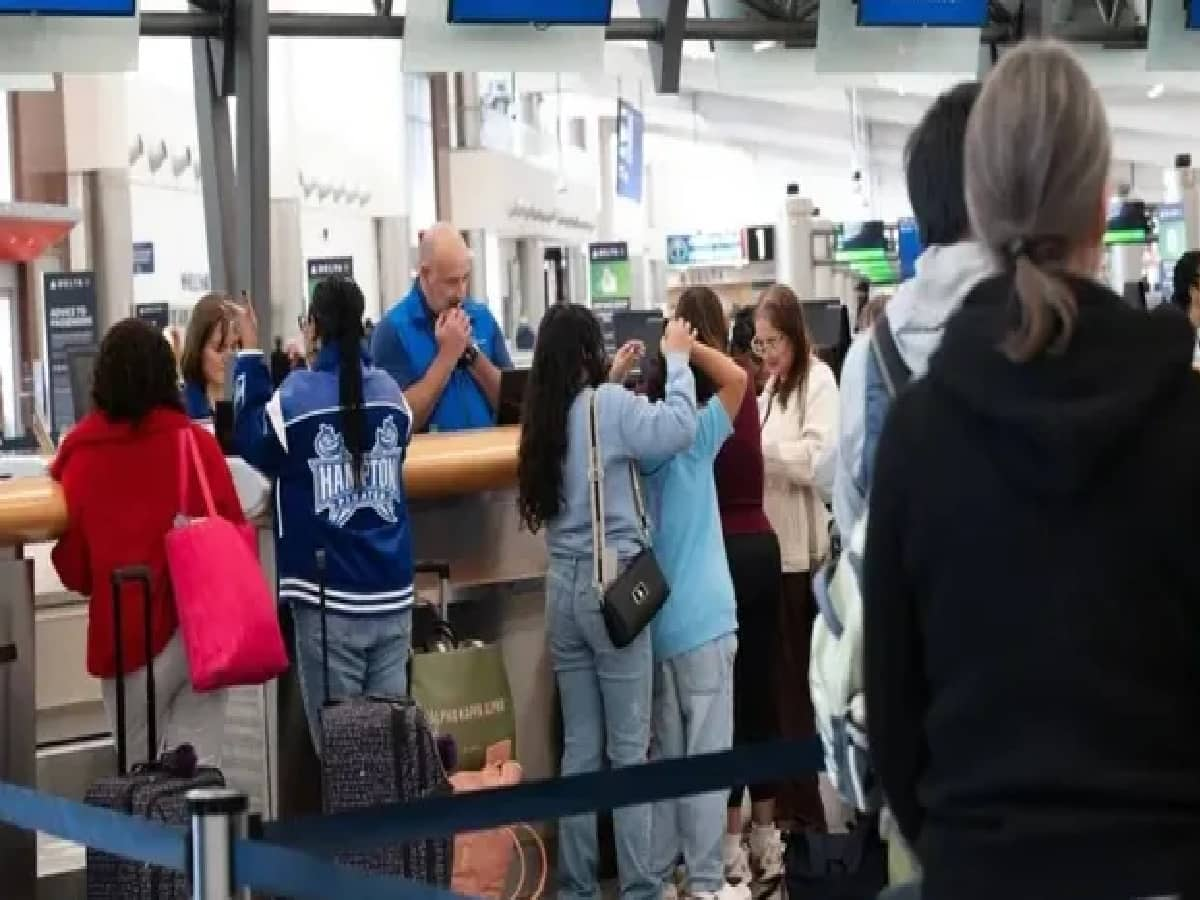
US Flight Crisis: 300 More Cancelled on Day 3; Airlines Lose $345M
Air travel across the United States began returning toward normal operations on Monday, November 16, 2026, after a major Federal Aviation Administration (FAA) air traffic control communications glitch disrupted flights for a third consecutive day—pushing cumulative cancellations since Friday's rare nationwide ground stop past 18,500 flights and inflicting an estimated $345 million (over ₹2,900 crore) pre-tax financial hit on America's four largest airlines. According to flight-tracking platform FlightAware, roughly 300 flights were cancelled and around 1,500 delayed on Monday—a sharp improvement from Sunday, when more than 2,300 flights were cancelled and nearly 11,000 delayed as carriers struggled to reposition stranded aircraft and flight crews. Federal aviation officials traced the root cause of the crisis—widely described as one of the steepest operational disruptions to hit US commercial aviation in 25 years—to a single faulty router installed by aerospace and defense contractor L3Harris during routine maintenance aimed at replacing 1980s-era copper telecommunications lines with fiber-optic cables. Once powered on Friday afternoon, the router inadvertently flooded regional Air Route Traffic Control Centers with more than 1,000 connection requests every four to five seconds, corrupting radar feeds and pilot communications and forcing the FAA to impose a four-hour, 21-minute nationwide ground stop. Reacting to the breakdown, US President Donald Trump remarked that aging aviation equipment was effectively "having heart attacks" and required immediate replacement, while US Transportation Secretary Sean Duffy warned that decades-old FAA infrastructure—still reliant on outdated Compaq computers, floppy disks, and paper flight strips alongside a persistent shortage of air traffic controllers—must undergo comprehensive modernization. Meanwhile, federal officials rejected speculation of cyber sabotage or any link to the FAA's new AI-powered SMART data tool, emphasizing that the system was not connected to live air traffic control networks. For travelers, airline investors, aviation professionals, and readers across New York, Chicago, Dallas, Atlanta, Washington, San Francisco, London, New Delhi, Lucknow, and Mumbai, the three-day meltdown exposes the staggering economic cost of aging aviation infrastructure just days before the busy US Thanksgiving travel rush.
Financial Fallout: $345 Million Earnings Hit and Airline Stock Reaction
As flight schedules stabilized on Monday, Wall Street analysts tallied the severe financial toll of three days of cancellations, crew overtime, and passenger rebookings across major carriers:
| Airline / Contractor | Cancellation Impact (Weekend Peak) | Estimated Financial & Market Impact |
| Big Four US Carriers (Combined) | Over 18,500 total US flights cancelled since Friday's ground stop (FlightAware) | Brokerage Bernstein estimates ~$345 million combined pre-tax loss (range: $270M–$430M) |
| JetBlue Airways | Hardest hit among major carriers—cancelled 28% of Sunday's schedule (BofA note) | Shares fell nearly 2% in Monday morning trading |
| American Airlines | Cancelled 22% of Sunday flights (including 805 cancellations late Sunday) | Part of the $345M Big Four earnings hit; shares fluctuated after multi-day slide |
| Delta, United & Southwest | Sunday cancellations stood at 5% (Delta), 3% (United), and 4% (Southwest) | Absorbed heavy schedule recovery costs alongside American Airlines |
| L3Harris Technologies | Contractor that installed the router during FAA copper-to-fiber upgrade | Stock dropped ~2.3% to 3% in early Monday trading following federal disclosures |
How a Routine Router Upgrade Triggered the Longest Ground Stop Since 2001
Explaining the technical chain reaction over the weekend, Transportation Secretary Sean Duffy and FAA Administrator Bryan Bedford noted that L3Harris technicians were upgrading legacy copper telecom lines to fiber-optic infrastructure at a remote FAA facility on Friday, November 13. Instead of syncing cleanly, the newly installed router bombarded neighboring switches with over 1,000 connection attempts every four to five seconds.
Because controllers began receiving intermittent radar and voice communication anomalies across multiple Air Route Traffic Control Centers, the FAA halted all departing flights nationwide from 3:54 PM to 8:15 PM EST—marking only the third nationwide ground stop since the September 11, 2001 attacks (following the January 2023 NOTAM outage).
Floppy Disks, Paper Strips, and Controller Shortages Spur Urgent Reform Calls
Speaking to CNBC and reporters at the White House, Secretary Sean Duffy highlighted that roughly 28,000 flights were delayed over the course of the disruption, generating billions of dollars in wider economic losses across tourism and commerce. Pointing out that the FAA still operates legacy Compaq terminals, floppy disks, and paper strips to track aircraft—compounded by an acute nationwide shortage of certified air traffic controllers—Duffy urged Congress to back sweeping modernization funding so America's skies do not suffer repeat system failures.




