







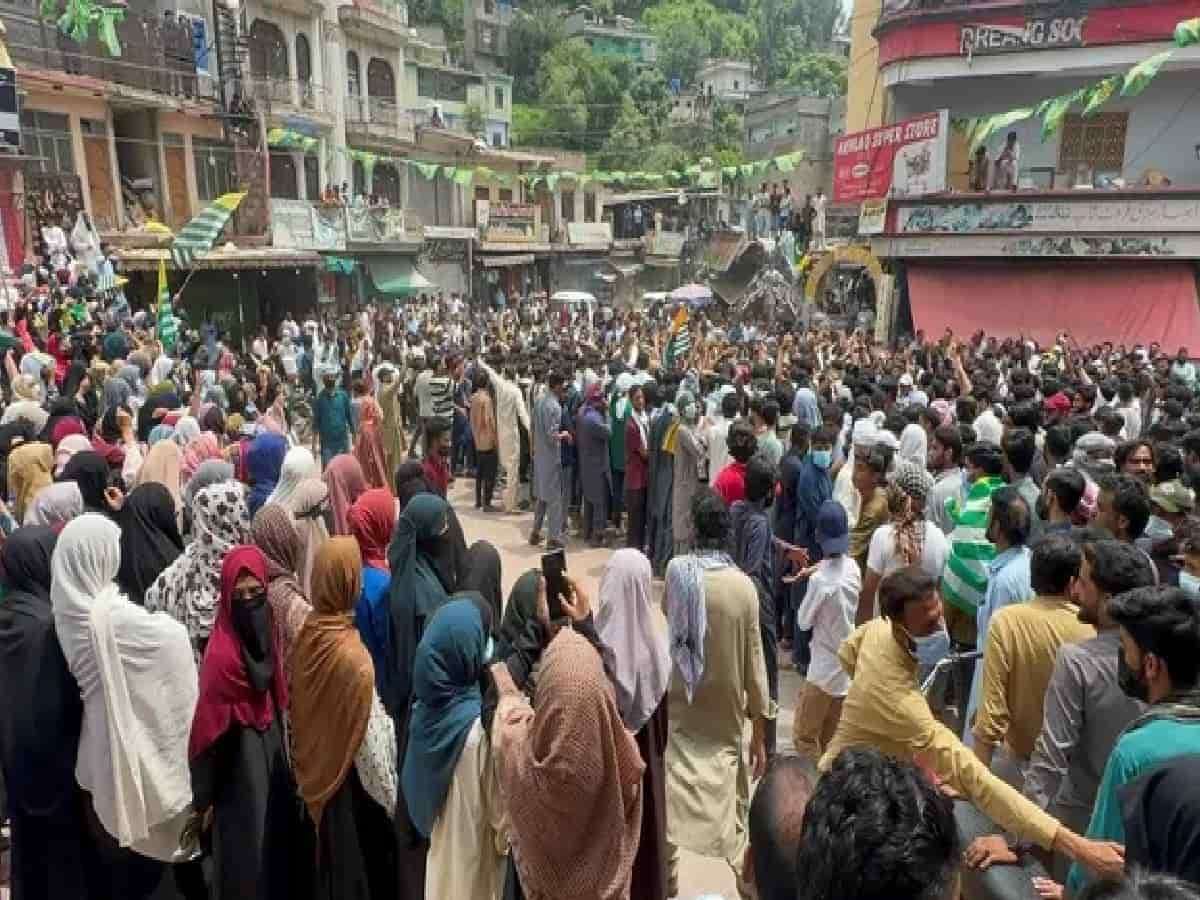
PoK Protests: 20 Civilians Killed in Pak Army Firing in Rawalakot
A severe humanitarian and security crisis has erupted across Pakistan-occupied Kashmir (PoK) after Pakistani security forces launched an aggressive, multi-pronged crackdown on civilians protesting against runaway inflation, power tariff hikes, and broken government commitments. In the mountain town of Rawalakot and surrounding tehsils of the Poonch division, at least 20 civilians were feared dead, more than 200 sustained severe injuries, and dozens remain unaccounted for following indiscriminate firing by paramilitary forces and military units. The fatal clashes, which erupted during the enforcement of a strict regional curfew, represent one of the deadliest escalations in the territory in decades. What began months ago as a peaceful, civil-society-led agitation demanding affordable flour, fair electricity pricing, and the implementation of an agreed-upon 38-point charter of rights has morphed into an armed clampdown by the state, sparking widespread civil rebellion that has quickly spilled over to the regional capital of Muzaffarabad.
Bloody Crackdown in Rawalakot: Nighttime Raids and Heavy Munitions
The violence reached a boiling point late Friday night when thousands of unarmed citizens assembled at Umar Farooq Chowk in the heart of Rawalakot, defying administrative curfews to stage a continuous sit-in. Eyewitnesses and local community leaders reported that heavily armed security contingents—including elements of the paramilitary Frontier Corps and regular army formations—converged on the central square from multiple directions to forcibly disperse the demonstration. Instead of deploying standard riot-control protocols such as tear gas canisters or water cannons, security personnel allegedly opened direct, live fire into the dense crowds at multiple locations.
Compounding the bloodshed, local activists and hospital workers confirmed that security units deployed rocket-propelled grenades (RPGs) and low-flying armed surveillance drones to dislodge demonstrators. Field medical facilities and district headquarters hospitals in Rawalakot and neighboring Bagh were overwhelmed with casualties, struggling to treat severe shrapnel wounds, bullet trauma, and burn injuries amid acute shortages of emergency blood units and surgical supplies. Local journalists reported that security personnel sealed access routes to primary healthcare clinics, preventing the injured from receiving timely medical attention and contributing to the steep death toll.
The 38-Point Charter: Why the Hills of PoK Are Boiling
The roots of the current rebellion trace back to systemic economic disenfranchisement and Islamabad’s consistent failure to honor the 38-point Charter of Rights formulated by the Jammu Kashmir Joint Awami Action Committee (JKJAAC). The JAAC, an alliance comprising trade unions, bar associations, transport syndicates, and student groups, has spearheaded a civil disobedience movement across the region. The charter centers on basic economic survival: rolling back astronomical electricity billing, reinstating subsidized wheat flour rations, abolishing excessive municipal taxes, and ending the unconstitutional allocation of 12 legislative assembly seats reserved for non-resident refugees living in mainland Pakistan.
Residents of Pakistan-occupied Kashmir have long voiced outrage over the structural exploitation of their natural resources. The region generates substantial, cost-effective hydroelectric power through massive mega-dams constructed on the Jhelum and Neelum rivers, including the Mangla Dam and the Neelum-Jhelum Hydroelectric Project. Yet, despite generating electricity at a fraction of a rupee per kilowatt-hour, local households are forced to pay exorbitant tariffs loaded with federal surcharges and taxes, with the bulk of generated power diverted to industrial hubs in Punjab province. When inflation skyrocketed and flour subsidies were rolled back earlier this year, household budgets collapsed, leaving communities with little recourse other than street protests. While federal ministers initially signed agreements acknowledging the 38-point demands, the administrative machinery in Islamabad ultimately reneged on its pledges, triggering a complete breakdown in public trust.
Video Evidence and Drone Strikes: JAAC Leadership Speaks Out
As news of the overnight killings spread, JAAC leader Sardar Umar Nazir released an urgent video message from an undisclosed location in Rawalakot, showing physical shrapnel and fragments of air-dropped munitions collected from residential neighborhoods following the drone strikes. In the broadcast, Nazir accused the Pakistani military establishment of treating its own administrative subjects as combatants in an active war zone, declaring that residential colonies were attacked from several flanks simultaneously.
"They have used drones to drop bombs onto civilian dwellings and fired RPGs into crowded public streets," Nazir stated, displaying metallic debris to the camera. "This is no longer a government maintaining public order; it is an occupational force attempting to crush a legitimate rights movement with brute military power. We demanded flour, affordable power, and the right to live with dignity, and in return, they have delivered corpses to our doorsteps". Despite the lethal force used against them, footage verified from Umar Farooq Chowk showed thousands of defiant residents refusing to vacate the squares, chanting slogans condemning state brutality and waving banners demanding regional autonomy and accountability.
Unrest Spreads to Muzaffarabad: Curfew, Strikes, and Enforced Disappearances
The deadly events in Rawalakot have ignited a chain reaction across the region. By Saturday morning, mass protests erupted in the regional capital of Muzaffarabad, as well as in Mirpur, Kotli, and Poonch, bringing normal life to a complete halt. Commercial markets, grain mandis, and transport corridors observed a spontaneous, indefinite shutter-down strike. Barricades erected by security forces to prevent long marches toward administrative complexes have severed connectivity between districts, stranding essential food supply lines and emergency ambulances.
Human rights organizations operating underground have reported a sharp rise in enforced disappearances, arbitrary arrests, and nocturnal home raids. Hundreds of prominent civil society figures, including lawyers, teachers, and student organizers, have been rounded up under preventative detention laws. Internet and mobile telecommunication services have been severely throttled or severed in several tehsils to prevent the outward transmission of videos depicting military action, creating an information blackout reminiscent of past regional crackdowns. Despite these barriers, citizen journalists continue to upload footage through cross-border virtual networks, showing burning state vehicles, ransacked police checkposts, and grieving families conducting funeral prayers in open streets for slain protesters.
The Anti-Terrorism Clampdown: Islamabad’s Shrinking Room for Maneuver
The military's severe response comes on the heels of the government’s decision to ban the Joint Awami Action Committee under the Anti-Terrorism Act of 2014, placing key community leaders on wanted lists and offering monetary bounties for their capture. Senior ministers in Islamabad have attempted to delegitimize the civilian uprising by branding the demonstrators as anti-state agitators, but the sheer scale and demographic breadth of the movement—encompassing women, elderly pensioners, and rural farmers—have undermined that narrative.
With the death toll continuing to climb and the total number of fatalities over months of sustained unrest now exceeding 200, the situation in Pakistan-occupied Kashmir has reached a dangerous flashpoint. The use of military hardware against unarmed civilians has destroyed whatever political goodwill remained between the local populace and the state. As thousands of protesters remain entrenched at checkpoints and public squares from Rawalakot to Muzaffarabad, the crisis poses a grave challenge to Islamabad’s authority in the region, underscoring that brute force cannot extinguish the growing public demand for economic dignity and fundamental civil rights.




