







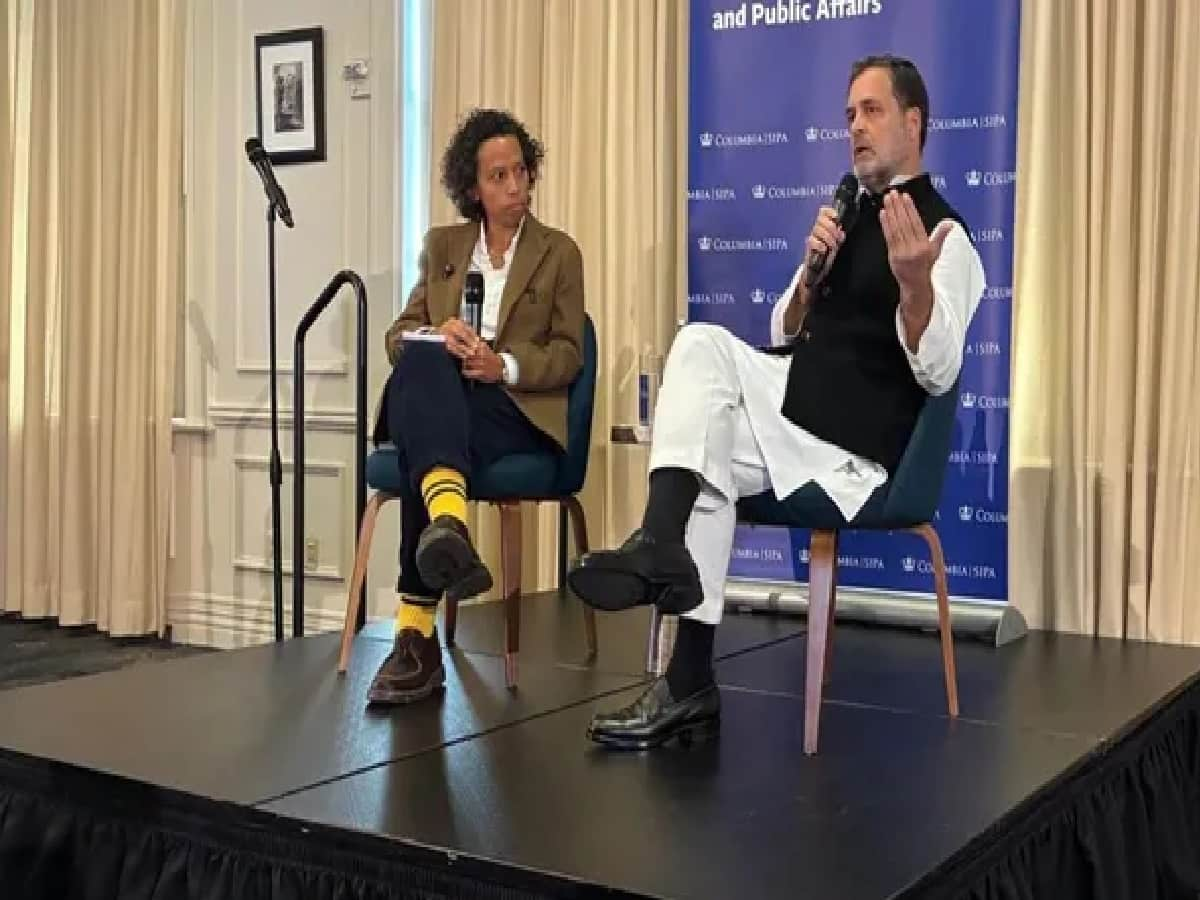
India Sitting on Economic Disaster: Rahul Gandhi at Columbia Varsity
New Delhi / New York: A sharp political debate has erupted back home after Leader of the Opposition (LoP) in the Lok Sabha Rahul Gandhi asserted during an academic interaction at Columbia University in New York that India is "sitting on an economic disaster" driven by deep-rooted structural crises in employment generation and education. Participating in a moderated fireside chat with journalist Lydia Polgreen on Tuesday, November 17, 2026, as part of a two-day academic tour of the United States, the senior Congress leader urged policymakers not to gloss over ground realities. Addressing students and faculty members, Gandhi stated bluntly that while some observers and sections of the media might brush the warning aside, India is confronting a massive unemployment problem alongside a broken education framework that fails to prepare young people for the modern economy. Responding to questions on the mood among Indian youth, the former Congress president highlighted growing frustration among educated young men and women from middle-class families who have completed formal schooling and university degrees yet see little viable economic future ahead of them. According to Gandhi, this lack of opportunity is also widening a generational fault line inside Indian households, with young adults openly questioning their parents' career advice and telling elders that traditional pathways no longer deliver stable jobs or upward mobility. Arguing that the services sector alone can absorb only a small fraction of India's vast workforce—roughly one to five percent—Gandhi called for rebuilding domestic manufacturing and revitalizing small and medium enterprises alongside agriculture, which he described as the damaged "spine" of the economy. His remarks immediately drew fierce pushback from the Bharatiya Janata Party (BJP) in New Delhi, with national spokesperson Pradeep Bhandari accusing the Congress MP of spreading "anti-India propaganda" abroad and undermining the country's global standing. Meanwhile, Rahul Gandhi continues the second leg of his US tour on Wednesday, November 18, 2026, at the University of Chicago, where he is scheduled to hold a geopolitics discussion with noted political scientist Professor Robert Pape. For students, economists, voters, and political observers across New Delhi, Lucknow, Kanpur, Varanasi, Prayagraj, Patna, Mumbai, Bengaluru, Hyderabad, and Kolkata, the exchange underscores how debates over jobs, manufacturing, and youth aspirations remain central to India's national discourse.
Key Arguments Raised by Rahul Gandhi at Columbia University vs. BJP's Response
Organized around academic dialogues rather than diaspora political rallies, Rahul Gandhi's November 17–18 US itinerary has triggered intense domestic political reactions. The table below outlines the core themes of his Columbia University remarks, his upcoming Chicago schedule, and the ruling party's rebuttal:
| Focus Area | Key Statements & Schedule Details | Political & Economic Context |
| Economy & Unemployment Warning (Columbia University, Nov 17) | Stated that India is "sitting on an economic disaster", arguing that services alone can employ only 1% to 5% of the workforce and calling for renewed focus on manufacturing, MSMEs, and agriculture. | Framed job creation and revival of small and medium businesses as India's most urgent economic priority. |
| Education System & Middle-Class Youth Disillusionment | Flagged systemic flaws in India's education model and noted that formally educated middle-class youth do not see a future for themselves. | Highlighted growing intergenerational friction, with youngsters telling parents that conventional career paths no longer guarantee stable employment. |
| BJP's Sharp Counterattack (New Delhi, Nov 18) | BJP spokesperson Pradeep Bhandari accused Gandhi of "anti-India propaganda" on foreign soil and termed him a "disaster as a responsible LoP". | Contrasted Gandhi's overseas speeches with Prime Minister Narendra Modi's foreign visits, asserting that the government is driving rapid economic and democratic progress. |
| Second Leg of US Tour (University of Chicago, Nov 18) | Scheduled fireside conversation on geopolitics and global affairs with Professor Robert Pape on November 18, 2026. | Coordinated by the Indian Overseas Congress (chaired by Sam Pitroda) to engage university students and faculty on global trends. |
Why Gandhi Highlighted Generational Tension Inside Middle-Class Homes
One of the most striking moments of the Columbia University dialogue came when moderator Lydia Polgreen asked about the outlook of India's young demographic. Rather than citing macroeconomic indicators alone, Rahul Gandhi pointed to qualitative conversations he and his team have held with parents and students across India.
He explained that educated middle-class youngsters—who invested years in degrees expecting secure careers—are increasingly disillusioned because the job market has not kept pace with their aspirations. As a result, Gandhi noted, young people are pushing back against parental guidance, telling their fathers and mothers that the career formulas of an earlier generation simply do not work in today's economy.
What to Expect From Rahul Gandhi's University of Chicago Interaction Today
Following Tuesday's New York session focusing on student movements, democracy, and economic challenges, Rahul Gandhi travels to Illinois on Wednesday, November 18, 2026, for his second scheduled academic engagement at the University of Chicago. Alongside distinguished international security scholar Dr. Robert Pape, the Lok Sabha LoP is expected to examine shifting global geopolitics, Middle East tensions, and India's strategic role in an interconnected world—even as political sparring over his Columbia remarks continues to reverberate across Indian Parliament and newsrooms.




