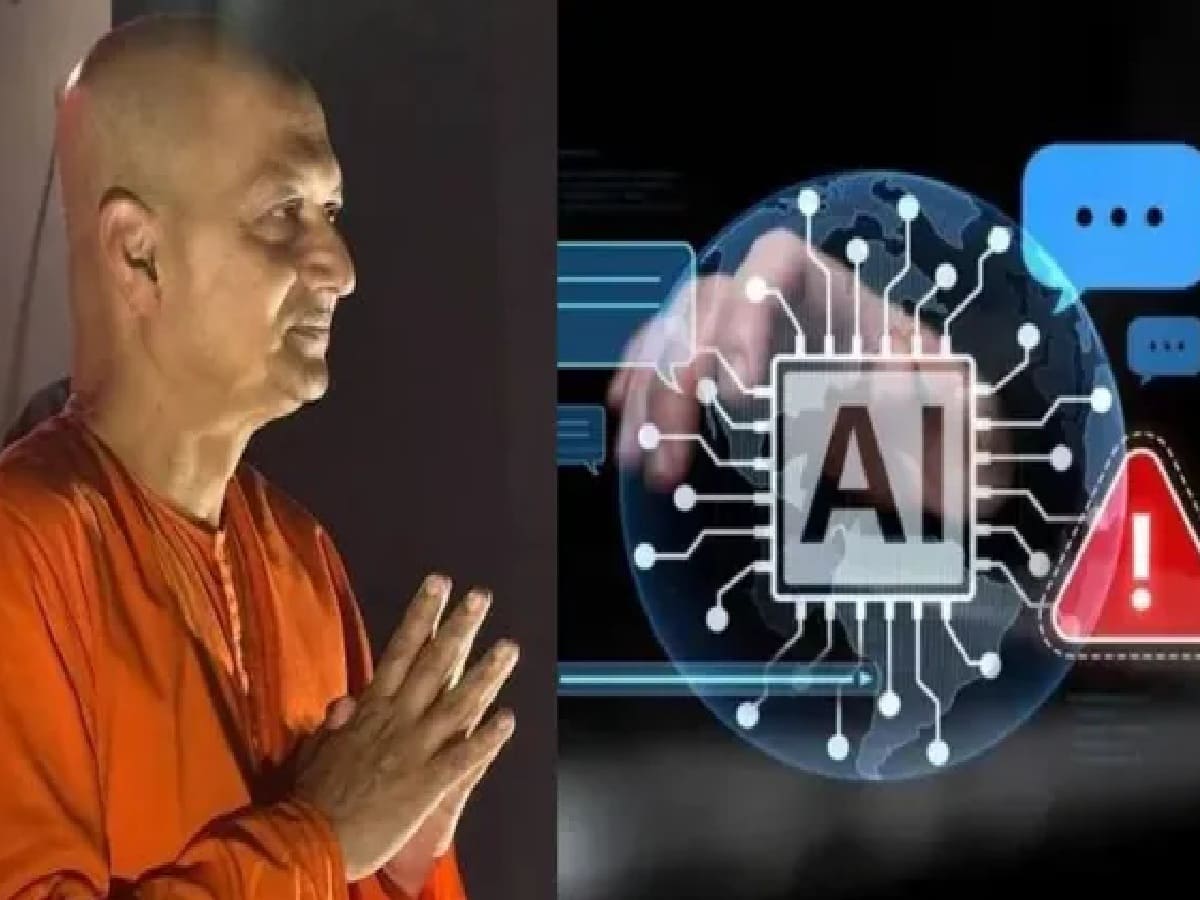
Anthropic Consults Swami Sarvapriyananda & Faith Leaders to Train Claude
Departing from the conventional tech industry playbook of solving complex computational roadblocks strictly through software engineers and algorithmic pipelines, premier artificial intelligence lab Anthropic has turned toward ancient philosophy and spiritual metaphysics. At its San Francisco headquarters, the frontier AI developer convened an extraordinary closed-door summit featuring renowned religious scholars, philosophers, and theological ethicists. The high-level consultation aimed to tackle the foundational questions surrounding synthetic cognition, the limits of algorithmic morality, and the moral boundaries that must govern advanced generative models.
Swami Sarvapriyananda Joins San Francisco Brainstorming on Claude's Moral Core
Prominent Advaita Vedanta scholar and Head of the Vedanta Society of New York, Swami Sarvapriyananda, was among the select spiritual leaders invited to provide foundational insights. Speaking at a recent public lecture, the Ramakrishna Mission monk confirmed his participation at the San Francisco gathering, where researchers discussed ethical alignment for Anthropic's flagship model family, Claude. While strict non-disclosure obligations prevent him from revealing classified technical blueprints, Swamiji noted that discussions touched on upcoming frontiers such as Project Glasswing and Mythos. During the sessions, Anthropic co-founder Christopher Olah and senior research scientists deliberated with participants on how emergent neural networks simulate human personality attributes, empathy, and emotional resonance.
From Corporate Management to Monastic Renunciation: The Voice of Advaita Vedanta
Swami Sarvapriyananda represents an authoritative bridge between rigorous philosophical metaphysics and modern science. After earning an MBA from the Xavier Institute of Management in Bhubaneswar, he embraced monastic life under the Ramakrishna Mission in 1994, taking formal vows of sannyasa in 2004 before assuming leadership of the historic Vedanta Society of New York in 2017. A former fellow at Harvard Divinity School whose discourses on the Mandukya Upanishad have reached millions across digital platforms, Swamiji approaches consciousness through an analytical lens that directly interfaces with contemporary neuroscience, quantum physics, and computational logic.
Drawing Moral Wisdom from Over 15 World Faiths and Traditions
Anthropic confirmed that the initiative forms part of an expansive, multi-month engagement program encompassing scholars and ethicists across more than 15 religious and philosophical traditions, spanning Hinduism, Buddhism, Sikhism, Islam, Christianity, and Judaism. The company clarified that its operational objective is not to adopt religious doctrine into artificial intelligence, but rather to distill centuries-old human wisdom regarding moral virtue, duty, empathy, and responsible action. These timeless principles are being adapted to enrich Claude's Constitutional AI framework, refine safety training guidelines, and instill balanced decision-making guardrails within the model's core architecture.
Can Synthetic Systems Ever Truly Awaken? Intelligence vs. Consciousness
A central philosophical inquiry examined whether advanced autonomous networks could ever achieve true sentience or qualify for moral rights. While some participants, including former engineer turned Rabbi Abraham Navon, observed that researchers increasingly view advanced frontier models as potentially conscious entities deserving ethical consideration, Swami Sarvapriyananda drew a decisive Vedantic distinction between intelligence and consciousness. Under classical Indian philosophy, mind (manas) and intellect (buddhi) are subtle forms of material nature rather than awareness itself; consequently, while an AI system can marvelously emulate analytical reasoning, whether a digital machine can ever experience pure consciousness (Chit) or merely calculate an illusion of awareness remains the ultimate question. In practice, Anthropic has utilized these moral reflections to build internal prompting tools that prompt Claude to weigh ethical obligations before executing sensitive queries, resulting in significant reductions in harmful algorithmic behavior.