







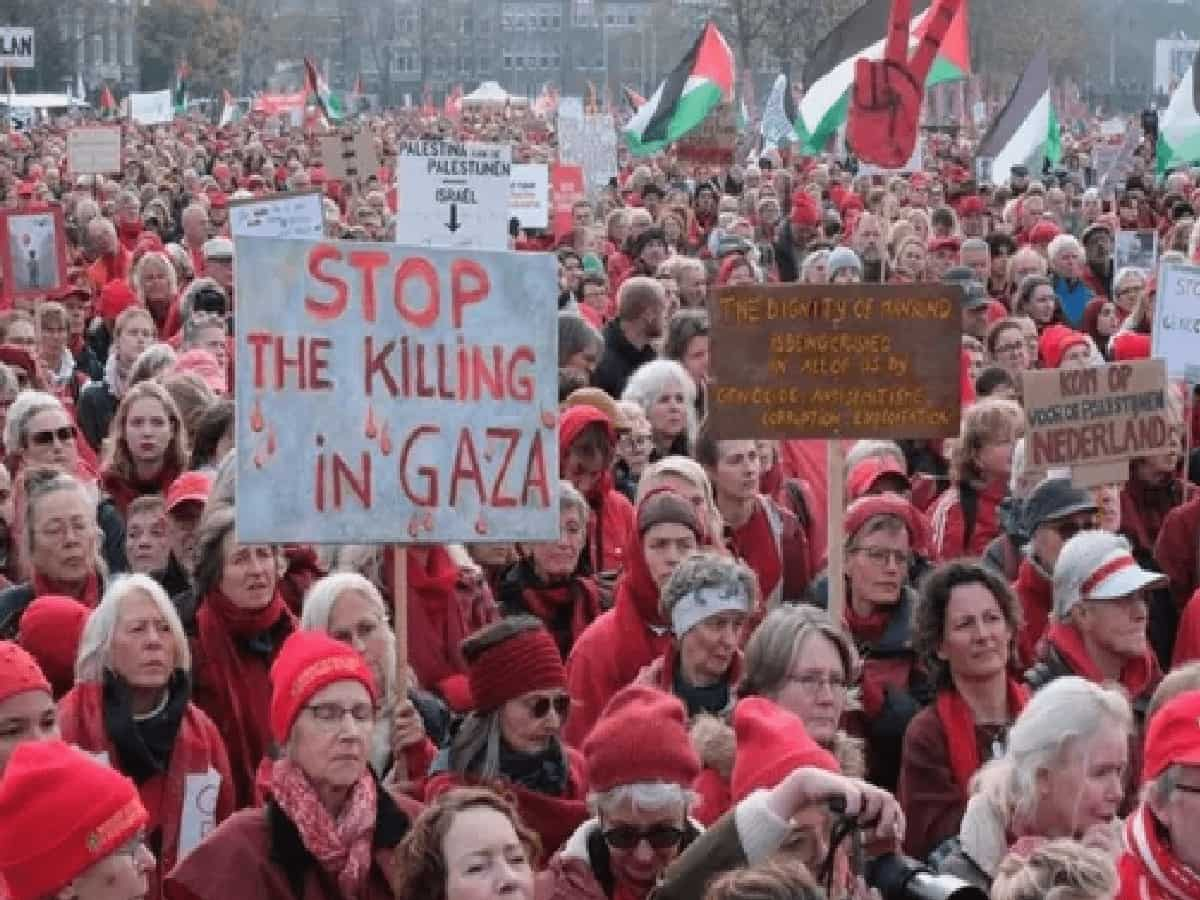
200,000 March in Amsterdam Against Dutch Stance on Gaza War
In one of the largest civic mobilizations witnessed in western Europe in decades, an estimated crowd of more than 200,000 demonstrators filled the streets of the Dutch capital on Sunday, November 8, 2026, challenging the government of the Netherlands over its policy toward Israel’s military campaign in the Gaza Strip. Known as the "Red Line March," the massive demonstration transformed central thoroughfares into an expanse of crimson as participants wore red coats, scarves, and hats to signify a moral boundary that they argued European leaders have permitted to be crossed. Organized by a broad coalition of prominent humanitarian, legal, and civil rights groups led by Amnesty International’s Dutch branch, alongside Oxfam Novib and Save the Children, the demonstration brought central Amsterdam to a standstill. Marchers carried banners reading "No Money for Genocide," explicitly calling on Prime Minister Rob Jetten's administration to halt all remaining military exports and parts shipments to Israel, impose strict bilateral trade embargoes, and officially hold Tel Aviv accountable under international law.
A Sea of Red Through Museumplein: Inside the 200,000-Strong Protest
Gathering from mid-morning at the historic Museumplein near the Van Gogh Museum and the Rijksmuseum, tens of thousands of citizens, students, union members, and families arrived via specialized train shuttles and regional buses from across the Netherlands. By early afternoon, the crowd expanded across major urban avenues, prompting municipal authorities and city police to close central transit thoroughfares to regular vehicular traffic.
The demonstration was characterized by coordinated visual symbolism:
-
The Crimson Symbolic Human Chain: Marchers dressed in vibrant red garments to visually represent an uncrossable "red line" against violations of international humanitarian law and civilian destruction in the Palestinian territories.
-
Chants for Justice: Along major boulevards, demonstrators carrying Palestinian flags and Dutch civil banners rallied around speakers stationed at tram stops, where organizers chanting "Free, Free Palestine!" through megaphones were echoed by thousands marching past.
-
Coalition Strength: More than 130 non-governmental organizations, legal associations, and medical aid bodies endorsed the march, reflecting broad public concern regarding the human cost of the conflict.
Core Demands: Arms Embargo, Stricter Sanctions, and Legal Declarations
The central thrust of the Amsterdam protest targeted the perceived disconnect between the Dutch government's public expressions of concern and its diplomatic and economic policies. Addressing the assembly, spokespersons from Amnesty International Netherlands emphasized that symbolic statements are no longer sufficient while humanitarian aid delivery remains obstructed and civilian infrastructure in Gaza lies in ruins.
The organizers presented three demands to the Dutch parliament and the cabinet:
-
Comprehensive Arms Embargo: An immediate and permanent halt to all direct weapons deliveries, dual-use technology transfers, and the transit of military aircraft components—such as parts for F-35 fighter jets—routed through Dutch logistic hubs bound for Israeli defense forces.
-
Economic and Trade Restrictions: The enforcement of strict trade sanctions on commercial products originating from illegal Israeli settlements in the occupied West Bank, alongside pushing the European Union to suspend preferential trade provisions under the EU-Israel Association Agreement.
-
Formal International Legal Recognition: Demanding that the Dutch state formally recognize the findings of international judicial panels and designate Israel’s military campaign in Gaza as violating the 1948 Genocide Convention.
Public Frustration Over Government Inaction: 'They Don't Dare Take Serious Steps'
Among the participants walking through the city center, widespread frustration was voiced regarding the cabinet’s handling of the crisis. Demonstrator Mike van Dongen expressed common sentiment among attendees, criticizing the Dutch authorities for lagging behind international legal standards. "What is happening there is fundamentally inhumane," Van Dongen said. "As far as I'm concerned, the government is doing practically nothing. They simply don't dare to take any serious, meaningful steps because of diplomatic sensitivities".
While Dutch Prime Minister Rob Jetten stated ahead of the march that his coalition was increasing diplomatic and political pressure on Israel to honor commitments regarding aid corridors and cease combat operations, protesters argued that gentle diplomacy has yielded negligible results on the ground. Activists pointed out that although the Netherlands previously introduced localized restrictions on certain settlement goods, domestic cabinet disagreements over deeper economic sanctions had previously prompted high-level ministerial resignations, underscoring ongoing political gridlock within the ruling coalition.
The Humanitarian Reality: Beyond the Fragile October Ceasefire
The massive turnout in Amsterdam comes against the backdrop of a prolonged humanitarian emergency in the Middle East. The broader war was triggered on October 7, 2023, when Hamas-led militants launched cross-border attacks into southern Israel, resulting in the deaths of approximately 1,200 people and the capture of 251 hostages. Over the subsequent two years of sustained aerial bombardments and ground incursions, international health monitors report that the Palestinian death toll has surpassed 74,000, including more than 21,000 children.
Although an internationally brokered ceasefire agreement officially entered into force in October 2025, humanitarian conditions across the devastated Gaza Strip remain acute. According to the Gaza Health Ministry and United Nations agencies, sporadic airstrikes, artillery exchanges, and skirmishes have continued on an almost daily basis, claiming more than 1,550 Palestinian lives since the nominal truce took effect. Protesters in Amsterdam emphasized that with basic healthcare, clean water access, and food supplies severely compromised across tent encampments, European governments carry legal and moral obligations under the Geneva Conventions to use economic levers to end civilian suffering.
Growing European Pressure on Middle East Policy
The demonstration marks the fourth major "Red Line" demonstration held in the Netherlands since mid-2025, building on earlier mass mobilizations in The Hague outside the International Court of Justice and previous rallies at Museumplein that drew hundreds of thousands. With sister marches also taking place in other European capitals, including Brussels and Stockholm, grassroots pressure is mounting across the continent.




