







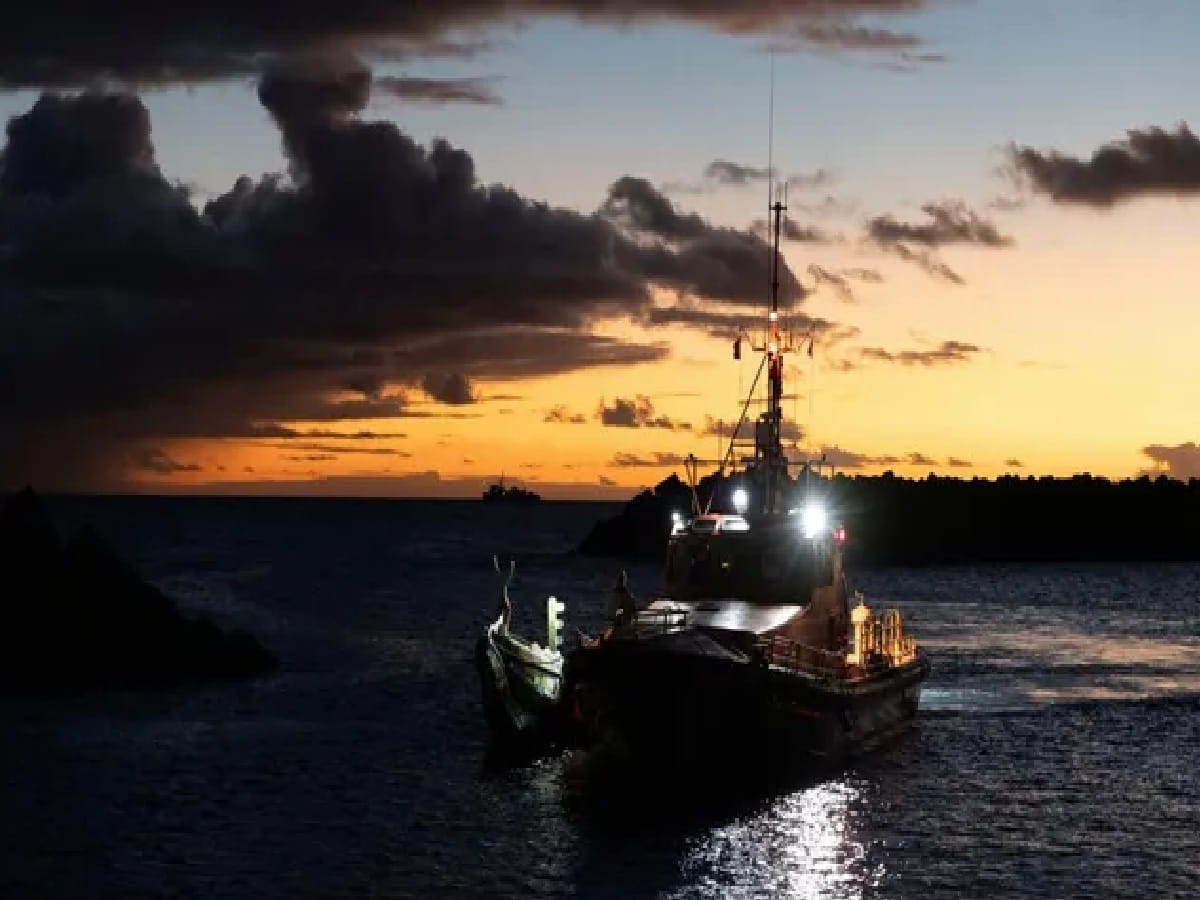
14 Migrants Found Dead on Boat Rescued Off Spain's Canary Islands
Fourteen migrants were found dead and six others were airlifted to hospital in serious condition after Spanish maritime rescue teams intercepted a wooden vessel carrying roughly 100 people off Spain's Canary Islands. The tragedy unfolded 39 nautical miles (about 72 kilometers) south of El Hierro, the westernmost island in the Atlantic archipelago, intensifying political debate over border policy just days before Spain's general election.
Rescue Operation Off El Hierro After Days Adrift at Sea
According to Spain's Maritime Rescue Service (Salvamento Marítimo) and reports from Spanish news agency EFE, the vessel had departed from Banjul, the capital of The Gambia, approximately 10 days earlier before suffering engine failure three days prior to being spotted in open Atlantic waters. Once located south of El Hierro on Friday, rescue vessels and a helicopter launched an urgent evacuation operation.
-
Fatalities recovered: Rescue personnel recovered 14 bodies from the vessel, which was subsequently towed toward the port of La Estaca on El Hierro.
-
Emergency medical airlifts: Six survivors in critical or serious condition were flown by helicopter to medical facilities on El Hierro for immediate treatment.
-
Survivors brought ashore: Eighty-four survivors, including a child, were safely disembarked at the port of La Restinga, while one individual initially remained aboard during towing operations.
On the dockside at La Restinga, Civil Guard officers, Spanish Red Cross volunteers, and personnel from the Military Emergencies Unit assisted exhausted survivors as they came ashore. Some migrants were carried off on stretchers, while others were wrapped in thermal foil blankets to guard against hypothermia after days exposed to Atlantic winds and cold water.
Migration Dominates Spain's General Election Campaign
The deaths near El Hierro have reverberated immediately across Spain's national politics ahead of Sunday's general election, where border enforcement and asylum policy have become central battlegrounds. Conservative and far-right opposition leaders seized on the incident to criticize Prime Minister Pedro Sánchez's socialist-led coalition government over its handling of irregular sea arrivals.
Main opposition Popular Party (PP) leader Alberto Núñez Feijóo wrote on social media platform X that deaths at sea represent the gravest consequence of government irresponsibility, calling for an orderly migration framework capable of preventing perilous crossings. Far-right Vox party leader Santiago Abascal similarly accused Madrid of abandoning frontline territories such as Ceuta and El Hierro. Opinion polls suggest the Popular Party could emerge as the largest bloc in Parliament while falling short of an outright majority, potentially leaving it reliant on Vox to form a governing coalition.
Record Arrivals Strain El Hierro and Canary Islands Infrastructure
The latest tragedy comes amid an acute autumn surge along the West African Atlantic migration route, widely regarded as one of the world's most hazardous maritime crossings. Figures from Spain's Interior Ministry show that 24,364 migrants reached the Canary Islands between January 1 and November 15, 2026—up sharply from 14,690 during the corresponding period in 2025. More than 11,000 of those arrivals occurred during the first half of November alone.
Pressure spiked further this week when a single-day record of roughly 2,100 migrants reached the archipelago on November 25, the vast majority landing on El Hierro—a small volcanic island with a permanent population of only about 11,400 residents. Canary Islands regional president Fernando Clavijo expressed deep sorrow over the 14 deaths and renewed appeals to Madrid and the European Union—including EU border agency Frontex—for urgent operational support both in the archipelago and along departure coasts in Senegal and The Gambia.




