







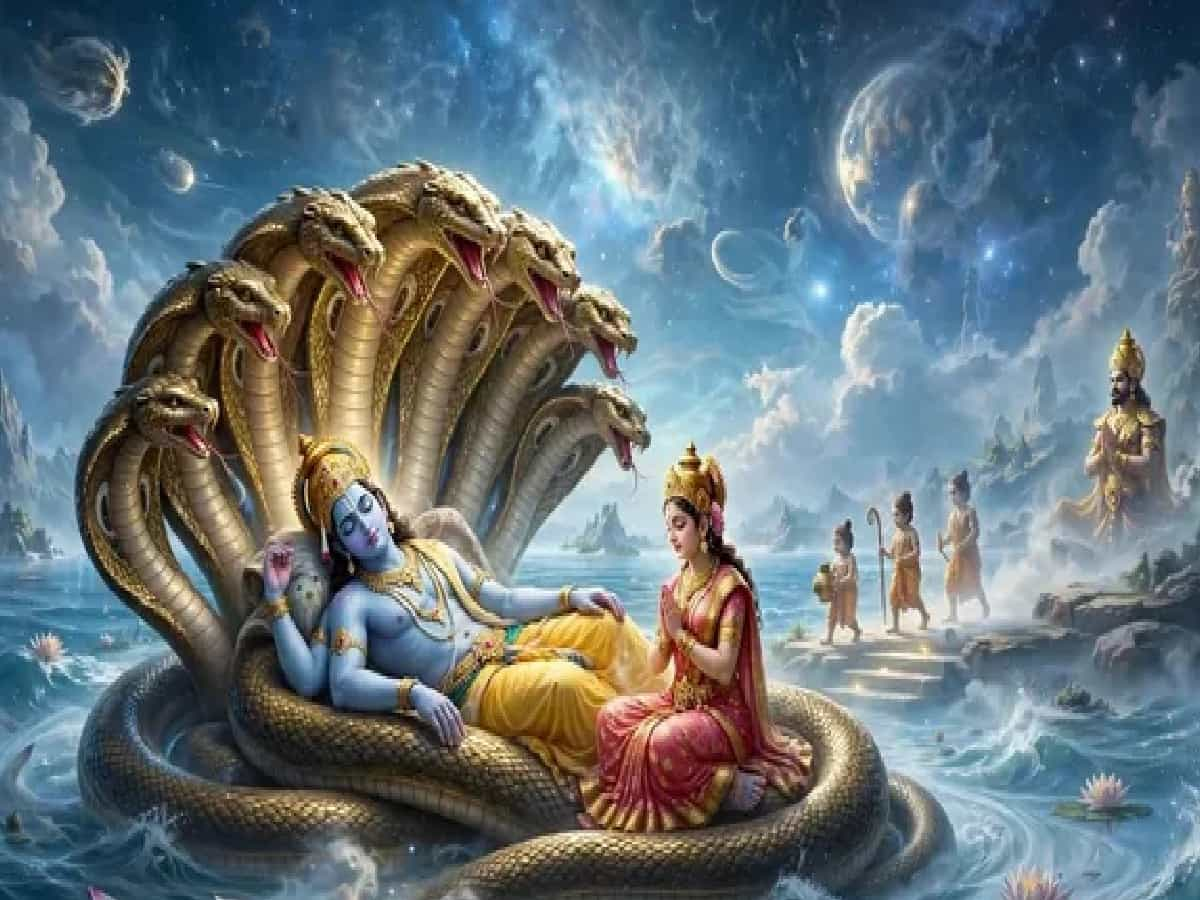
Why Lord Vishnu Enters 4-Month Yognidra: King Bali & Rakhi Story
Every year in the Hindu lunar calendar, Lord Vishnu—the preserver of the cosmos—enters a sacred four-month period of Yognidra (yogic sleep) known as Chaturmas, during which auspicious ceremonies such as weddings, housewarmings, and sacred thread rituals remain paused across India until his awakening on Dev Uthani Ekadashi, which falls this year on Friday, November 20, 2026. While millions of devotees observe fasts, charity, and spiritual discipline throughout Chaturmas, a timeless question often arises: where does Lord Vishnu reside during these four months, and why does the supreme protector of the universe enter Yognidra in the first place? Classical Hindu scriptures—including the Srimad Bhagavata Purana, Vamana Purana, Bhavishya Purana, and Padma Purana—trace this sacred tradition directly to an extraordinary covenant involving King Bali, Lord Vishnu's Vamana incarnation, and a heartfelt gesture of sisterly devotion by Goddess Lakshmi. Far from being a tale of conquest, the Puranic narrative reveals how a boon born of unconditional generosity bound the Lord of Vaikuntha to serve as the guardian of the netherworld (Patala Loka), and how Goddess Lakshmi's sacred Rakhi harmonized cosmic duty with divine compassion. For devotees, spiritual seekers, wedding planners, and families across New Delhi, Varanasi, Prayagraj, Ayodhya, Mathura, Vrindavan, Lucknow, Kanpur, Jaipur, Haridwar, Ujjain, and Mumbai, understanding the scriptural link between King Bali's promise and Dev Uthani Ekadashi deepens the significance of the upcoming auspicious wedding season.
The Puranic Story Behind Chaturmas: Key Milestones From Scripture
According to the Srimad Bhagavata Purana, Vamana Purana, Bhavishya Purana, and Padma Purana, Lord Vishnu's annual four-month sojourn in Patala Loka rests on four interconnected events:
| Sacred Episode | Scriptural Context & Key Figures | Spiritual & Cultural Significance Today |
| 1. Birth of the Vamana Avatar | Goddess Aditi prayed to Lord Vishnu after demon King Bali gained sovereignty over the three worlds (Triloka). | Vishnu manifested as Vamana (a radiant Brahmin dwarf) not to destroy Bali, but to restore cosmic balance and the authority of the Devas. |
| 2. Three Steps of Land & King Bali's Vow | At Bali's grand yagna, Vamana asked for just three paces of land. Despite preceptor Shukracharya's warning, Bali honored his word. | Expanding to cosmic proportions (Trivikrama), Vamana measured the Earth and heavens in two steps; Bali offered his own head for the third step. |
| 3. Vishnu Becomes Gatekeeper of Patala | Moved by Bali's unmatched devotion and truthfulness, Lord Vishnu granted him a boon—and Bali asked the Lord to reside beside him in Patala Loka. | Bound by his own promise, the ruler of the universe assumed the role of gatekeeper (Dwarapala) in King Bali's subterranean realm. |
| 4. Goddess Lakshmi's Rakhi & Chaturmas | Alone in Vaikuntha, Goddess Lakshmi visited Patala in disguise, tied a sacred Rakhi on King Bali's wrist, and asked for Vishnu's return as her brotherly gift. | Honoring both Bali's devotion and Lakshmi's bond, Vishnu decreed he would reside in Patala in Yognidra for four months (Chaturmas) each year before returning on Dev Uthani Ekadashi. |
How Vamana's Three Steps and King Bali's Generosity Bound the Lord
When the righteous yet mighty King Bali—grandson of the great devotee Prahlada—established dominion over heaven, earth, and the netherworlds, the celestial deities (Devas) lost their abode. Moved by the prayers of Mata Aditi, Lord Vishnu incarnated as Vamana and approached Bali during a grand Vedic sacrifice, knowing the king never turned away a seeker empty-handed.
Even when Bali's royal guru Shukracharya recognized Vamana's divine identity and warned that granting three steps would cost him his entire empire, King Bali refused to break his vow—declaring that nothing is greater than keeping one's word. After Vamana expanded to encompass the entire physical and celestial universe in two strides, Bali bowed humbly and offered his own head for the third step. Overwhelmed by such selfless surrender, Lord Vishnu blessed Bali with sovereignty over Patala Loka and promised to fulfill any wish—whereupon Bali asked that the Lord remain constantly before his eyes as his protector.
Goddess Lakshmi's Rakhi and Dev Uthani Ekadashi on November 20, 2026
With Lord Vishnu fulfilling his vow in Patala Loka, Goddess Lakshmi felt his absence deeply in Vaikuntha. Assuming the guise of a humble woman, she traveled to Bali's court, tied a sacred thread (Rakhi) around the king's wrist, and accepted him as her brother—an act widely celebrated in Puranic lore as one of the earliest origins of Raksha Bandhan. When King Bali pledged to grant his new sister any gift she desired, Goddess Lakshmi pointed toward the gatekeeper and asked for her Lord back.
True to his noble character, Bali immediately honored her request, while Lord Vishnu established an eternal balance: every year from Devshayani Ekadashi through Dev Uthani (Prabodhini) Ekadashi, he resides in Patala Loka in Yognidra to honor King Bali's devotion, entrusting cosmic governance to Lord Shiva during Chaturmas. On November 20, 2026, as devotees celebrate Dev Uthani Ekadashi and Tulsi Vivah, Lord Vishnu awakens from his four-month yogic slumber—ushering back auspicious muhurats for weddings and sacred celebrations nationwide.




